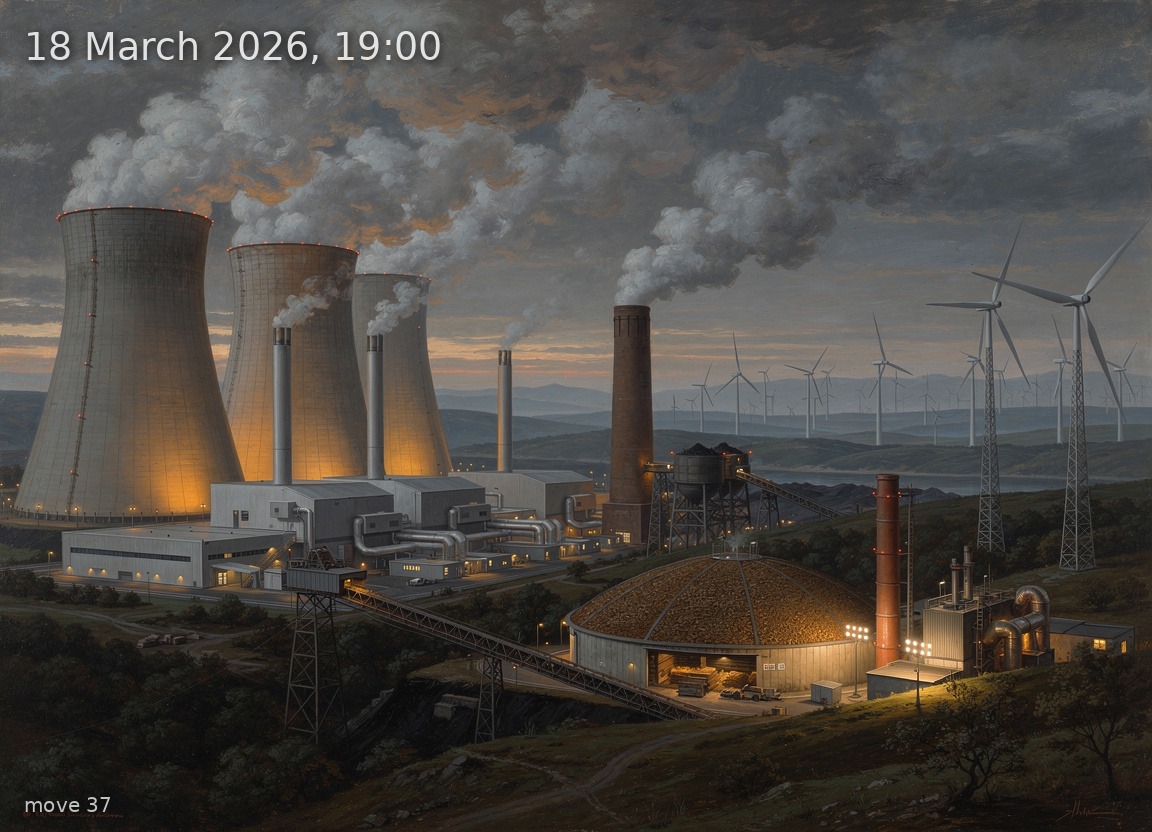
Brown coal, gas, and hard coal anchor evening supply as imports bridge a 14.6 GW gap at peak demand.
Back
Generation mix
Wind onshore 31%
Wind offshore 2%
Solar 0%
Biomass 9%
Hydro 3%
Natural gas 19%
Hard coal 11%
Brown coal 25%
46%
Renewable share
15.8 GW
Wind (on + offshore)
0.0 GW
Solar
47.6 GW
Total generation
-14.6 GW
Net import
170.2 €/MWh
Day-ahead price
9.9°C / 5 km/h
Temp / Wind speed
Open-Meteo, Kassel (51.3°N 9.5°E)
0% / 1.2 W/m²
Cloud cover / Radiation
377
gCO₂/kWh
Image prompt
Brown coal 11.9 GW dominates the left third of the scene as a massive lignite power station with four hyperbolic cooling towers emitting thick white-grey steam plumes lit from below by sodium-orange industrial lights; natural gas 8.9 GW fills the centre-left as three compact CCGT units with tall slender exhaust stacks venting thin heat shimmer; hard coal 5.1 GW appears centre-right as a smaller coal plant with a single large smokestack and conveyor belts feeding dark fuel into hoppers; wind onshore 15.0 GW spans the entire right third and background as dozens of three-blade turbines on lattice and tubular towers spread across rolling hills, blades turning slowly in light wind; wind offshore 0.8 GW is a faint cluster of turbines barely visible on a distant horizon line; biomass 4.4 GW appears as a mid-sized industrial facility with a wood-chip storage dome and modest stack glowing warmly near the coal plant; hydro 1.5 GW is a small dam structure with water cascading, tucked into a valley at far right. TIME AND LIGHTING: dusk at 19:00 in March — the sky is deep indigo overhead transitioning to a narrow band of fading burnt-orange and crimson along the lower horizon in the west; stars are beginning to appear; the landscape is mostly dark, with all industrial facilities illuminated by harsh sodium and LED floodlights casting sharp amber pools on surrounding infrastructure. The sky feels heavy and oppressive, hazy near the cooling towers, reflecting the very high electricity price. WEATHER AND SEASON: clear sky with zero cloud cover, bare early-spring trees with no leaves, dormant brown grass, temperature around 10°C suggesting a cool damp atmosphere with faint ground mist forming in low areas. Overhead high-voltage transmission lines on steel lattice pylons stretch across the scene, emphasising the massive import flows. STYLE: highly detailed oil painting in the tradition of 19th-century German Romantic landscape painters — rich impasto brushwork visible in the steam plumes and twilight sky, atmospheric depth created by layered cool blues and warm industrial oranges, meticulous engineering detail on every turbine nacelle, cooling tower ribbing, CCGT exhaust stack, and coal conveyor. The scene evokes Caspar David Friedrich's sublime tension between nature and industry, rendered as a monumental panoramic canvas. No text, no labels.