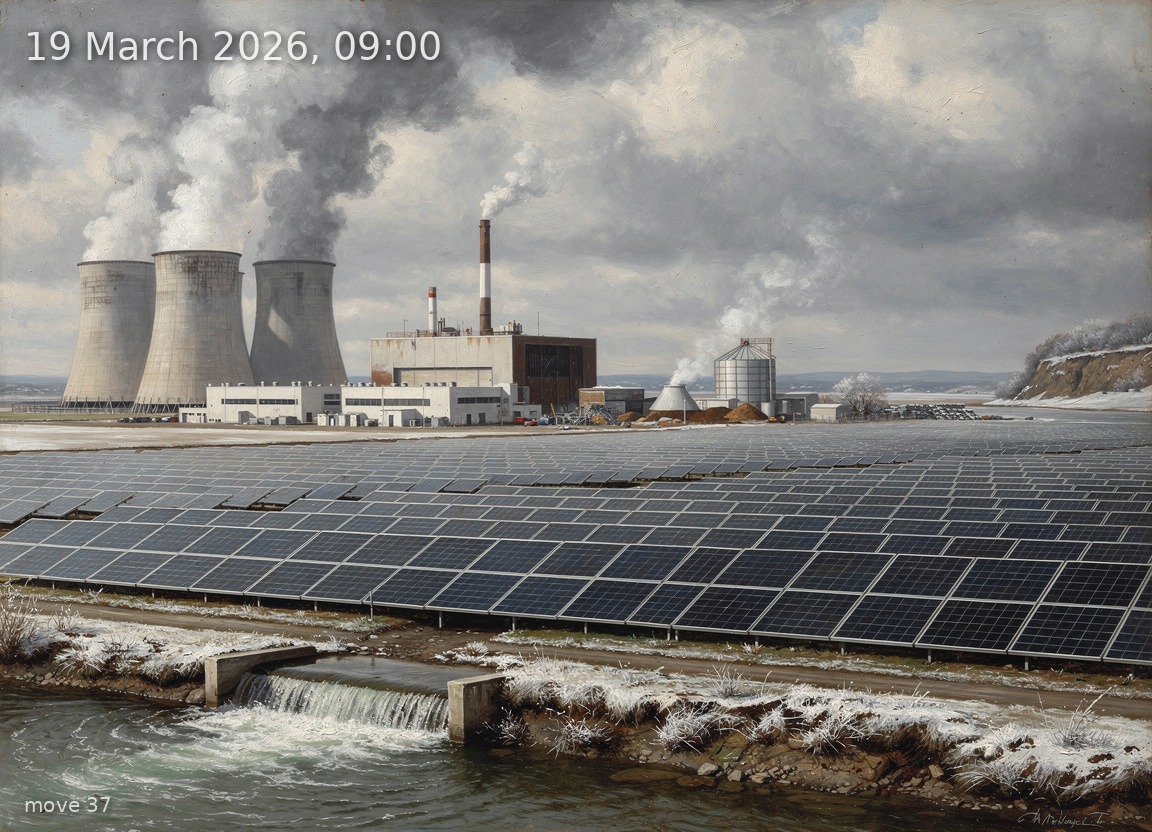
Solar leads at 32.3 GW but near-zero wind forces heavy coal and gas dispatch with 4.9 GW net imports.
Back
Generation mix
Wind onshore 3%
Wind offshore 0%
Solar 55%
Biomass 7%
Hydro 2%
Natural gas 10%
Hard coal 7%
Brown coal 16%
68%
Renewable share
1.6 GW
Wind (on + offshore)
32.3 GW
Solar
58.3 GW
Total generation
-4.9 GW
Net import
90.9 €/MWh
Day-ahead price
1.3°C / 2 km/h
Temp / Wind speed
Open-Meteo, Kassel (51.3°N 9.5°E)
71% / 35.5 W/m²
Cloud cover / Radiation
229
gCO₂/kWh
Image prompt
Solar 32.3 GW dominates the right two-thirds of the scene as an enormous expanse of aluminium-framed crystalline silicon PV panels stretching across flat farmland into the hazy distance; brown coal 9.3 GW occupies the left background as a cluster of four massive hyperbolic cooling towers with thick white-grey steam plumes rising heavily into still air; natural gas 5.7 GW appears left-of-centre as two modern CCGT plants with slim exhaust stacks venting thin heat shimmer; hard coal 3.9 GW sits behind the gas units as a single older power station with a tall rectangular boiler house and squat chimney; biomass 4.2 GW is rendered as a mid-ground wood-chip-fed CHP plant with a conical fuel silo and moderate steam output; hydro 1.2 GW appears as a small concrete run-of-river weir with visible spillway along a river in the mid-left; wind onshore 1.6 GW is shown as just three distant three-blade turbines on a ridge at far right, their rotors virtually motionless; wind offshore 0.1 GW is a single barely visible turbine silhouette on the far horizon. Time is 09:00 on a late-winter morning: full daylight but muted and overcast at 71% cloud cover—a flat, heavy grey-white sky with occasional thin breaks letting wan, diffuse light through, no direct sunbeams. Temperature is 1.3 °C: the landscape is cold, with patches of frost on bare brown fields, leafless trees with dark skeletal branches, remnant dirty snow in furrows. The air is completely still—no motion in grass, no flags stirring, smoke and steam rise vertically. The atmosphere feels oppressive and heavy, reflecting the elevated 90.9 EUR/MWh price—a brooding, weighty sky pressing down on the industrial plain. Rendered as a highly detailed oil painting in the tradition of 19th-century German Romantic landscape painting—rich impasto brushwork, deep atmospheric perspective, carefully observed industrial engineering detail on every turbine nacelle, every cooling tower's parabolic curve, every PV panel's grid lines—with the grandeur and emotional depth of a Caspar David Friedrich or Carl Blechen canvas transposed onto the modern energy landscape. No text, no labels.