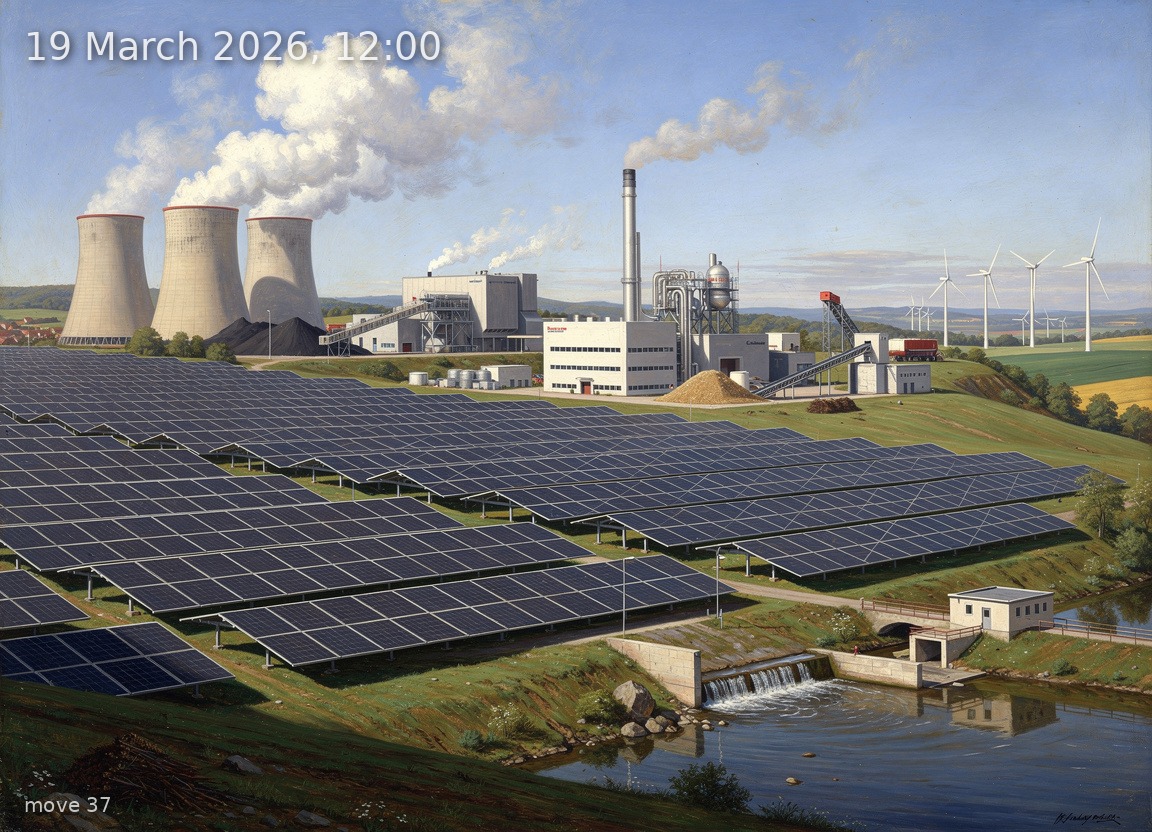
Solar at 48.3 GW drives 83.5% renewable share, collapsing prices to zero and pushing 6.5 GW net exports.
Back
Generation mix
Wind onshore 3%
Wind offshore 0%
Solar 73%
Biomass 6%
Hydro 2%
Natural gas 4%
Hard coal 3%
Brown coal 9%
84%
Renewable share
1.9 GW
Wind (on + offshore)
48.3 GW
Solar
66.2 GW
Total generation
+6.5 GW
Net export
0.0 €/MWh
Day-ahead price
12.7°C / 9 km/h
Temp / Wind speed
Open-Meteo, Kassel (51.3°N 9.5°E)
51% / 469.5 W/m²
Cloud cover / Radiation
118
gCO₂/kWh
Image prompt
Solar 48.3 GW dominates the entire scene as vast fields of aluminium-framed crystalline silicon PV panels stretching across rolling central German hills, occupying roughly three-quarters of the composition, their blue-black surfaces gleaming under bright midday spring sun. Brown coal 6.1 GW appears at the far left as a cluster of massive hyperbolic cooling towers emitting thick white steam plumes against the sky. Biomass 3.9 GW sits behind the solar fields as a medium-sized wood-chip-fired plant with a single squat smokestack and conveyor belts feeding fuel. Natural gas 3.0 GW is rendered as a compact modern CCGT facility with a single tall exhaust stack and visible heat shimmer, positioned left of centre behind the panels. Hard coal 1.9 GW appears as a smaller conventional power station with a rectangular boiler house and coal bunker adjacent to the brown coal complex. Wind onshore 1.8 GW is shown as a small handful of widely spaced three-blade turbines on a distant ridge, their rotors barely turning in the light breeze. Hydro 1.2 GW is suggested by a small concrete run-of-river weir visible along a stream in the mid-ground valley. Wind offshore 0.1 GW is omitted as negligible. The sky is partly cloudy — roughly half covered with scattered cumulus clouds, bright blue patches between them, strong direct sunlight casting defined shadows across the landscape. Early spring vegetation: fields greening up, bare deciduous trees just beginning to bud, patches of yellow colza in the distance. Temperature is mild at 12.7°C — no frost, light jackets weather. The atmosphere is calm and open, reflecting the zero electricity price — expansive, unhurried, luminous. Highly detailed oil painting in the tradition of 19th-century German Romantic landscape painters such as Caspar David Friedrich and Carl Blechen, with rich saturated colour, visible confident brushwork, atmospheric depth and haze toward the horizon, dramatic compositional balance between industrial infrastructure and pastoral countryside. Meticulous engineering accuracy on every technology: correct turbine nacelles, lattice towers, PV module grid patterns, cooling tower parabolic geometry, steam plume thermodynamics. No text, no labels, no people prominent — the landscape and its machines are the subject.