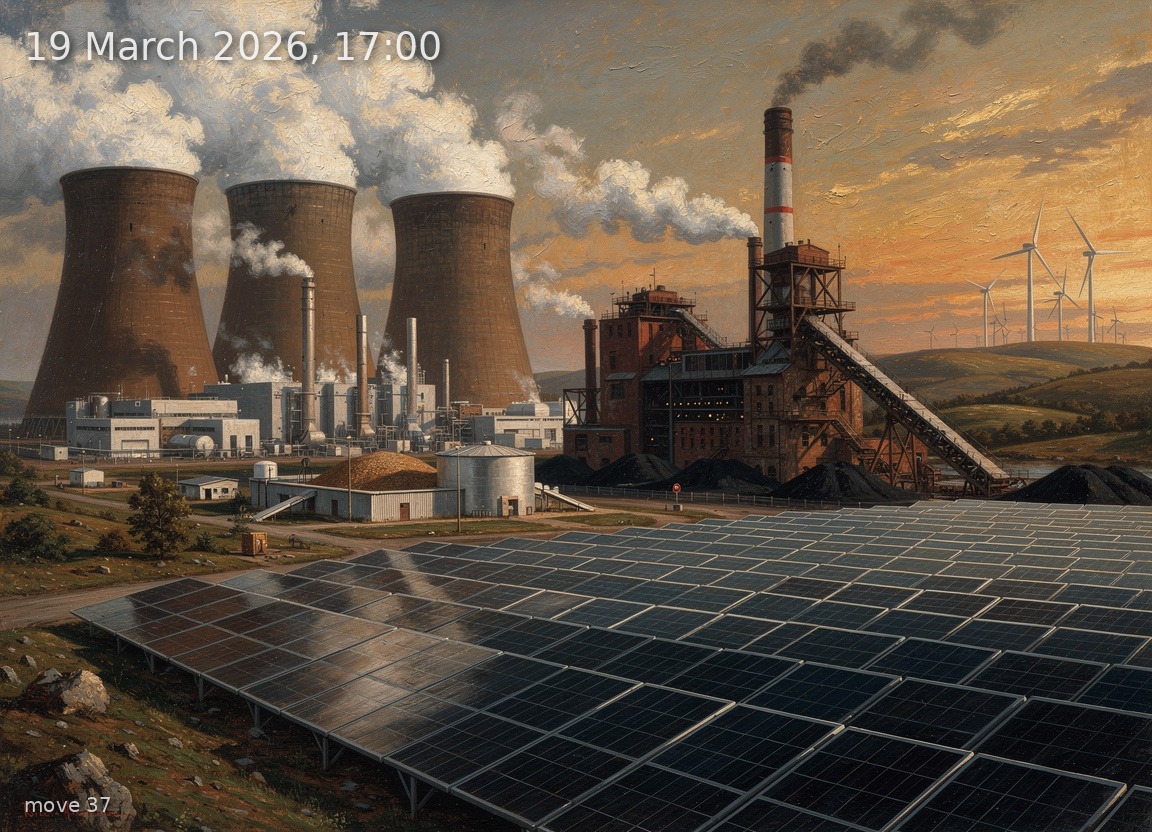
Brown coal, gas, and hard coal dominate as weak wind and fading solar drive heavy imports and high prices.
Back
Generation mix
Wind onshore 7%
Wind offshore 2%
Solar 14%
Biomass 10%
Hydro 3%
Natural gas 25%
Hard coal 11%
Brown coal 28%
37%
Renewable share
4.1 GW
Wind (on + offshore)
6.1 GW
Solar
43.1 GW
Total generation
-14.6 GW
Net import
152.2 €/MWh
Day-ahead price
13.8°C / 6 km/h
Temp / Wind speed
Open-Meteo, Kassel (51.3°N 9.5°E)
0% / 176.8 W/m²
Cloud cover / Radiation
429
gCO₂/kWh
Image prompt
Brown coal 12.0 GW occupies the left third of the scene as a massive lignite power complex with four hyperbolic cooling towers emitting thick white steam plumes; natural gas 10.6 GW fills the centre-left as a cluster of modern CCGT plants with tall slender exhaust stacks and visible heat shimmer; hard coal 4.7 GW appears centre-right as a darker, older coal station with a single large smokestack and conveyor belts feeding coal bunkers; solar 6.1 GW is rendered as a broad field of aluminium-framed crystalline silicon panels in the right foreground catching the last orange-red rays of sunlight at a low angle; wind onshore 3.1 GW appears as a small group of three-blade turbines on gentle hills in the far right background, their rotors barely turning in the calm air; wind offshore 1.0 GW is suggested by a handful of distant turbines on the far horizon; biomass 4.3 GW is depicted as a modest wood-chip-fired plant with a rounded silo and a thin exhaust plume near centre; hydro 1.4 GW is a small run-of-river weir with a modest powerhouse visible along a river in the middle distance. TIME AND LIGHT: 17:00 dusk in mid-March — the sun is very low on the western horizon, casting a deep orange-red glow along the lower sky, while the upper sky transitions from warm amber to darkening blue-grey; long shadows stretch across the landscape. WEATHER: perfectly clear sky with zero clouds, mild spring temperature — bare-branched trees with the first hints of green buds, fresh grass emerging. ATMOSPHERE: oppressive, heavy industrial mood reflecting the high electricity price — the steam and exhaust plumes hang dense and low in the still air, diffusing the fading sunlight into a sulfurous haze; the scene feels weighty and expensive. STYLE: highly detailed oil painting in the tradition of 19th-century German Romantic landscape painters such as Caspar David Friedrich and Carl Blechen — rich saturated colour with deep amber, ochre, and slate tones, visible impasto brushwork, dramatic atmospheric depth and chiaroscuro. Every energy technology rendered with meticulous engineering accuracy: three-blade rotor turbines with visible nacelles and lattice towers, hyperbolic concrete cooling towers with realistic condensation plumes, CCGT stacks with heat distortion, solar panels with visible cell grids and aluminium frames. The composition evokes a sublime industrial panorama — part elegy, part documentation. No text, no labels, no human figures.