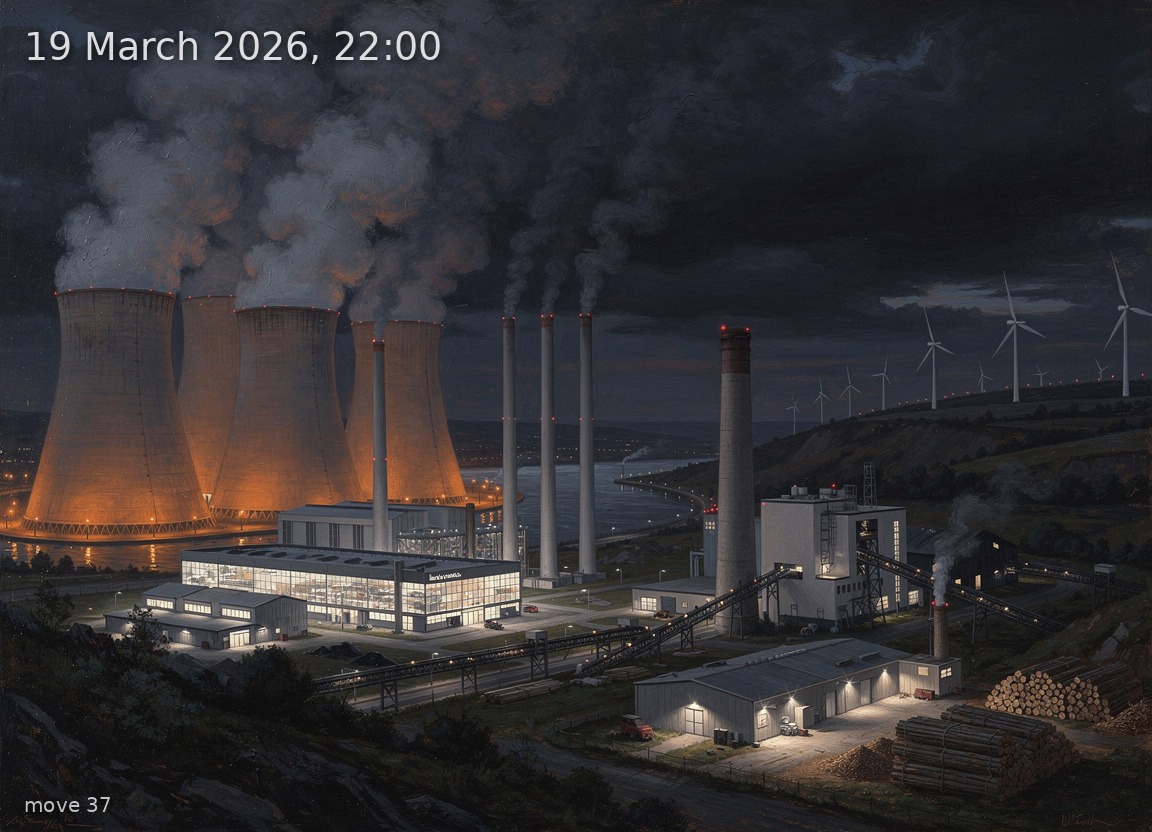
Brown coal, gas, and hard coal dominate a nighttime grid with low wind and no solar, driving significant net imports.
Back
Generation mix
Wind onshore 16%
Wind offshore 6%
Solar 0%
Biomass 10%
Hydro 3%
Natural gas 26%
Hard coal 11%
Brown coal 29%
34%
Renewable share
9.4 GW
Wind (on + offshore)
0.0 GW
Solar
42.7 GW
Total generation
-10.3 GW
Net import
139.6 €/MWh
Day-ahead price
4.9°C / 0 km/h
Temp / Wind speed
Open-Meteo, Kassel (51.3°N 9.5°E)
96% / 0.0 W/m²
Cloud cover / Radiation
446
gCO₂/kWh
Image prompt
Brown coal 12.4 GW dominates the left third of the scene as a cluster of massive hyperbolic cooling towers rising into the night, thick white-grey steam plumes billowing upward and lit from below by orange sodium floodlights; natural gas 11.0 GW fills the centre-left as a row of modern combined-cycle gas turbine plants with tall slender exhaust stacks emitting thin heat shimmer, their rectangular turbine halls glowing with interior light; hard coal 4.7 GW appears centre-right as a smaller coal-fired station with a single large smokestack and visible conveyor belts feeding dark fuel; wind onshore 6.8 GW is rendered as a scattered line of three-blade turbines on low hills in the right background, their red aviation warning lights blinking, rotors nearly still in the calm air; wind offshore 2.6 GW is suggested by distant tiny red lights on the far-right horizon over a barely visible dark sea; biomass 4.1 GW appears as a compact wood-chip-fired plant with a modest chimney and stacked timber in a lit yard, positioned centre-right; hydro 1.2 GW is a small concrete run-of-river dam in the lower right foreground with dark water flowing over spillways, illuminated by a single lamp. The sky is completely dark, deep navy-black, no twilight, no stars visible through 96% cloud cover, a heavy overcast pressing down oppressively to convey the high electricity price of 139.6 EUR/MWh. The temperature is near 5°C: bare deciduous trees with no leaves, patches of frost on the ground, early spring dormant brown grass. Almost no wind motion—flags hang limp, smoke and steam rise vertically. The landscape is a broad Rhine-Ruhr-style industrial river valley viewed from a slightly elevated vantage. All illumination comes from artificial sources: sodium-orange streetlights lining a road in the foreground, bluish LED floodlights on plant perimeters, warm yellow windows in control buildings. Rendered as a highly detailed oil painting in the tradition of 19th-century German Romantic landscape painters—rich, sombre colour palette of deep indigo, burnt sienna, and lamp-black, visible impasto brushwork, atmospheric depth with industrial haze softening distant towers, meticulous engineering accuracy in every turbine nacelle, cooling tower profile, and exhaust stack proportion. The mood is brooding, monumental, industrial sublime. No text, no labels.