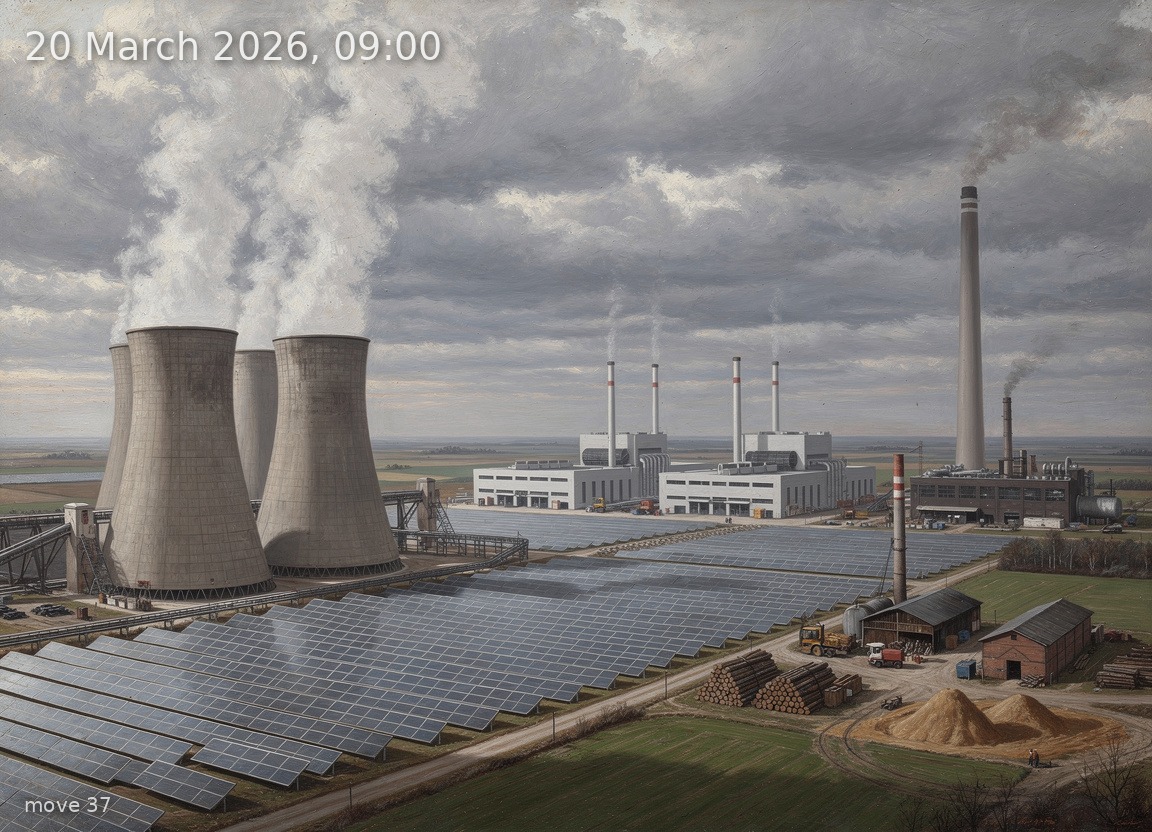
Solar leads at 28 GW despite overcast; near-zero wind forces heavy coal and gas dispatch with 6.3 GW net imports.
Back
Generation mix
Wind onshore 1%
Wind offshore 1%
Solar 48%
Biomass 7%
Hydro 2%
Natural gas 12%
Hard coal 8%
Brown coal 21%
60%
Renewable share
1.3 GW
Wind (on + offshore)
28.0 GW
Solar
58.2 GW
Total generation
-6.3 GW
Net import
132.0 €/MWh
Day-ahead price
1.8°C / 2 km/h
Temp / Wind speed
Open-Meteo, Kassel (51.3°N 9.5°E)
100% / 2.5 W/m²
Cloud cover / Radiation
284
gCO₂/kWh
Image prompt
Brown coal 12.0 GW dominates the left third of the scene as a massive lignite power station complex with four hyperbolic cooling towers emitting thick white-grey steam plumes that merge into the overcast sky; solar 28.0 GW spans the entire middle ground as vast fields of aluminium-framed crystalline silicon PV panels stretching to the horizon, their glass surfaces reflecting dull grey light under total cloud cover; natural gas 6.7 GW appears right of centre as a pair of modern CCGT plants with tall slender exhaust stacks venting thin heat shimmer; hard coal 4.6 GW stands in the right background as a classic coal-fired station with a single large chimney and rectangular boiler house; biomass 4.3 GW is rendered as a mid-ground wood-chip fuelled CHP plant with a modest stack and adjacent timber storage yard; hydro 1.3 GW appears as a small concrete dam and penstock on a hillside stream in the far right; wind onshore 0.8 GW is a single distant three-blade turbine on a lattice tower, its blades barely turning; wind offshore 0.5 GW is a tiny cluster of turbines visible on a far grey horizon line. The sky is entirely blanketed in heavy, low, uniform stratus cloud at 100% cover — no blue sky, no sun disc visible — creating flat diffuse daylight consistent with 09:00 in late-winter central Germany. The atmosphere feels oppressive and weighty, reflecting the high electricity price. Temperature is near freezing at 1.8°C: bare deciduous trees with no leaves, patches of frost on brown grass, breath-visible cold. No wind motion anywhere — flags hang limp, smoke rises vertically, puddles are glassy still. The landscape is flat central German terrain with gentle rolling agricultural fields between industrial installations. Painted in the style of a highly detailed 19th-century German Romantic oil painting — rich impasto brushwork, atmospheric depth with muted earth tones and grey-blues, meticulous engineering accuracy on every turbine nacelle, cooling tower curvature, and panel frame, evoking Caspar David Friedrich's sense of sublime scale but applied to the modern industrial energy landscape. No text, no labels.