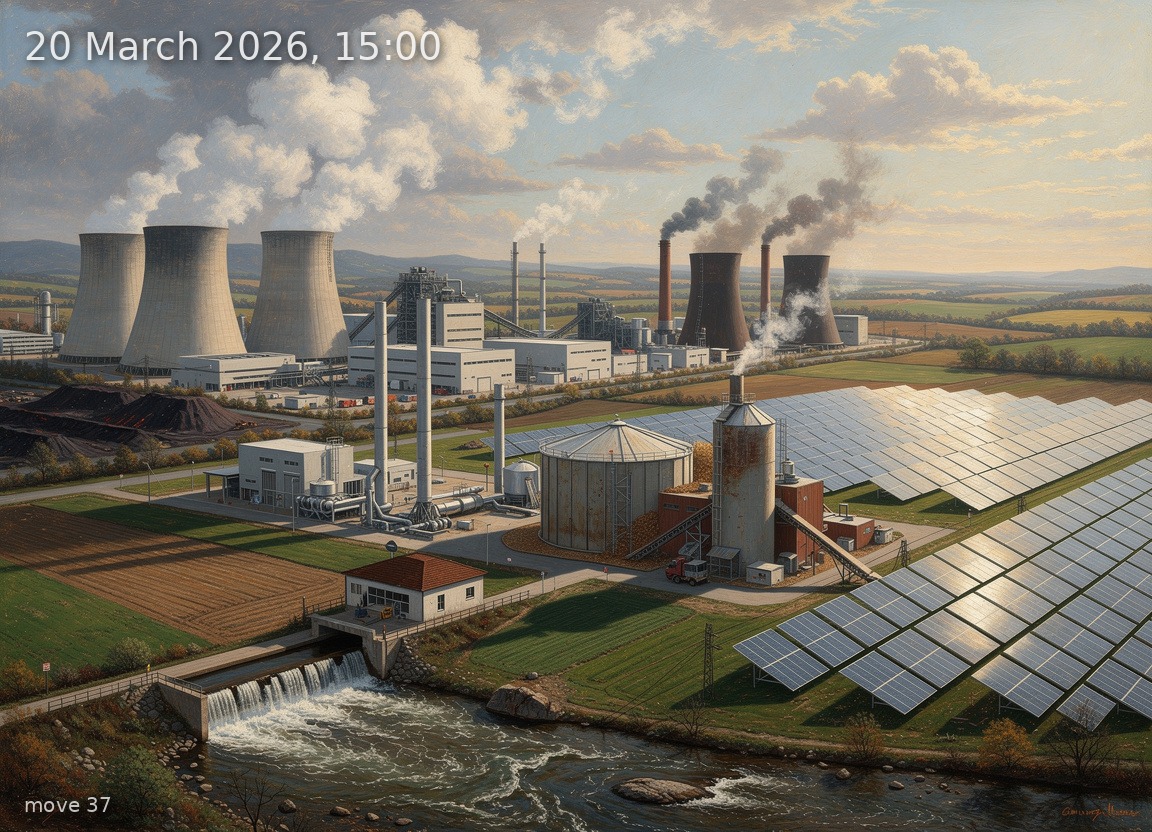
Strong solar at 24.5 GW and heavy brown coal at 11.7 GW anchor an afternoon with minimal wind and elevated prices.
Back
Generation mix
Wind onshore 3%
Wind offshore 1%
Solar 47%
Biomass 8%
Hydro 2%
Natural gas 8%
Hard coal 8%
Brown coal 22%
61%
Renewable share
2.2 GW
Wind (on + offshore)
24.5 GW
Solar
52.6 GW
Total generation
-1.5 GW
Net import
117.2 €/MWh
Day-ahead price
13.2°C / 7 km/h
Temp / Wind speed
Open-Meteo, Kassel (51.3°N 9.5°E)
59% / 266.0 W/m²
Cloud cover / Radiation
287
gCO₂/kWh
Image prompt
Brown coal 11.7 GW occupies the left quarter of the scene as a sprawling lignite power complex with four massive hyperbolic cooling towers emitting thick white-grey steam plumes; hard coal 4.4 GW appears just to its right as two smaller conventional coal stacks with dark exhaust; natural gas 4.4 GW is rendered as a pair of compact modern CCGT plants with slender silver exhaust stacks and faint heat shimmer in the centre-left; solar 24.5 GW dominates the right half and centre of the composition as vast fields of aluminium-framed crystalline silicon photovoltaic panels stretching across gently rolling farmland toward the horizon, their glass surfaces catching bright white-gold reflections of afternoon sunlight; wind onshore 1.6 GW appears as a small cluster of three-blade turbines on a distant ridge at far right, their rotors barely turning in the still air; wind offshore 0.5 GW is suggested by two or three tiny turbines visible on the far horizon line; biomass 4.1 GW is depicted as a mid-sized wood-chip-fired plant with a broad cylindrical silo and a modest smokestack near centre; hydro 1.2 GW appears as a small concrete run-of-river weir and powerhouse along a stream in the lower foreground. Time of day: 3 PM on March 20 in central Germany — full spring-afternoon daylight, sun at moderate altitude in the southwest casting warm but not harsh light. The sky is partly cloudy at 59% cover: broken cumulus clouds drift across a pale blue sky with large patches of open sunlight and scattered shadows rolling across the landscape. Temperature 13°C: early spring conditions with fresh green grass just emerging, leafless or barely budding deciduous trees, and lingering brown-grey winter tones in the hedgerows. The atmosphere feels heavy and slightly oppressive despite the sunshine — a faint yellowish industrial haze sits along the horizon near the coal plants, reflecting the elevated 117 EUR/MWh price tension. Style: highly detailed oil painting in the tradition of 19th-century German Romantic landscape masters such as Caspar David Friedrich and Carl Blechen — rich saturated colour, visible impasto brushwork, dramatic atmospheric depth and chiaroscuro, meticulous engineering detail on every turbine nacelle, cooling tower, PV rack, and smokestack. The composition balances industrial grandeur with pastoral expanse. No text, no labels, no human figures.