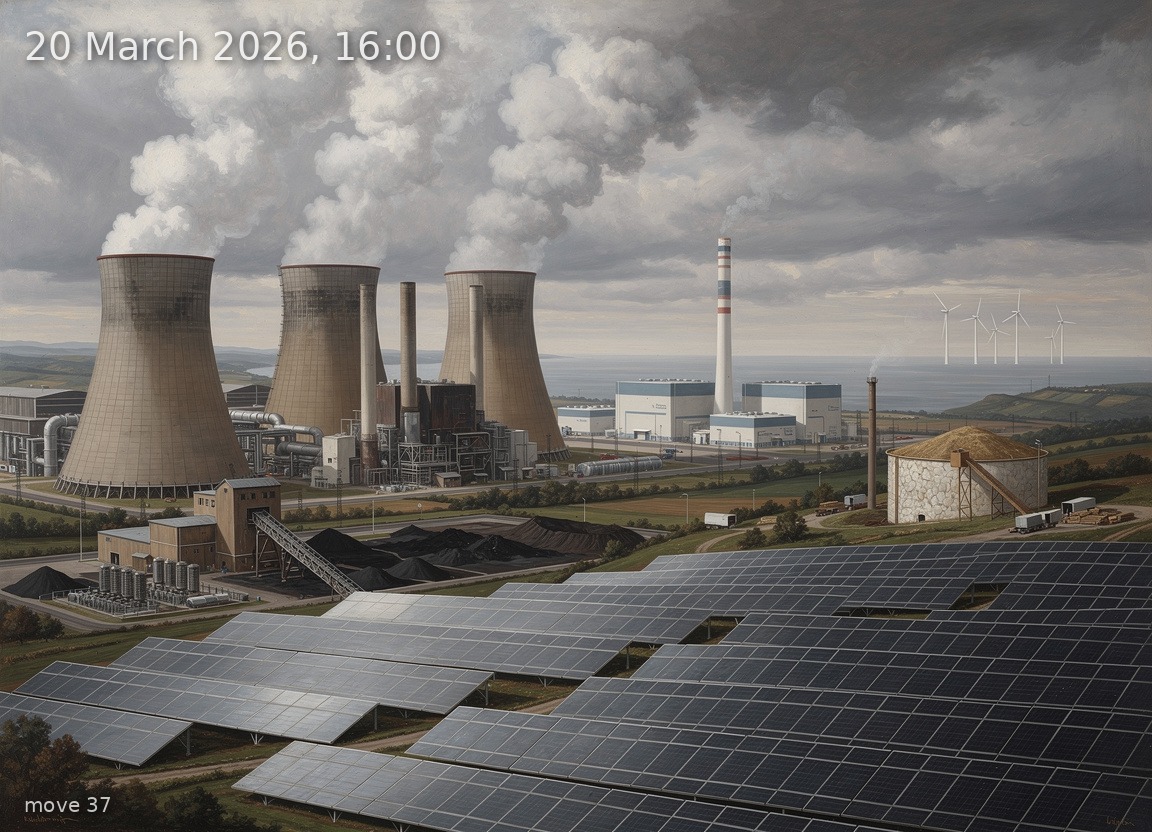
Brown coal and solar lead generation as weak winds and high demand drive 9.7 GW net imports and elevated prices.
Back
Generation mix
Wind onshore 5%
Wind offshore 1%
Solar 32%
Biomass 9%
Hydro 3%
Natural gas 14%
Hard coal 10%
Brown coal 27%
50%
Renewable share
2.7 GW
Wind (on + offshore)
14.4 GW
Solar
45.6 GW
Total generation
-9.6 GW
Net import
144.7 €/MWh
Day-ahead price
13.3°C / 7 km/h
Temp / Wind speed
Open-Meteo, Kassel (51.3°N 9.5°E)
88% / 168.2 W/m²
Cloud cover / Radiation
362
gCO₂/kWh
Image prompt
Brown coal 12.1 GW dominates the left third of the scene as a massive lignite power complex with four hyperbolic cooling towers releasing thick white steam plumes into an overcast sky; solar 14.4 GW fills the centre-right foreground as vast fields of aluminium-framed crystalline silicon PV panels stretching across gently rolling farmland, their surfaces reflecting diffuse grey-white light; natural gas 6.2 GW appears as two compact CCGT units with tall single exhaust stacks and smaller vapour trails positioned behind the coal complex; hard coal 4.7 GW is rendered as a classical coal-fired station with twin rectangular chimneys and conveyor belts feeding dark fuel, set to the left middle ground; biomass 4.3 GW appears as a wood-chip fired plant with a rounded silo and modest smokestack near the right edge; wind onshore 2.1 GW is shown as a small cluster of three-blade turbines on a distant ridge, their rotors nearly still in the calm air; wind offshore 0.6 GW is barely suggested as tiny turbines on a hazy far horizon line; hydro 1.3 GW appears as a small dam and powerhouse nestled in a valley at the far right. Time is 16:00 on a March afternoon — full but muted daylight filtered through 88% cloud cover, the sky a heavy blanket of layered grey stratus with only occasional pale brightness hinting at the sun's position low in the west. The atmosphere feels oppressive and dense, reflecting the high electricity price. Early spring vegetation: bare deciduous trees with the first faint green buds, brown-green grass, patches of mud. Temperature around 13°C gives the air a cool damp quality. The landscape is rendered as a highly detailed oil painting in the tradition of 19th-century German Romantic landscape painters — rich tonal depth, visible impasto brushwork, atmospheric perspective with haze softening distant elements. Each technology is painted with meticulous engineering accuracy: turbine nacelles and lattice towers, PV panel grid patterns, cooling tower parabolic geometry, industrial piping and transformer yards. The composition evokes Caspar David Friedrich's sense of sublime scale but applied to an industrial energy landscape. No text, no labels.