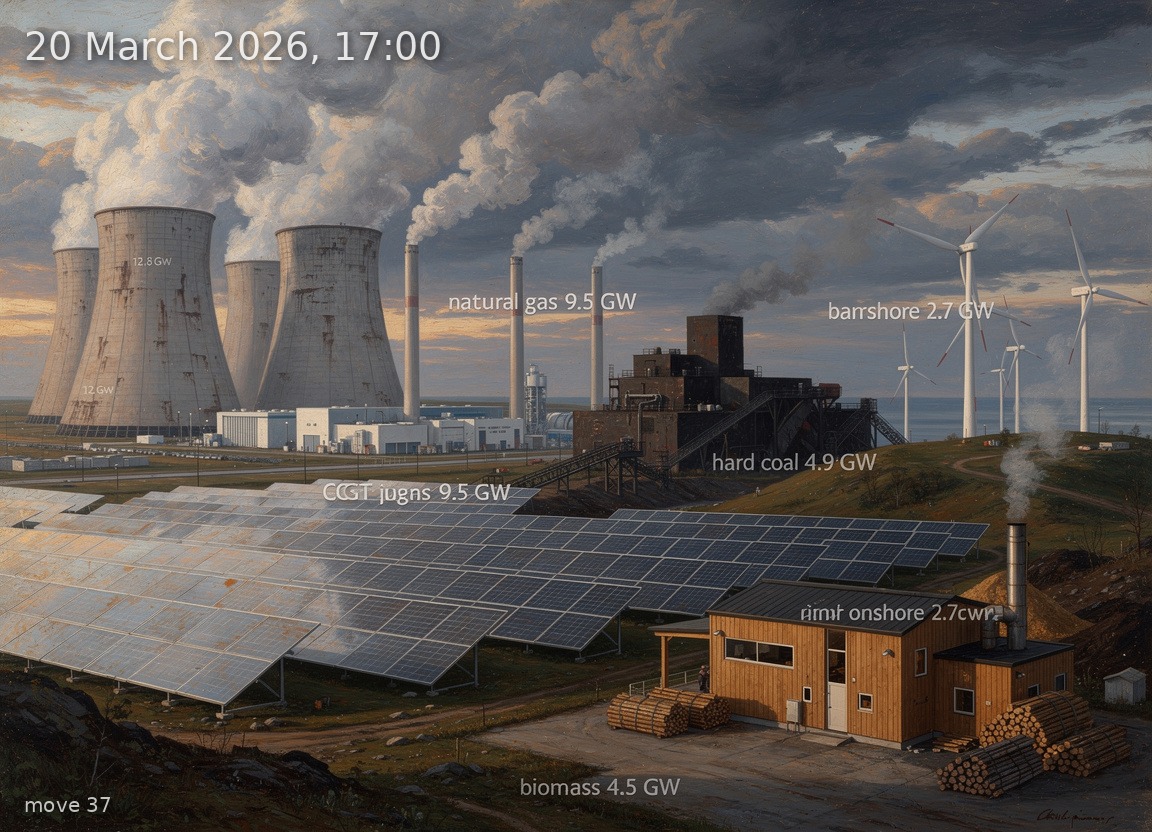
Brown coal and gas dominate as weak wind and fading solar force 15.6 GW of net imports at elevated prices.
Back
Generation mix
Wind onshore 7%
Wind offshore 1%
Solar 12%
Biomass 11%
Hydro 3%
Natural gas 23%
Hard coal 12%
Brown coal 31%
34%
Renewable share
3.3 GW
Wind (on + offshore)
5.0 GW
Solar
41.4 GW
Total generation
-15.6 GW
Net import
174.8 €/MWh
Day-ahead price
12.8°C / 5 km/h
Temp / Wind speed
Open-Meteo, Kassel (51.3°N 9.5°E)
72% / 89.0 W/m²
Cloud cover / Radiation
456
gCO₂/kWh
Image prompt
Brown coal 12.8 GW dominates the left third of the scene as a cluster of massive hyperbolic cooling towers with thick white-grey steam plumes rising heavily into the sky; natural gas 9.5 GW fills the centre-left as a row of compact CCGT plants with tall single exhaust stacks venting thin translucent heat haze; hard coal 4.9 GW appears centre-right as a dark industrial block with conveyor belts and a single square chimney trailing grey smoke; solar 5.0 GW is rendered as a field of aluminium-framed crystalline silicon panels in the middle distance catching the last weak amber light; biomass 4.5 GW sits to the right as a wood-clad CHP facility with a modest stack and stored timber piles; wind onshore 2.7 GW appears as a small group of three-blade turbines on a distant ridge, rotors barely turning in the light breeze; wind offshore 0.6 GW is suggested by two tiny turbines on the far horizon; hydro 1.3 GW is a small dam and powerhouse nestled in a valley in the far right background. The lighting is dusk at 17:00 in late March — a narrow band of deep orange-red glow clings to the lower horizon beneath 72% overcast cloud, the upper sky darkening rapidly to slate grey and indigo, the whole atmosphere heavy and oppressive suggesting high electricity prices. The temperature is mild at 12.8°C; early spring vegetation shows pale green buds on bare deciduous trees and patchy green grass. The air feels still with almost no wind. Rendered as a highly detailed oil painting in the tradition of 19th-century German Romantic landscape painters — rich saturated colour, visible impasto brushwork, dramatic atmospheric depth with layered clouds and industrial haze, meticulous engineering accuracy on every turbine nacelle, PV panel frame, and cooling tower hyperbolic curve. The mood is solemn and monumental. No text, no labels.