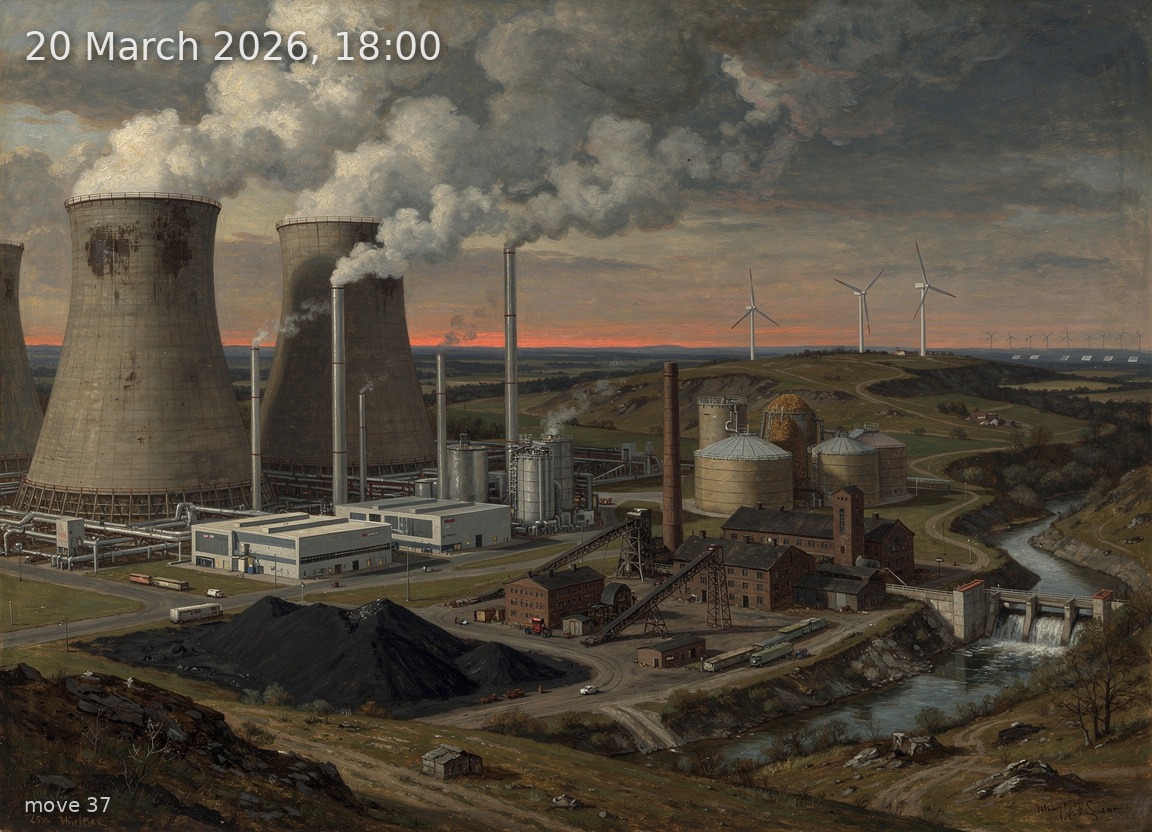
Lignite, gas, and coal dominate as low wind and fading light drive high prices and heavy imports.
Back
Generation mix
Wind onshore 10%
Wind offshore 1%
Solar 1%
Biomass 12%
Hydro 3%
Natural gas 26%
Hard coal 13%
Brown coal 33%
28%
Renewable share
4.5 GW
Wind (on + offshore)
0.3 GW
Solar
38.9 GW
Total generation
-20.0 GW
Net import
211.0 €/MWh
Day-ahead price
11.3°C / 8 km/h
Temp / Wind speed
Open-Meteo, Kassel (51.3°N 9.5°E)
77% / 31.5 W/m²
Cloud cover / Radiation
498
gCO₂/kWh
Image prompt
Brown coal 13.0 GW dominates the left third of the scene as a vast complex of hyperbolic cooling towers with thick white-grey steam plumes rising into the sky; natural gas 10.2 GW fills the centre-left as a row of modern CCGT power stations with tall single exhaust stacks and thinner, hotter plumes; hard coal 5.0 GW appears centre-right as a cluster of older industrial boiler houses with conveyor belts and dark stockpiles; biomass 4.6 GW is rendered as a mid-ground facility with cylindrical digesters and wood-chip silos; wind onshore 4.0 GW is shown as a modest line of three-blade turbines on a distant ridge, blades turning slowly in light wind; hydro 1.3 GW appears as a small dam structure in a valley fold at the far right; wind offshore 0.5 GW is barely visible as tiny turbines on the extreme right horizon. Solar is essentially absent — no panels visible. The lighting is dusk at 18:00 in late March: the lower horizon glows a muted orange-red, rapidly fading upward into deep slate-blue and gathering darkness; heavy cloud cover at 77% creates an oppressive, low ceiling of textured grey-violet clouds pressing down on the industrial landscape. The atmosphere feels heavy and costly — a thick, hazy quality to the air, smoke and steam merging with low clouds. The temperature is mild at 11 °C: early spring vegetation is just emerging, pale green grass and bare-branched trees with the first buds. The terrain is gently rolling central German lowland. Sodium streetlights are beginning to flicker on along roads connecting the facilities. Highly detailed oil painting in the tradition of 19th-century German Romantic landscape painters — rich, sombre colour palette of umber, ochre, slate, and dull copper; visible impasto brushwork; atmospheric depth with industrial haze receding into the darkening distance; meticulous engineering detail on every turbine nacelle, cooling tower, and exhaust stack. The scene conveys the monumental scale of thermal generation under a brooding, expensive sky. No text, no labels.