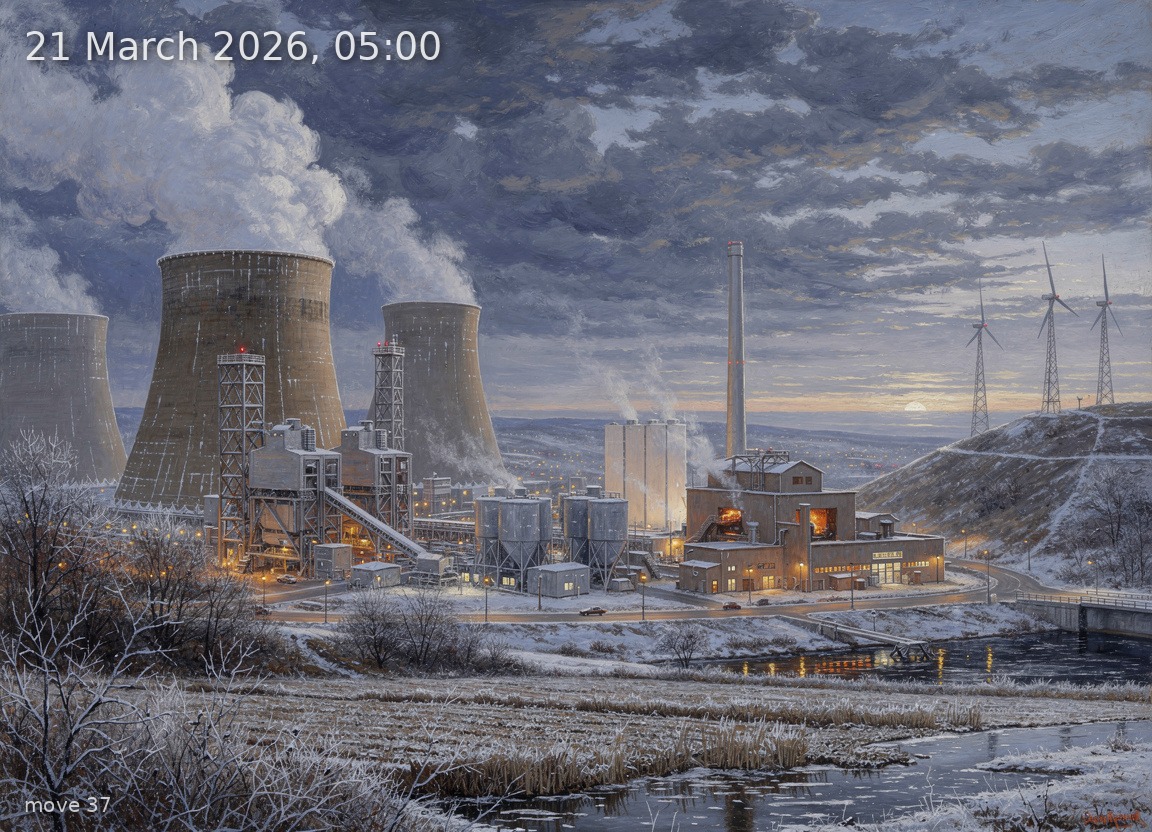
Brown coal, gas, and hard coal dominate a cold, windless pre-dawn hour with 8.9 GW net imports needed.
Back
Generation mix
Wind onshore 10%
Wind offshore 0%
Solar 0%
Biomass 12%
Hydro 3%
Natural gas 20%
Hard coal 15%
Brown coal 39%
26%
Renewable share
3.5 GW
Wind (on + offshore)
0.0 GW
Solar
33.7 GW
Total generation
-8.9 GW
Net import
137.7 €/MWh
Day-ahead price
-0.7°C / 3 km/h
Temp / Wind speed
Open-Meteo, Kassel (51.3°N 9.5°E)
70% / 0.0 W/m²
Cloud cover / Radiation
530
gCO₂/kWh
Image prompt
Brown coal 13.0 GW dominates the left third of the scene as a vast complex of hyperbolic cooling towers exhaling thick white steam plumes into the freezing air; hard coal 5.2 GW appears centre-left as a pair of large coal-fired stations with tall rectangular stacks and conveyor gantries; natural gas 6.8 GW fills the centre as a cluster of compact CCGT plants with slim single exhaust stacks emitting thin vapour trails; biomass 4.1 GW sits centre-right as a set of industrial wood-chip combustion facilities with glowing furnace windows and modest stacks; onshore wind 3.4 GW occupies the far right as a sparse line of three-blade turbines on lattice towers, their rotors barely turning in near-calm conditions; hydro 1.1 GW is suggested by a small dam and reservoir visible at the far-right edge. Time is 05:00 in late March — the sky is deep blue-grey pre-dawn, no direct sunlight, no orange glow, only the faintest pale luminance along the eastern horizon behind the cooling towers. Sub-zero temperature: frost coats the bare winter vegetation in the foreground — leafless trees, frozen stubble fields, thin ice on puddles. Cloud cover at 70% creates a mottled, oppressive canopy overhead, adding a heavy, brooding atmosphere reflecting the 137.7 EUR/MWh price. Sodium-orange streetlights and industrial floodlights illuminate the power plant complexes, casting long amber reflections on frozen ground. No solar panels anywhere — it is fully dark. Highly detailed oil painting in the tradition of 19th-century German Romantic landscape painting — rich, layered colour with visible impasto brushwork, atmospheric depth achieved through careful gradation of dark tones, meticulous engineering detail on every facility: turbine nacelles with three-blade rotors, hyperbolic cooling tower concrete textures with condensation streaks, CCGT exhaust stacks with heat shimmer, coal conveyor structures. The composition conveys the immense industrial effort of keeping a nation powered through a freezing, windless, sunless hour. No text, no labels.