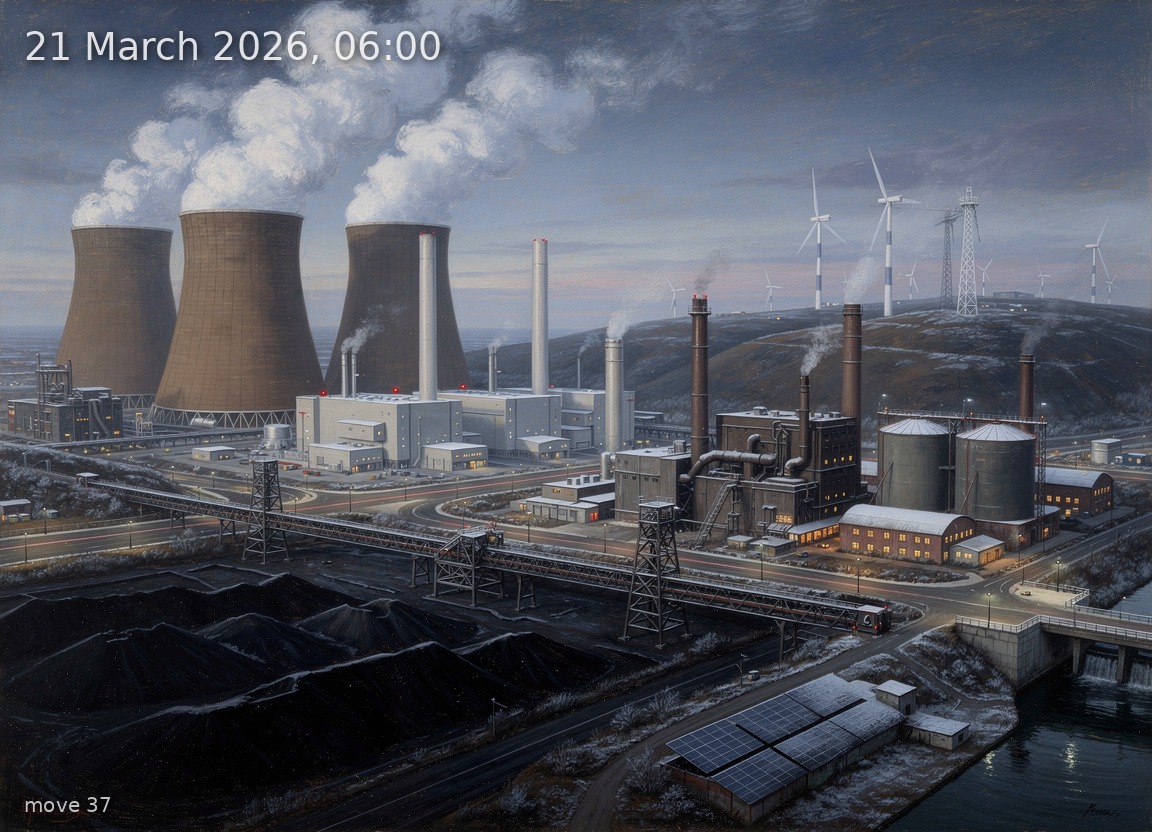
Brown coal, gas, and hard coal dominate a cold, calm pre-dawn hour requiring 9.9 GW of net imports.
Back
Generation mix
Wind onshore 10%
Wind offshore 0%
Solar 1%
Biomass 13%
Hydro 3%
Natural gas 20%
Hard coal 15%
Brown coal 38%
27%
Renewable share
3.4 GW
Wind (on + offshore)
0.5 GW
Solar
34.4 GW
Total generation
-9.8 GW
Net import
142.3 €/MWh
Day-ahead price
-1.0°C / 3 km/h
Temp / Wind speed
Open-Meteo, Kassel (51.3°N 9.5°E)
56% / 0.0 W/m²
Cloud cover / Radiation
522
gCO₂/kWh
Image prompt
Brown coal 13.0 GW dominates the left third of the scene as a massive complex of hyperbolic cooling towers emitting thick white steam plumes into the frigid air; natural gas 6.9 GW fills the center-left as several compact CCGT plants with tall single exhaust stacks venting pale vapor; hard coal 5.2 GW appears center-right as a cluster of industrial boiler buildings with conveyor belts and stockpiles of black coal; biomass 4.4 GW is rendered as medium-scale power plants with cylindrical wood-chip silos and modest chimneys in the right-center; wind onshore 3.3 GW appears as a sparse row of three-blade turbines on a distant ridge, rotors completely still in the calm air; hydro 1.1 GW is suggested by a small dam structure with water channel at the far right edge; solar 0.5 GW is barely hinted by a few dark, frost-covered PV panels on a rooftop, producing nothing. Time is 06:00 in late March — pre-dawn with a deep blue-grey sky, the faintest pale band of cold lavender light on the eastern horizon, no direct sunlight whatsoever, the landscape mostly dark and illuminated by orange sodium streetlights and the industrial glow of the power stations. Temperature is -1°C: frost covers the bare ground and leafless deciduous trees, patches of old snow linger, breath-visible cold atmosphere. Cloud cover is moderate at 56%, visible as grey stratiform layers against the dark pre-dawn sky. The atmosphere is heavy and oppressive, reflecting a high electricity price — a brooding, dense quality to the air with industrial haze settling low. Highly detailed oil painting in the tradition of 19th-century German Romantic landscape painters such as Caspar David Friedrich and Carl Blechen — rich deep color palette of navy, slate grey, amber industrial glow, and cold blue-white steam; visible expressive brushwork; atmospheric depth and aerial perspective with distant towers fading into haze; meticulous technical accuracy on all engineering structures including turbine nacelles, lattice towers, cooling tower parabolic profiles, conveyor systems, and CCGT exhaust geometry. The scene conveys the immense scale of fossil thermal generation shouldering a cold nation's demand in the dark hours before dawn. No text, no labels.