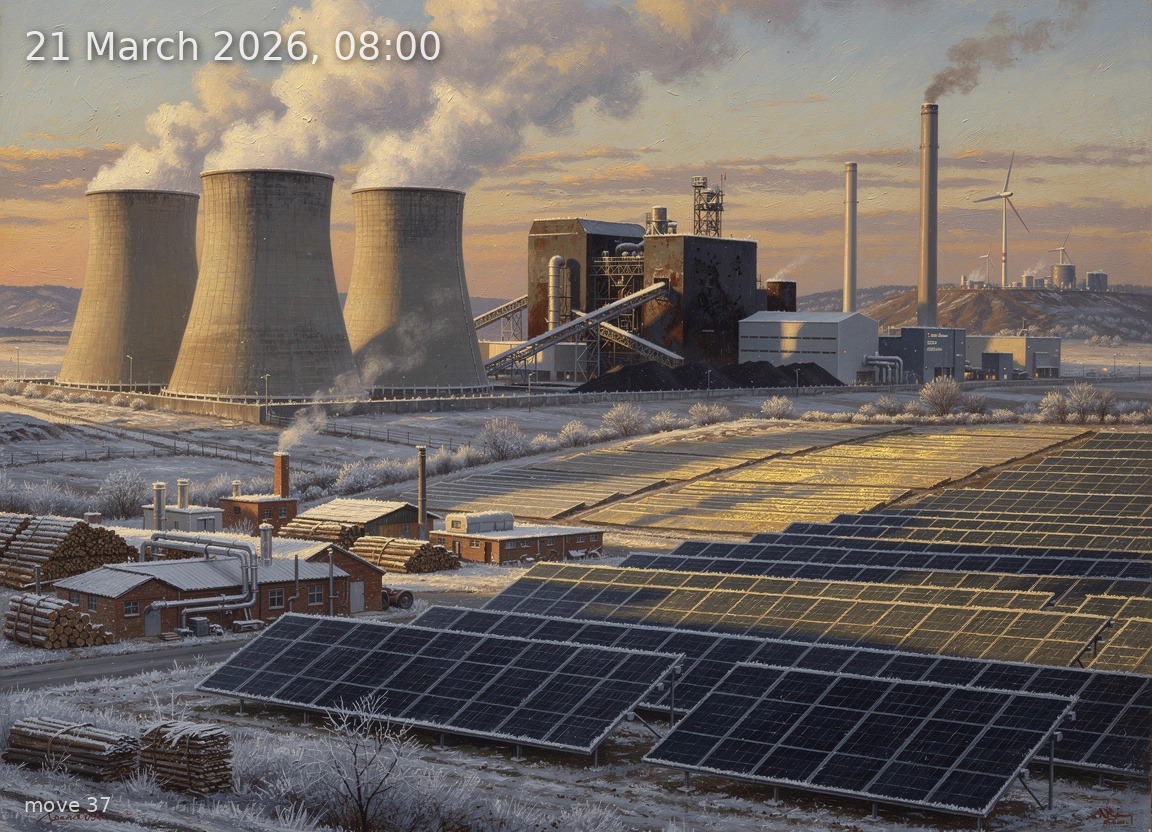
Cold, windless March morning: lignite and coal dominate as weak wind forces heavy thermal dispatch and 7 GW net imports.
Back
Generation mix
Wind onshore 6%
Wind offshore 0%
Solar 26%
Biomass 10%
Hydro 2%
Natural gas 14%
Hard coal 12%
Brown coal 28%
45%
Renewable share
2.9 GW
Wind (on + offshore)
11.4 GW
Solar
43.8 GW
Total generation
-7.1 GW
Net import
127.3 €/MWh
Day-ahead price
0.4°C / 3 km/h
Temp / Wind speed
Open-Meteo, Kassel (51.3°N 9.5°E)
0% / 38.5 W/m²
Cloud cover / Radiation
392
gCO₂/kWh
Image prompt
Brown coal 12.4 GW dominates the left third of the scene as a massive lignite power complex with four hyperbolic cooling towers emitting thick white steam plumes into freezing air; solar 11.4 GW fills the centre-right as expansive fields of aluminium-framed crystalline silicon photovoltaic panels catching low-angle morning sunlight; natural gas 6.3 GW appears as two compact CCGT plants with tall single exhaust stacks and thin heat shimmer behind the coal complex; hard coal 5.2 GW stands as a dark industrial plant with conveyor belts and a single large smokestack beside the lignite towers; biomass 4.5 GW is rendered as a cluster of smaller wood-fuelled CHP facilities with modest chimneys and stacked timber yards; wind onshore 2.7 GW appears as a sparse row of five three-blade turbines on a distant ridge, rotors barely turning in near-still air; hydro 1.1 GW is a small concrete run-of-river weir in a frozen stream in the far background; wind offshore 0.2 GW is a faint pair of turbines barely visible on the far horizon. Time is 08:00 on a late-winter morning: the sun has just cleared the eastern horizon, casting long golden-orange light at a very low angle across a frost-covered central German landscape. The sky is perfectly cloudless, a cold gradient from pale gold at the horizon to deep cerulean blue overhead. Temperature is near freezing — frost covers bare branches, brown stubble fields, and the metal frames of the solar panels glint with ice crystals. The atmosphere feels heavy and oppressive despite the clear sky, conveying expensive energy: a faint industrial haze hangs low, refracting the sunlight into a slightly amber cast. Bare deciduous trees and dormant brown vegetation indicate late winter. Style: highly detailed oil painting in the tradition of 19th-century German Romantic landscape painters such as Caspar David Friedrich and Carl Blechen — rich impasto brushwork, atmospheric depth with careful aerial perspective, dramatic chiaroscuro from the low sun, meticulous engineering detail on every turbine nacelle, cooling tower flute, PV panel junction box, and smokestack rivet. The composition balances sublime natural beauty with the monumental presence of industrial infrastructure. No text, no labels.