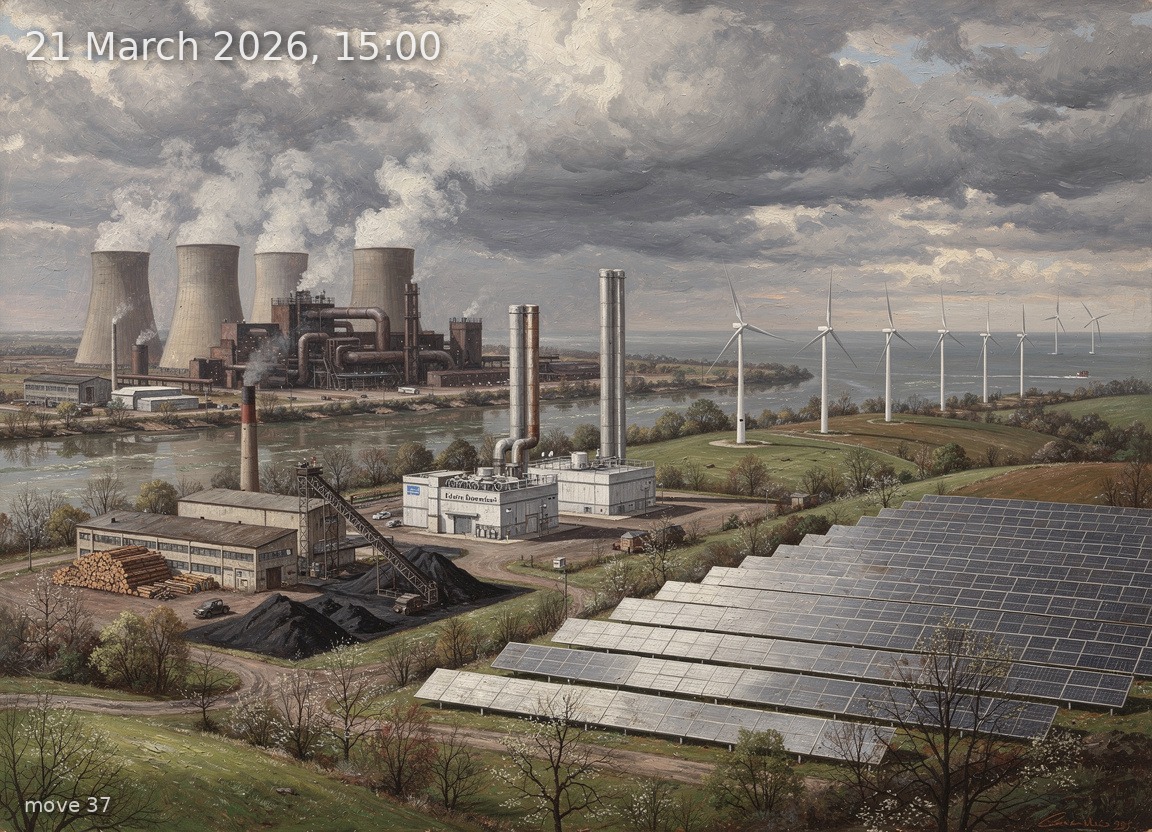
Solar leads at 17.1 GW under heavy overcast, backed by 11.4 GW brown coal and modest wind, driving a 90 EUR/MWh price.
Back
Generation mix
Wind onshore 12%
Wind offshore 1%
Solar 35%
Biomass 8%
Hydro 2%
Natural gas 9%
Hard coal 9%
Brown coal 23%
59%
Renewable share
6.2 GW
Wind (on + offshore)
17.1 GW
Solar
48.6 GW
Total generation
+0.7 GW
Net export
90.0 €/MWh
Day-ahead price
9.4°C / 9 km/h
Temp / Wind speed
Open-Meteo, Kassel (51.3°N 9.5°E)
91% / 43.2 W/m²
Cloud cover / Radiation
303
gCO₂/kWh
Image prompt
Brown coal 11.4 GW dominates the left third of the scene as a sprawling lignite power station with four massive hyperbolic cooling towers emitting thick white steam plumes; hard coal 4.4 GW appears just left of centre as a pair of tall stacks with darker exhaust and a coal conveyor belt; natural gas 4.2 GW sits at centre as two compact CCGT units with slim silvery exhaust stacks and faint heat shimmer; solar 17.1 GW fills the entire right half and middle-ground as vast fields of aluminium-framed crystalline silicon PV panels stretching to the horizon, their surfaces reflecting dull grey-white light from the overcast sky; wind onshore 5.7 GW appears as a scattered line of eight three-blade turbines with white tubular towers on gentle rolling hills behind the solar field, blades turning slowly in light breeze; wind offshore 0.6 GW is a tiny cluster of two turbines barely visible on the far-right horizon; biomass 4.1 GW is a medium-sized wood-chip plant with a single chimney and timber yard in the mid-left background; hydro 1.1 GW is a small run-of-river weir with a low concrete dam visible at the far left edge beside a grey-green river. The sky is almost entirely covered by a thick, oppressive layer of stratocumulus clouds in shades of pewter and slate grey, only the faintest diffuse brightness overhead suggesting a sun somewhere behind the blanket—full mid-afternoon daylight but deeply muted and shadowless. The landscape is early spring in central Germany: bare deciduous trees with the first tiny buds, patches of pale green grass, cool 9°C atmosphere with faint mist near the river. The heavy clouds and high electricity price create a brooding, weighted atmosphere. Rendered as a highly detailed oil painting in the tradition of 19th-century German Romantic landscape art—rich impasto brushwork, atmospheric aerial perspective with haze softening distant towers, a palette of slate blues, warm browns, and cool greens—yet every turbine nacelle, every PV cell grid, every cooling tower hyperbolic curve is rendered with meticulous engineering accuracy. No text, no labels.