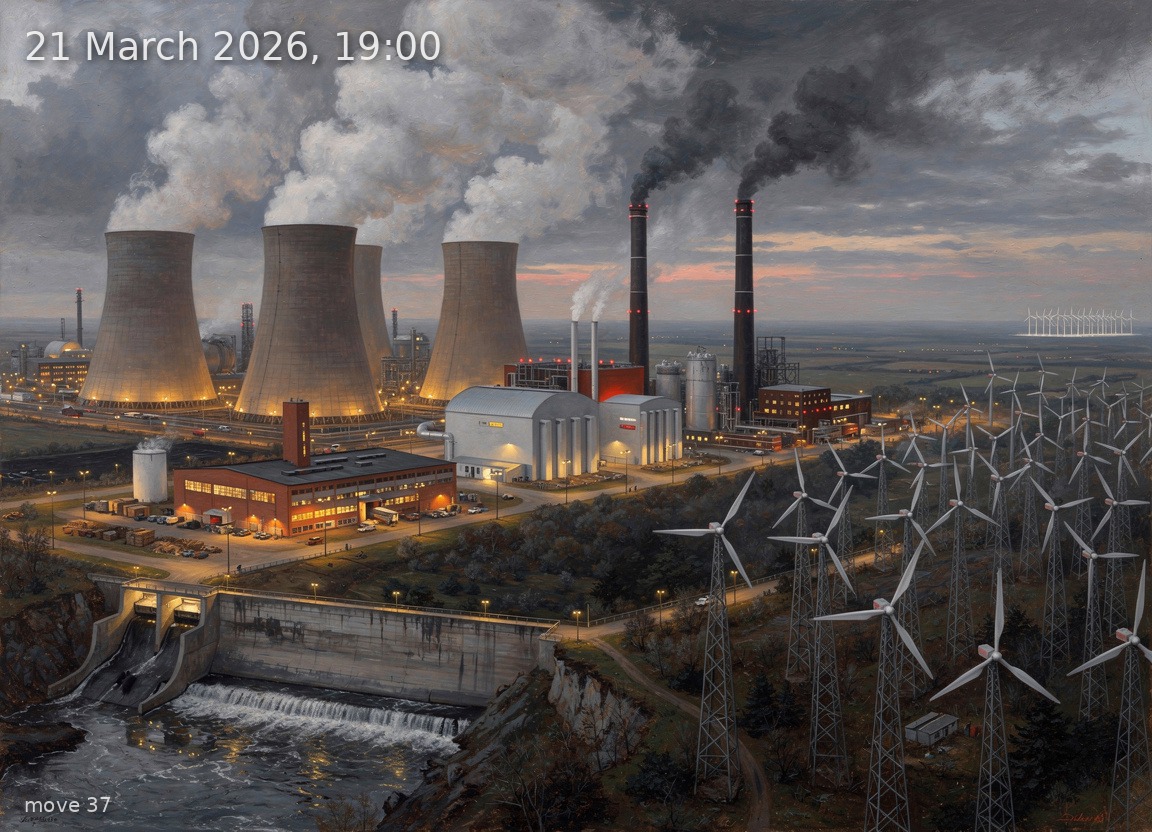
Brown coal and onshore wind lead generation as post-sunset demand drives 9.6 GW net imports and elevated prices.
Back
Generation mix
Wind onshore 28%
Wind offshore 2%
Biomass 11%
Hydro 3%
Natural gas 15%
Hard coal 12%
Brown coal 29%
44%
Renewable share
13.1 GW
Wind (on + offshore)
0.0 GW
Solar
43.2 GW
Total generation
-9.6 GW
Net import
163.1 €/MWh
Day-ahead price
7.6°C / 9 km/h
Temp / Wind speed
Open-Meteo, Kassel (51.3°N 9.5°E)
64% / 0.0 W/m²
Cloud cover / Radiation
403
gCO₂/kWh
Image prompt
Brown coal 12.8 GW dominates the left third of the scene as a sprawling lignite power complex with four massive hyperbolic cooling towers emitting thick steam plumes lit from below by amber industrial lights; hard coal 5.2 GW appears just right of centre as two tall smokestacks with smaller cooling towers; natural gas 6.3 GW occupies the centre as a pair of compact CCGT units with slender exhaust stacks venting thin white vapor; onshore wind 12.1 GW fills the right third of the composition as a deep field of three-blade turbines on lattice towers receding into the distance, blades turning moderately; offshore wind 1.1 GW is suggested by a faint cluster of turbines on a distant horizon line at far right; biomass 4.6 GW appears as a mid-ground wood-chip-fired plant with a single rectangular stack and warm amber glow from its furnace hall; hydro 1.3 GW is a small concrete dam with spillway visible at the far left foreground edge. The sky is a late-dusk scene at 19:00 in March—a narrow band of deep burnt-orange and magenta hugs the western horizon, rapidly giving way upward to darkening steel-blue and near-black overhead, with 64% broken cloud cover catching the last fading colour. No sunlight remains on the land; all foreground detail is illuminated by sodium-yellow streetlights, orange industrial floodlights, and the red aircraft warning lights atop stacks and turbine nacelles. The atmosphere is heavy and oppressive, reflecting the high electricity price—low haze clings to the industrial structures, steam merges with cloud. Early-spring landscape: bare deciduous trees with the faintest hint of budding, dormant brown-green grass, patches of cold mud. Temperature 7.6°C conveyed by visible breath-like condensation near ground-level workers and slight frost on metal railings. High-voltage transmission pylons recede toward the eastern horizon, symbolising import flows. Style: highly detailed oil painting in the tradition of 19th-century German Romantic landscape painters—rich, luminous colour contrasts between industrial amber glow and the cooling twilight sky, visible confident brushwork, atmospheric depth with sfumato haze, meticulous engineering accuracy on every turbine nacelle, cooling tower profile, and stack detail. No text, no labels.