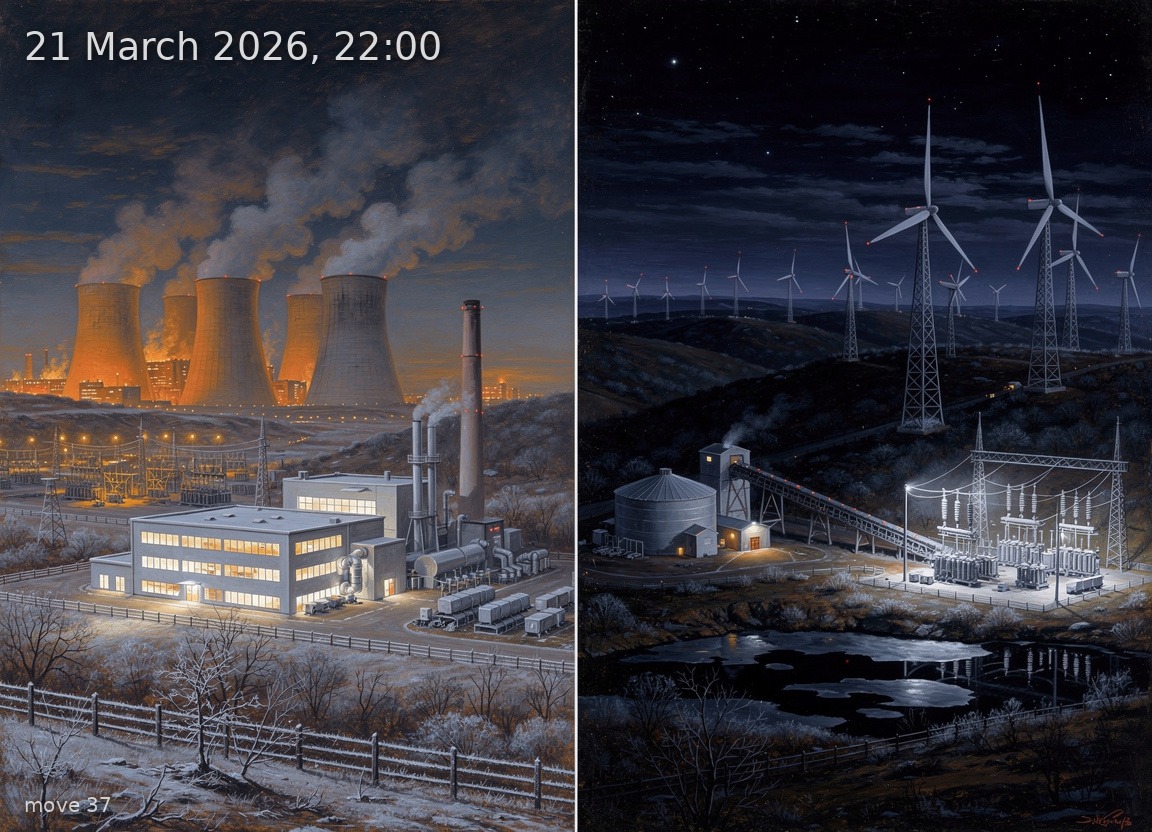
Wind onshore and brown coal jointly anchor a tight nocturnal grid under cold, clear March skies.
Back
Generation mix
Wind onshore 35%
Wind offshore 3%
Biomass 9%
Hydro 2%
Natural gas 12%
Hard coal 11%
Brown coal 28%
49%
Renewable share
17.0 GW
Wind (on + offshore)
0.0 GW
Solar
45.4 GW
Total generation
-0.7 GW
Net import
120.2 €/MWh
Day-ahead price
1.8°C / 8 km/h
Temp / Wind speed
Open-Meteo, Kassel (51.3°N 9.5°E)
16% / 0.0 W/m²
Cloud cover / Radiation
371
gCO₂/kWh
Image prompt
Wind onshore 15.7 GW fills the right third of the scene as dozens of towering three-blade wind turbines with white nacelles and lattice towers stretching across dark rolling hills, their red aviation warning lights blinking against the night sky; brown coal 12.7 GW dominates the left third as a massive lignite power station complex with four immense hyperbolic cooling towers emitting thick pale steam plumes lit from below by sodium-orange industrial lighting; natural gas 5.3 GW appears centre-left as a compact CCGT plant with slender exhaust stacks venting thin white vapour, its turbine hall glowing through tall windows; hard coal 5.1 GW sits adjacent as a blocky station with a single large chimney and conveyor belts visible under floodlights; biomass 4.2 GW is rendered as a mid-sized facility with a rounded wood-chip silo and modest steam stack near the centre; hydro 1.1 GW appears as a small dam and powerhouse nestled in a valley in the distant centre-right, its spillway faintly illuminated; wind offshore 1.3 GW is suggested as a thin row of tiny turbine silhouettes on the far-right horizon above a dark sea line. The sky is completely black to deep navy, no twilight, no glow on the horizon — a true 10 PM March night; scattered bright stars peek through 16% thin cloud wisps. Frost glistens on bare winter ground and leafless trees; temperature near freezing is conveyed by rime on fences and frozen puddles. The atmosphere feels heavy and oppressive, reflecting a high electricity price — low thick haze clings around the industrial complexes, sodium light casts amber halos. Rendered as a highly detailed oil painting in the tradition of 19th-century German Romantic landscape painters — rich, dark tonal palette of indigo, umber, and burnt orange, visible impasto brushwork, dramatic chiaroscuro from artificial lighting against absolute darkness, atmospheric depth with misty middle-ground recession. Every energy technology is rendered with meticulous engineering accuracy: turbine blade profiles, cooling tower parabolic geometry, CCGT exhaust dampers, conveyor gantries, substation transformer yards with insulators. The painting evokes Caspar David Friedrich meeting industrial sublime. No text, no labels.