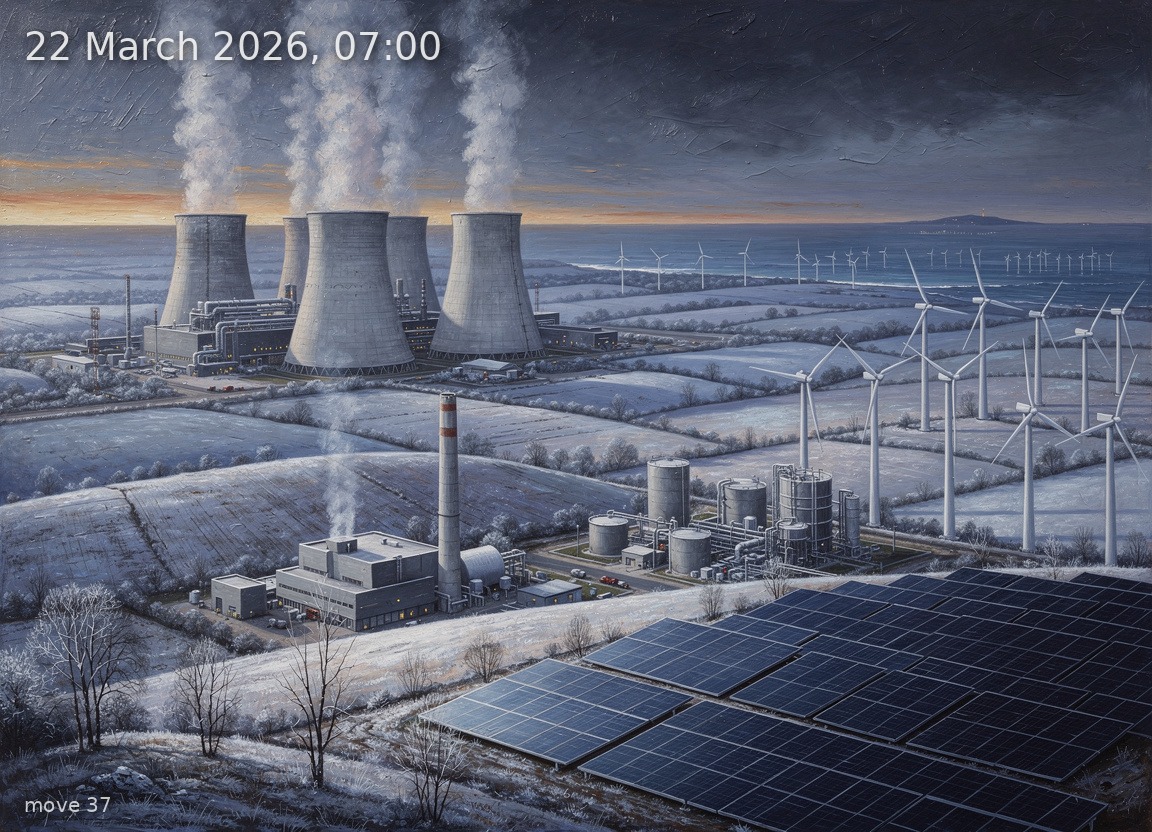
Wind and brown coal anchor a 64% renewable grid as cold dawn lifts over Germany.
Back
Generation mix
Wind onshore 30%
Wind offshore 3%
Solar 19%
Biomass 10%
Hydro 2%
Natural gas 9%
Hard coal 4%
Brown coal 23%
64%
Renewable share
14.3 GW
Wind (on + offshore)
8.6 GW
Solar
44.2 GW
Total generation
+0.5 GW
Net export
84.7 €/MWh
Day-ahead price
1.5°C / 4 km/h
Temp / Wind speed
Open-Meteo, Kassel (51.3°N 9.5°E)
0% / 2.2 W/m²
Cloud cover / Radiation
260
gCO₂/kWh
Image prompt
Wind onshore 13.2 GW dominates the right half of the scene as dozens of three-blade turbines with white tubular towers and nacelles stretching across rolling frost-covered fields toward the horizon; brown coal 10.0 GW occupies the left quarter as a massive lignite power station with four hyperbolic cooling towers emitting thick white steam plumes into the cold air; solar 8.6 GW appears as a broad field of aluminium-framed crystalline silicon photovoltaic panels in the centre-right foreground, their surfaces catching the faintest pre-dawn glow; biomass 4.4 GW is rendered as a mid-ground industrial facility with cylindrical digesters and a modest stack; natural gas 4.0 GW sits centre-left as a compact CCGT plant with a single tall exhaust stack venting a thin heat shimmer; hard coal 1.8 GW appears as a smaller coal-fired station with a single square cooling tower near the lignite complex; wind offshore 1.2 GW is suggested by a distant row of turbines on the far-right horizon above a faint coastal line; hydro 1.0 GW is a small concrete dam visible in a valley on the far left. TIME AND LIGHT: 07:00 in late March — pre-dawn deep blue-grey sky with the faintest pale salmon line along the eastern horizon, no direct sunlight yet, all structures lit by residual darkness and the first cold luminosity of dawn. The ground is covered in hoarfrost, bare deciduous trees with no leaves, temperature near freezing. The sky is perfectly clear with zero clouds, stars still faintly visible in the upper western sky. ATMOSPHERE: the cold air is dense and still, wind speed low, steam from the cooling towers rises vertically in heavy columns; the overall mood is heavy and oppressive reflecting the elevated electricity price — a weighty industrial dawn. STYLE: highly detailed oil painting in the tradition of Caspar David Friedrich and Carl Blechen — rich deep blues, slate greys, warm amber at the horizon, visible impasto brushwork, atmospheric depth with aerial perspective fading distant turbines into blue haze, meticulous engineering detail on every turbine nacelle, every panel frame, every cooling tower's parabolic curvature and concrete texture. No text, no labels, no humans.