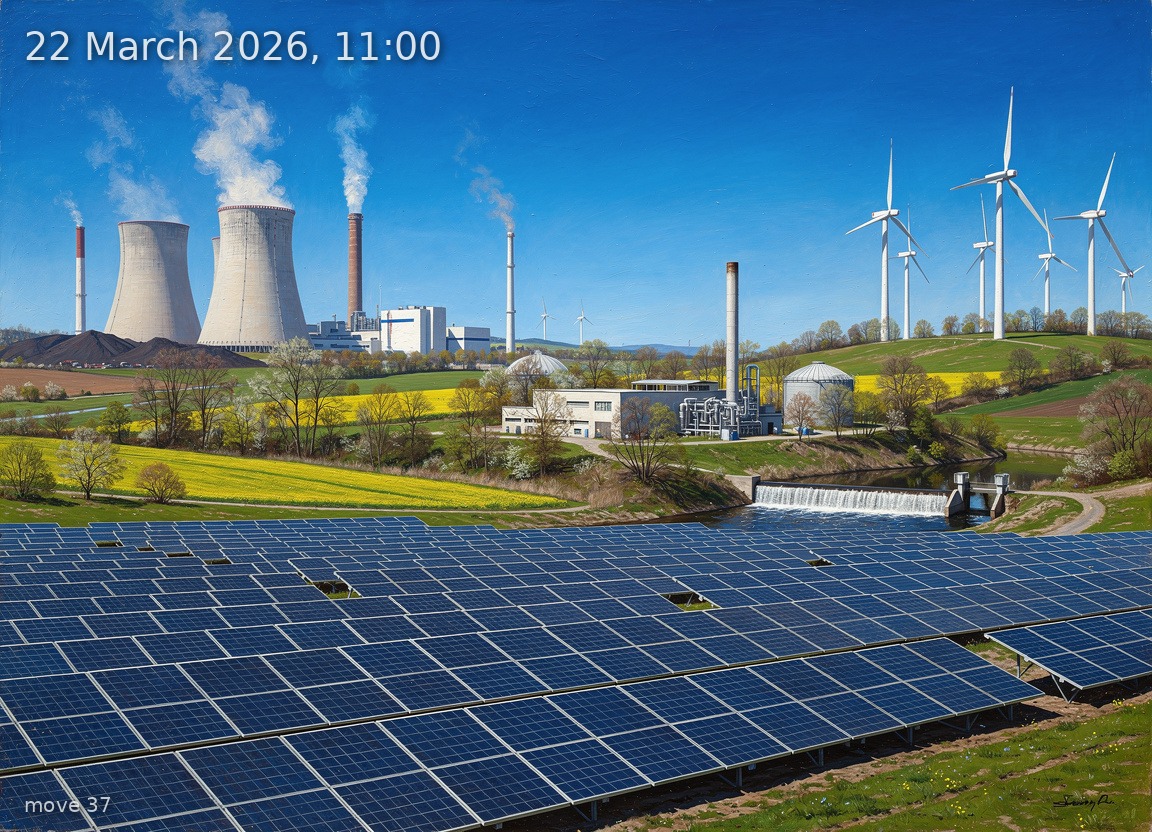
Solar at 46.4 GW under cloudless skies drives massive net exports and a mildly negative price.
Back
Generation mix
Wind onshore 8%
Wind offshore 1%
Solar 70%
Biomass 6%
Hydro 2%
Natural gas 4%
Hard coal 2%
Brown coal 8%
87%
Renewable share
6.1 GW
Wind (on + offshore)
46.4 GW
Solar
66.7 GW
Total generation
+16.2 GW
Net export
-4.4 €/MWh
Day-ahead price
10.8°C / 12 km/h
Temp / Wind speed
Open-Meteo, Kassel (51.3°N 9.5°E)
0% / 419.8 W/m²
Cloud cover / Radiation
95
gCO₂/kWh
Image prompt
Solar 46.4 GW dominates the scene as an immense expanse of crystalline silicon photovoltaic panels stretching across rolling central German farmland, occupying roughly two-thirds of the composition, their aluminium frames glinting under a brilliant, cloudless midday sun with sharp shadows. Wind onshore 5.6 GW appears as a cluster of modern three-blade turbines on gentle hills to the right, rotors turning slowly in a light breeze. Brown coal 5.2 GW is rendered as a group of massive hyperbolic cooling towers on the far left horizon, thin white steam plumes rising vertically into the still air. Biomass 4.1 GW is depicted as a medium-sized industrial facility with a rounded silo and modest exhaust stack nestled among bare-budding March trees. Natural gas 2.6 GW appears as a compact combined-cycle gas turbine plant with a single tall exhaust stack, positioned between the coal towers and the solar field. Hard coal 1.1 GW is a single smaller stack with a faint grey exhaust plume beside the brown coal complex. Hydro 1.2 GW is suggested by a small dam and spillway visible in a valley in the middle distance. Wind offshore 0.5 GW is hinted at by tiny turbine silhouettes on the far northern horizon. The sky is completely clear, deep cerulean blue, with intense direct sunlight casting crisp shadows — calm and open, reflecting the negative electricity price. Early spring vegetation: fields showing first green growth, deciduous trees with swelling buds but mostly bare branches, patches of rapeseed not yet in bloom. Temperature around 11°C suggested by light jackets on two tiny human figures inspecting PV panels. Style: highly detailed oil painting in the tradition of 19th-century German Romantic landscape painting — rich saturated colour, visible impasto brushwork, luminous atmospheric depth recalling Caspar David Friedrich and Carl Blechen — yet with meticulous engineering accuracy in every turbine nacelle, PV cell grid pattern, cooling tower curvature, and CCGT exhaust geometry. No text, no labels.