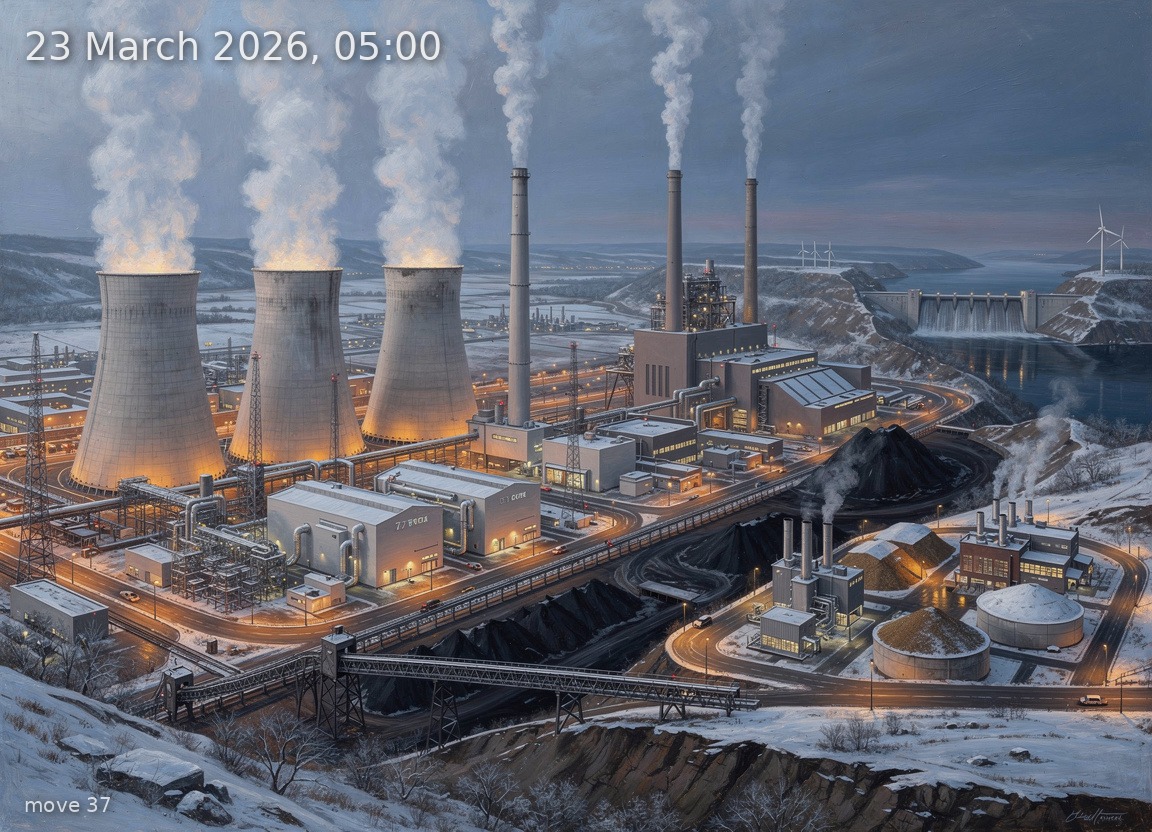
Brown coal, gas, and hard coal dominate a cold, windless pre-dawn grid requiring 16 GW of net imports.
Back
Generation mix
Wind onshore 3%
Wind offshore 1%
Solar 0%
Biomass 13%
Hydro 4%
Natural gas 24%
Hard coal 16%
Brown coal 40%
21%
Renewable share
1.3 GW
Wind (on + offshore)
0.0 GW
Solar
32.2 GW
Total generation
-16.2 GW
Net import
155.7 €/MWh
Day-ahead price
-0.9°C / 3 km/h
Temp / Wind speed
Open-Meteo, Kassel (51.3°N 9.5°E)
56% / 0.0 W/m²
Cloud cover / Radiation
560
gCO₂/kWh
Records
#1
Coal Hour
Image prompt
Brown coal 12.7 GW dominates the left third of the scene as a massive lignite power station complex with five hyperbolic cooling towers emitting thick white steam plumes rising vertically into still air; natural gas 7.7 GW occupies the centre-left as three compact CCGT units with tall single exhaust stacks and smaller heat-recovery steam generators; hard coal 5.1 GW appears centre-right as a coal-fired plant with two large chimneys and conveyor belts feeding dark fuel; biomass 4.1 GW is rendered as a cluster of smaller industrial boiler buildings with wood-chip storage domes and moderate stack emissions to the right; hydro 1.3 GW appears as a concrete dam with spillway in the far right background nestled in a valley; wind onshore 1.0 GW is shown as two or three barely-turning three-blade turbines on lattice towers on a distant ridge, rotors nearly still in the calm air; wind offshore 0.4 GW is a single faint turbine silhouette on the far horizon. Pre-dawn hour at 05:00: the sky is deep blue-grey with the faintest hint of pale light at the eastern horizon, no direct sunlight, no sunshine, no solar panels anywhere. Temperature is below zero — frost covers the barren late-winter ground, bare deciduous trees with icy branches, patches of frozen puddles reflecting artificial light. Wind speed is nearly zero, so all smoke and steam rises straight upward. The atmosphere is heavy and oppressive, conveying expensive electricity — a thick haze of condensation and industrial emissions hangs low over the landscape. Sodium-orange streetlights and yellowish industrial lighting illuminate the power stations from below, casting warm glows against the cold blue pre-dawn sky. Painted as a highly detailed oil painting in the tradition of 19th-century German Romantic landscape painters — Caspar David Friedrich meets industrial sublime — with rich, saturated colour, visible confident brushwork, dramatic atmospheric depth, and meticulous engineering accuracy on every turbine nacelle, cooling tower hyperbolic curve, and CCGT exhaust stack. No text, no labels.