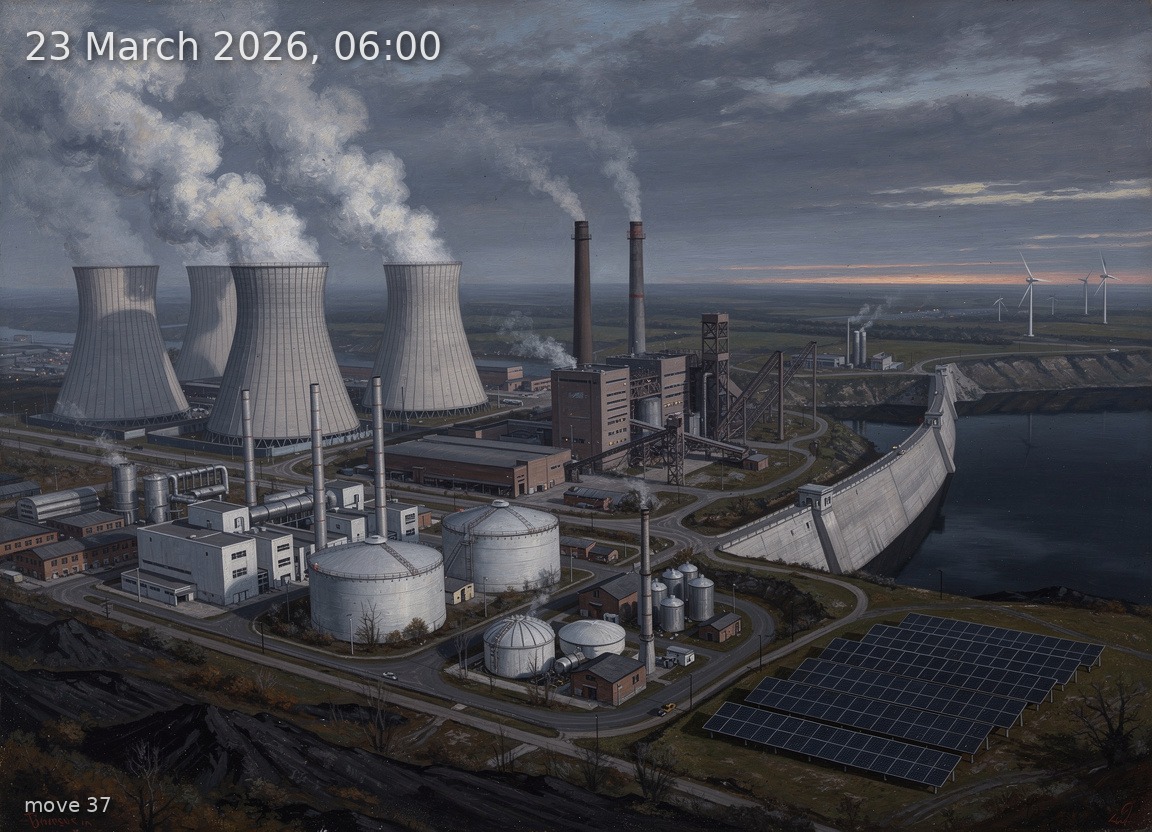
Brown coal and gas dominate as near-zero wind and freezing temperatures force 21 GW of net imports.
Back
Generation mix
Wind onshore 3%
Wind offshore 2%
Solar 3%
Biomass 13%
Hydro 4%
Natural gas 23%
Hard coal 15%
Brown coal 37%
25%
Renewable share
1.6 GW
Wind (on + offshore)
1.1 GW
Solar
34.0 GW
Total generation
-21.4 GW
Net import
182.3 €/MWh
Day-ahead price
-1.3°C / 1 km/h
Temp / Wind speed
Open-Meteo, Kassel (51.3°N 9.5°E)
62% / 0.0 W/m²
Cloud cover / Radiation
532
gCO₂/kWh
Image prompt
Brown coal 12.7 GW dominates the left third of the scene as a massive lignite power complex with five hyperbolic cooling towers trailing thick white steam plumes into the grey pre-dawn sky; natural gas 7.8 GW fills the centre-left as three compact CCGT units with tall single exhaust stacks venting thin heat shimmer; hard coal 5.1 GW appears centre-right as a classic coal-fired station with rectangular boiler houses and twin chimneys; biomass 4.3 GW is rendered as a cluster of smaller industrial plants with rounded storage silos and modest stacks; hydro 1.4 GW appears as a concrete dam with a dark reservoir in the mid-ground right; solar 1.1 GW is shown as a small field of aluminium-framed crystalline silicon panels, dim and unlit, angled uselessly under overcast skies; wind onshore 0.9 GW and offshore 0.7 GW are depicted as a handful of three-blade turbines on lattice and tubular towers, blades barely turning in dead-calm air, scattered along the far right horizon. Time is early dawn, 06:00 in late March: the sky is deep blue-grey with the faintest pale strip of pre-dawn light along the eastern horizon, no direct sunlight, ambient light barely revealing shapes. Temperature is below freezing — frost covers the barren ground, leafless trees, and frozen puddles reflect faint industrial glow. The air feels heavy and oppressive, hazy with steam and emissions, evoking the high electricity price. Overhead transmission lines with lattice pylons stretch toward the horizon in multiple directions, symbolising massive import flows. Style: highly detailed oil painting in the tradition of 19th-century German Romantic landscape painters — rich, dark colour palette of Prussian blue, slate grey, ochre, and burnt sienna; visible impasto brushwork; atmospheric depth with layers of industrial haze; meticulous engineering accuracy on every turbine nacelle, cooling tower profile, and smokestack; the scene feels monumental and brooding, a masterwork of industrial landscape art. No text, no labels.