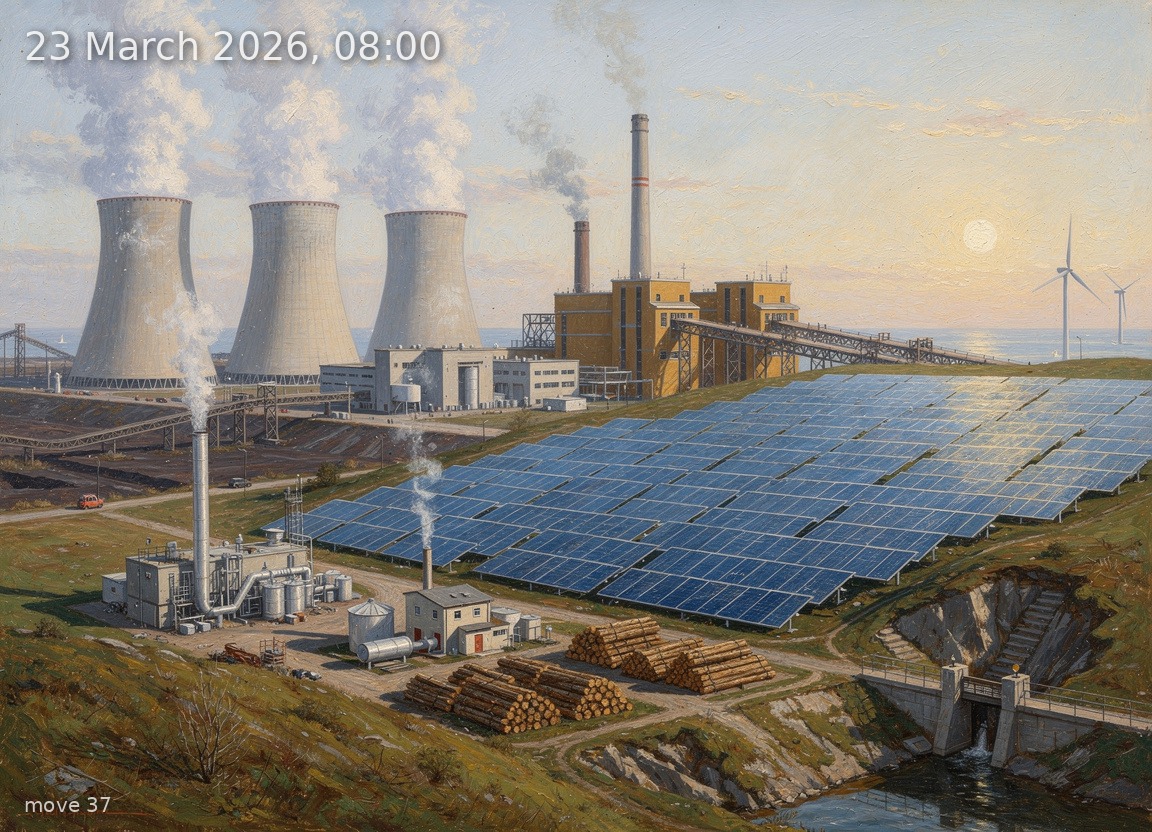
Strong solar but near-zero wind forces heavy coal and gas dispatch; 12.1 GW net imports fill the gap.
Back
Generation mix
Wind onshore 2%
Wind offshore 1%
Solar 39%
Biomass 9%
Hydro 3%
Natural gas 15%
Hard coal 10%
Brown coal 23%
53%
Renewable share
1.2 GW
Wind (on + offshore)
20.1 GW
Solar
51.2 GW
Total generation
-12.1 GW
Net import
147.6 €/MWh
Day-ahead price
-0.0°C / 1 km/h
Temp / Wind speed
Open-Meteo, Kassel (51.3°N 9.5°E)
57% / 22.8 W/m²
Cloud cover / Radiation
333
gCO₂/kWh
Image prompt
Brown coal 11.6 GW dominates the left third of the scene as a massive lignite power complex with four hyperbolic cooling towers emitting thick white steam plumes into the still cold air; natural gas 7.5 GW fills the centre-left as a row of compact CCGT plants with tall single exhaust stacks releasing thin heat shimmer; hard coal 5.1 GW appears centre-right as a classical coal station with rectangular boiler houses and twin chimneys trailing grey smoke; solar 20.1 GW spans the entire right third and middle distance as vast fields of aluminium-framed crystalline silicon photovoltaic panels catching pale morning light, their blue surfaces glinting softly; biomass 4.4 GW is rendered as a wood-fired CHP facility with a modest stack and stored timber rounds visible in a yard; hydro 1.3 GW appears as a small dam and penstock structure nestled in a valley fold at far right; wind onshore 0.8 GW is a pair of barely-turning three-blade turbines on a distant ridge, rotors nearly still; wind offshore 0.4 GW is a single turbine silhouette on the far horizon. The sky is a late-March 08:00 daytime sky over central Germany — sun low in the east, partially veiled by 57 percent cloud cover creating a milky, hazy brightness with intermittent pale rays breaking through; the atmosphere feels heavy and oppressive reflecting the high electricity price. The landscape is flat to gently rolling North German plain, bare deciduous trees and frost-whitened fields at 0 °C, patches of old snow in shaded hollows, no wind motion in grass or branches. Rendered as a highly detailed oil painting in the tradition of 19th-century German Romantic landscape masters — rich impasto brushwork, atmospheric depth with aerial perspective fading the distant turbines into haze, warm industrial tones of ochre and umber from the coal plants contrasting with the cool blue-grey of the PV fields and the pale wintry sky. Meticulous engineering detail on every technology: visible nacelle housings, lattice tower structures, panel junction boxes, cooling tower parabolic profiles with condensation drift. No text, no labels, no human figures.