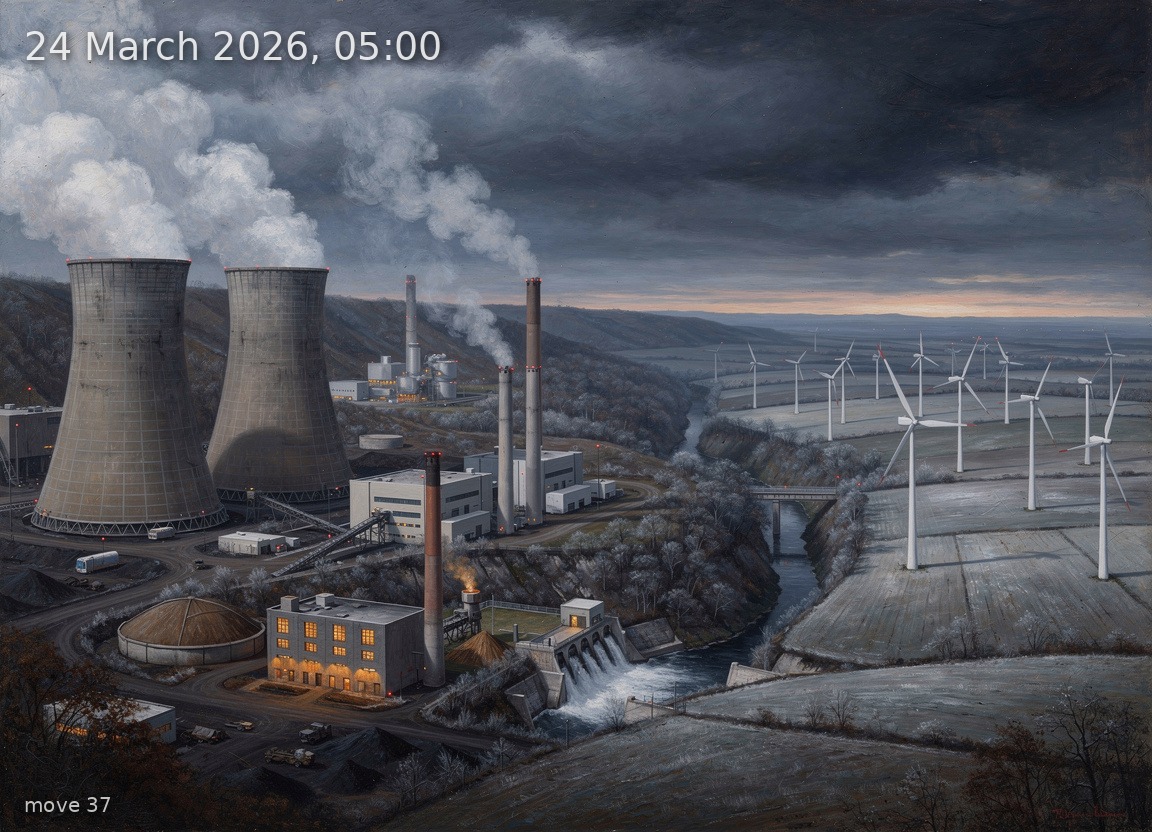
Wind and brown coal dominate a cold, dark pre-dawn grid as gas firms the 101 EUR/MWh clearing price.
Back
Generation mix
Wind onshore 30%
Wind offshore 12%
Solar 0%
Biomass 9%
Hydro 2%
Natural gas 16%
Hard coal 8%
Brown coal 24%
52%
Renewable share
19.8 GW
Wind (on + offshore)
0.0 GW
Solar
47.5 GW
Total generation
+3.8 GW
Net export
101.0 €/MWh
Day-ahead price
1.8°C / 3 km/h
Temp / Wind speed
Open-Meteo, Kassel (51.3°N 9.5°E)
100% / 0.0 W/m²
Cloud cover / Radiation
333
gCO₂/kWh
Image prompt
Brown coal 11.2 GW occupies the left third of the scene as a massive lignite power station with four hyperbolic cooling towers emitting dense white steam plumes into the cold air; natural gas 7.4 GW fills the centre-left as two compact CCGT units with tall single exhaust stacks venting thin grey plumes; wind onshore 14.1 GW spans the right half as dozens of tall three-blade turbines receding into the distance on rolling farmland, their red aviation warning lights blinking faintly; wind offshore 5.7 GW is suggested by a cluster of turbines visible on the far-right horizon above a dark sea; hard coal 3.9 GW appears as a smaller coal plant with a single squat stack and coal conveyors beside the brown coal complex; biomass 4.1 GW is rendered as a mid-sized industrial boiler facility with a wood-chip storage dome and a single chimney glowing warmly; hydro 1.0 GW is a small dam and powerhouse nestled in a valley in the middle distance. Time is 05:00 in late March — the sky is deep blue-grey pre-dawn, no direct sunlight, no twilight glow, only the faintest pale hint on the eastern horizon; absolutely no solar panels visible anywhere. Temperature near freezing: frost on the bare fields and leafless trees, patches of old snow. Overcast sky at 100% cloud cover presses down heavily, lending an oppressive weight reflecting the high electricity price. Sodium streetlights cast amber pools along an access road winding between the facilities. Visible breath-like mist around infrastructure. Style: highly detailed oil painting in the tradition of 19th-century German Romantic landscape painters — rich, dark palette of Prussian blue, umber, ochre, and warm amber; visible impasto brushwork; atmospheric depth and sfumato in the distant turbine rows; meticulous engineering detail on turbine nacelles, lattice towers, cooling tower parabolic profiles, CCGT stacks, and coal conveyors. The scene evokes Caspar David Friedrich's sublime scale but applied to the modern industrial energy landscape. No text, no labels.