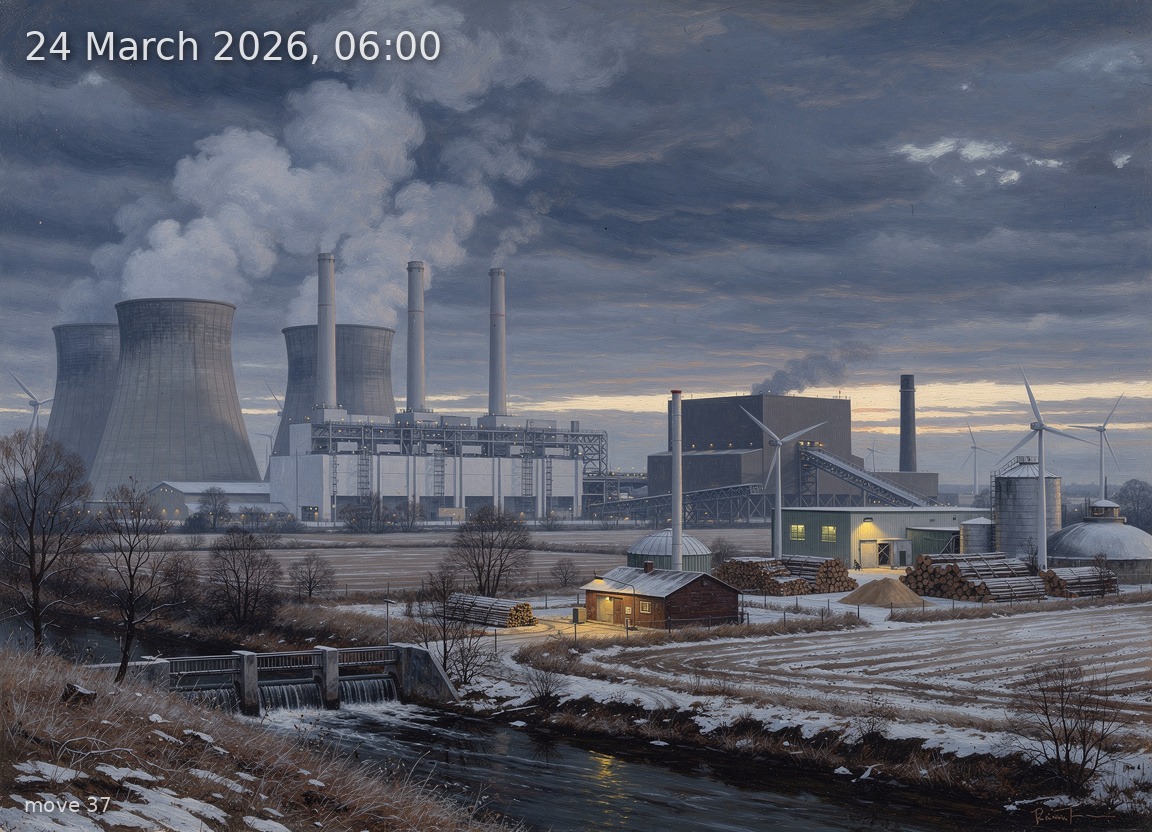
Wind leads at 23.6 GW but cold, overcast dawn demands heavy coal and gas dispatch with 3.3 GW net imports.
Back
Generation mix
Wind onshore 32%
Wind offshore 12%
Solar 2%
Biomass 8%
Hydro 2%
Natural gas 15%
Hard coal 7%
Brown coal 22%
56%
Renewable share
23.5 GW
Wind (on + offshore)
1.0 GW
Solar
53.6 GW
Total generation
-3.4 GW
Net import
110.8 €/MWh
Day-ahead price
2.0°C / 4 km/h
Temp / Wind speed
Open-Meteo, Kassel (51.3°N 9.5°E)
98% / 0.0 W/m²
Cloud cover / Radiation
308
gCO₂/kWh
Image prompt
Brown coal 11.7 GW dominates the left quarter of the scene as a cluster of massive hyperbolic cooling towers rising from a lignite power station, dense white steam plumes curling upward into the heavy sky; natural gas 8.1 GW fills the left-centre as a row of compact CCGT plants with tall single exhaust stacks venting thin grey plumes; hard coal 3.9 GW appears as a smaller coal-fired station with a single rectangular boiler house and squat chimney behind the gas units; wind onshore 17.3 GW spans the entire right half as dozens of three-blade turbines on lattice and tubular steel towers stretching across rolling farmland, blades turning slowly in light wind; wind offshore 6.3 GW is visible in the far-right background as a line of turbines standing in a grey sea on the distant horizon; biomass 4.2 GW appears as a modest wood-fired CHP plant with a small smokestack and timber yard in the mid-ground; hydro 1.0 GW is represented by a small run-of-river weir and powerhouse along a dark stream in the foreground; solar 1.0 GW is a barely visible small array of aluminium-framed crystalline silicon panels on a barn roof, catching no light whatsoever. Time of day is pre-dawn, 06:00 in late March: the sky is deep blue-grey with the faintest pale band of cold light along the eastern horizon, no direct sunlight, no warm colours — only the cool indigo of early twilight. Temperature is 2°C: frost coats the brown dormant grass and bare deciduous trees; patches of old snow linger in furrows. Cloud cover is 98%, forming a low, oppressive, unbroken ceiling of stratus that presses down on the landscape, reinforcing an atmosphere of heaviness matching the high electricity price. Wind is gentle at 3.9 km/h — turbine blades move but without urgency, bare branches barely stir. Artificial sodium-orange lights glow from the industrial facilities, reflected faintly in puddles and the stream. Style: highly detailed oil painting in the tradition of 19th-century German Romantic landscape painters — Caspar David Friedrich's brooding atmospherics combined with Adolph Menzel's industrial precision. Rich layered colour in deep indigos, slate greys, warm industrial oranges. Visible confident brushwork, atmospheric aerial perspective with haze softening distant turbines. Meticulous engineering detail on every technology — nacelle housings, rotor hubs, cooling tower fluting, condenser exhaust geometry. The composition reads as a monumental panoramic masterwork of Germany's energy-industrial dawn. No text, no labels, no human figures.