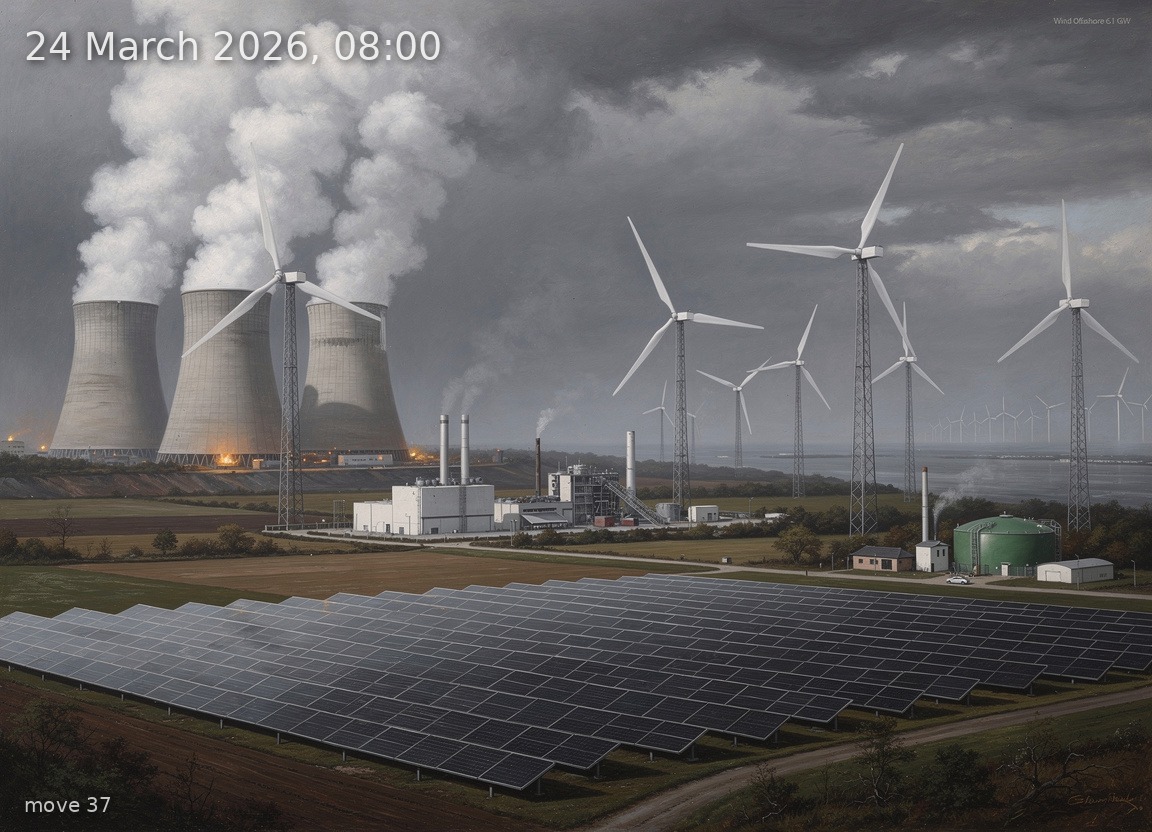
Wind leads at 25 GW with coal and gas firming a cold, overcast March morning driving elevated prices.
Back
Generation mix
Wind onshore 30%
Wind offshore 10%
Solar 22%
Biomass 7%
Hydro 2%
Natural gas 8%
Hard coal 5%
Brown coal 16%
71%
Renewable share
25.0 GW
Wind (on + offshore)
13.9 GW
Solar
62.6 GW
Total generation
-1.6 GW
Net import
97.5 €/MWh
Day-ahead price
3.6°C / 7 km/h
Temp / Wind speed
Open-Meteo, Kassel (51.3°N 9.5°E)
100% / 19.2 W/m²
Cloud cover / Radiation
209
gCO₂/kWh
Image prompt
Wind onshore 18.9 GW dominates the right half of the scene as dozens of tall three-blade turbines on lattice towers stretching across rolling central German hills; wind offshore 6.1 GW appears as a distant line of larger turbines barely visible through haze on the far-right horizon. Brown coal 9.7 GW occupies the left quarter as a massive lignite power station with three hyperbolic cooling towers emitting thick white steam plumes rising into the grey sky. Natural gas 5.2 GW sits left of centre as two compact CCGT units with slender single exhaust stacks venting thin transparent heat shimmer. Hard coal 3.4 GW appears as a smaller coal plant behind the gas units, with a rectangular boiler house and a single shorter cooling tower. Solar 13.9 GW fills the centre-right foreground as extensive rows of aluminium-framed crystalline silicon PV panels on a flat agricultural field, their surfaces reflecting only diffuse grey light—no sunlight or shadows. Biomass 4.3 GW is a modest biogas facility with a green domed digester and a small stack near the wind turbines. Hydro 1.1 GW appears as a small run-of-river weir with a low concrete dam barely visible in the middle distance along a river crossing the scene. Time is 08:00 in late March: full daylight but entirely overcast with a heavy, low, uniform 100% cloud ceiling in shades of slate grey and dull pewter—no blue sky visible, no direct sun, no sharp shadows anywhere. Temperature near freezing: bare deciduous trees with no leaves, brown dormant grass, patches of frost on the ground and rooftops. Wind is light at 6.6 km/h so turbine blades turn slowly. The atmosphere feels heavy and oppressive, reflecting the high electricity price—thick air, muted colours, a sense of industrial weight pressing down on the landscape. Style: highly detailed oil painting in the tradition of Caspar David Friedrich and Carl Blechen—rich tonal range from warm ochres in the coal station glow to cool blue-greys in the overcast sky, visible confident brushwork, atmospheric depth with haze softening distant turbines, meticulous engineering accuracy on every nacelle, panel frame, cooling tower curve, and exhaust stack. No text, no labels.