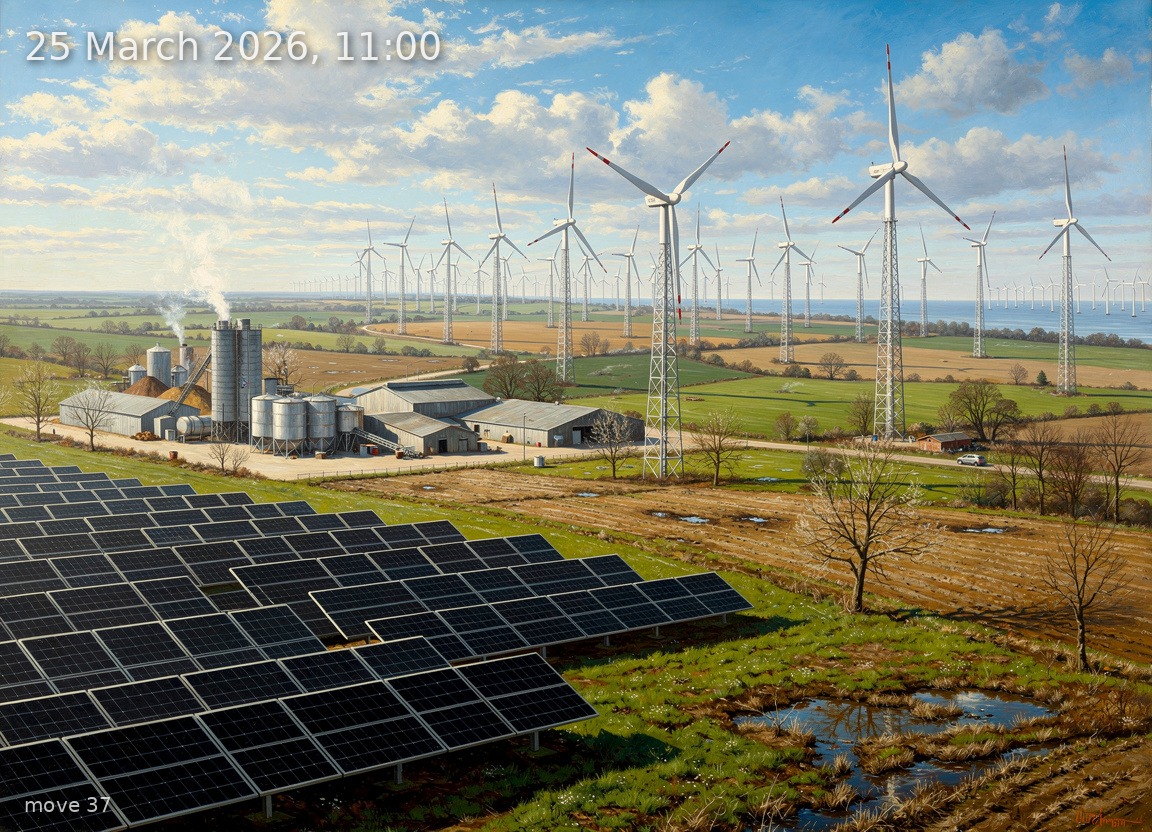
Onshore wind at 39 GW and 18 GW solar drive 89% renewable share, pushing prices to zero with 8.6 GW net export.
Back
Generation mix
Wind onshore 50%
Wind offshore 9%
Solar 23%
Biomass 5%
Hydro 1%
Natural gas 3%
Hard coal 3%
Brown coal 4%
89%
Renewable share
46.1 GW
Wind (on + offshore)
18.0 GW
Solar
77.6 GW
Total generation
+8.6 GW
Net export
-0.0 €/MWh
Day-ahead price
8.3°C / 23 km/h
Temp / Wind speed
Open-Meteo, Kassel (51.3°N 9.5°E)
28% / 226.0 W/m²
Cloud cover / Radiation
74
gCO₂/kWh
Records
#2
Storm Force
Image prompt
Wind onshore 39.1 GW dominates the scene, filling roughly half the canvas from centre to right as an immense field of hundreds of three-blade turbines on tall lattice and tubular towers stretching to the horizon across gently rolling green-brown early-spring farmland, rotors spinning briskly in strong wind. Wind offshore 7.0 GW appears in the far right background as a line of turbines rising from a pale strip of North Sea visible on the distant horizon. Solar 18.0 GW occupies the lower-left foreground and middle ground as vast arrays of aluminium-framed crystalline silicon photovoltaic panels angled toward a high late-morning sun, glinting with reflections. Biomass 4.0 GW is rendered as a cluster of modest industrial buildings with wood-chip silos and small stacks emitting thin white exhaust, placed left of centre. Brown coal 3.3 GW appears in the left background as two hyperbolic concrete cooling towers with thin, wispy steam plumes — noticeably subdued compared to full output. Natural gas 2.7 GW sits beside them as a compact combined-cycle gas turbine plant with a single tall exhaust stack and minimal visible emissions. Hard coal 2.3 GW is a smaller conventional power station with a single squat cooling tower and low stack, partially behind the brown coal facility. Hydro 1.1 GW is suggested by a small reservoir and dam structure nestled in low hills at the far left edge. The sky is late-March midday, mostly clear with 28% cloud cover — a few cumulus clouds drifting across a bright blue sky, strong direct sunlight casting defined shadows. Temperature 8°C: vegetation is early spring, fields showing green shoots amid brown stubble, bare deciduous trees with first buds. Wind is visible in bent grasses, rippling puddles, and spinning rotors. The atmosphere is calm and open — clear, luminous, reflecting the zero electricity price. Highly detailed oil painting in the tradition of 19th-century German Romantic landscape painters — rich saturated colour, visible confident brushwork, atmospheric perspective with haze toward the horizon, dramatic depth of field. Every technology rendered with meticulous engineering accuracy: turbine nacelles, blade pitch mechanisms, PV cell grid patterns, cooling tower parabolic geometry, CCGT exhaust detail. The scene feels like a monumental Romantic canvas depicting an industrial pastoral — grandeur without menace, abundance made visible. No text, no labels.