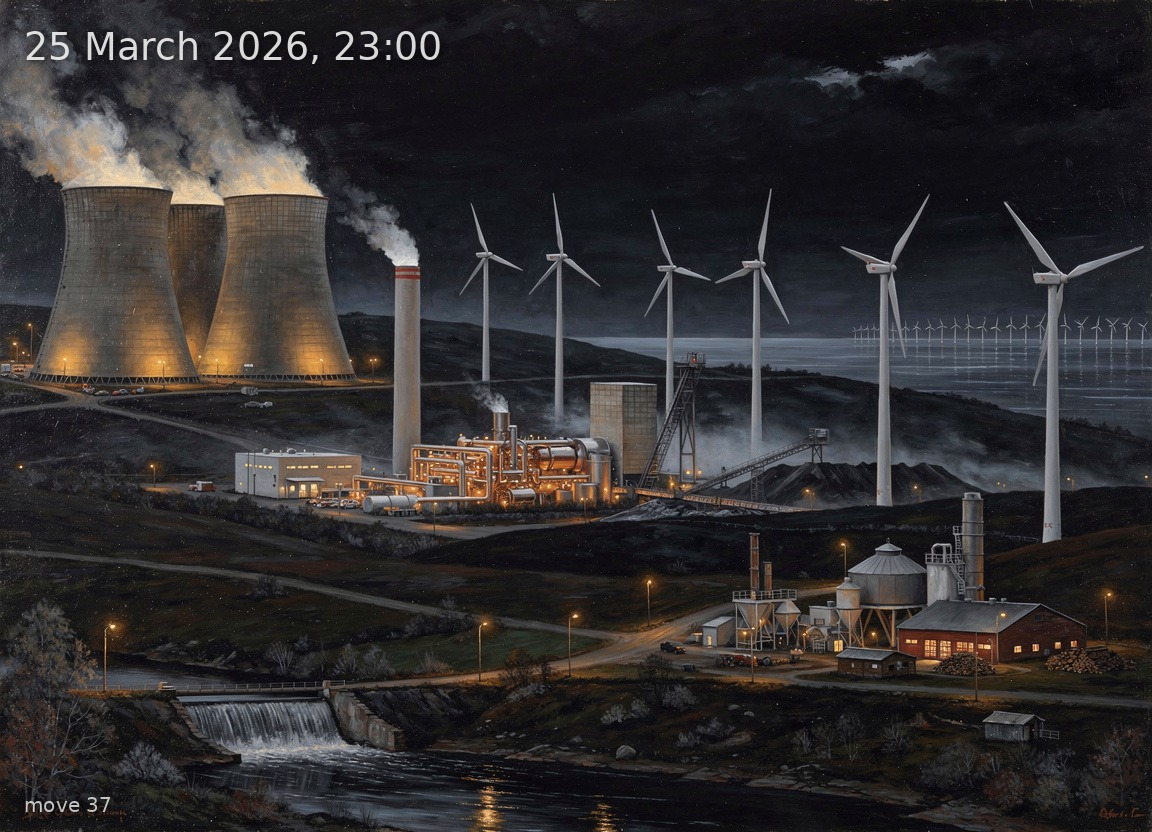
Strong wind (29.2 GW) leads overnight generation while coal and gas (16.3 GW) cover residual load under cold, overcast skies.
Back
Generation mix
Wind onshore 42%
Wind offshore 16%
Solar 0%
Biomass 8%
Hydro 2%
Natural gas 10%
Hard coal 7%
Brown coal 15%
68%
Renewable share
29.2 GW
Wind (on + offshore)
0.0 GW
Solar
50.7 GW
Total generation
-0.2 GW
Net import
88.8 €/MWh
Day-ahead price
1.7°C / 12 km/h
Temp / Wind speed
Open-Meteo, Kassel (51.3°N 9.5°E)
100% / 0.0 W/m²
Cloud cover / Radiation
224
gCO₂/kWh
Image prompt
Wind onshore 21.2 GW dominates the right two-thirds of the scene as dozens of tall three-blade turbines with white tubular towers and visible nacelles stretching across rolling dark hills; wind offshore 8.0 GW appears as a distant row of larger turbines on the far-right horizon above a faintly reflective North Sea strip. Brown coal 7.4 GW occupies the left foreground as a massive lignite power station with three hyperbolic cooling towers emitting thick pale steam plumes lit from below by amber sodium lights. Natural gas 5.2 GW sits left-of-centre as a compact CCGT plant with a tall single exhaust stack and a thinner white plume, its metallic surfaces catching orange industrial light. Hard coal 3.7 GW appears as a smaller station with a single square cooling tower and conveyor belt infrastructure just behind the gas plant. Biomass 4.1 GW is rendered as a mid-ground wood-chip-fed CHP plant with a modest chimney and a warm reddish glow from its furnace hall. Hydro 1.1 GW is a small run-of-river weir with a faintly illuminated spillway at the far left edge. The sky is completely dark, a deep black-navy vault with 100% cloud cover — no stars, no moon, no twilight glow whatsoever. The only light sources are sodium streetlamps casting pools of amber, the industrial glow of the power stations, and faint red aviation warning lights blinking atop the wind turbines receding into the distance. The landscape is late-winter bare: leafless trees, frost-tinged brown grass, patches of residual snow reflecting the artificial light. The atmosphere feels heavy, oppressive, and close, reflecting the high electricity price. Rendered as a highly detailed oil painting in the tradition of 19th-century German Romantic landscape art — rich impasto brushwork, dramatic chiaroscuro between deep shadow and industrial luminescence, atmospheric depth with misty steam plumes diffusing into the overcast void. Meticulous engineering detail on every turbine nacelle, cooling tower hyperbolic curvature, and CCGT stack structure. No text, no labels.