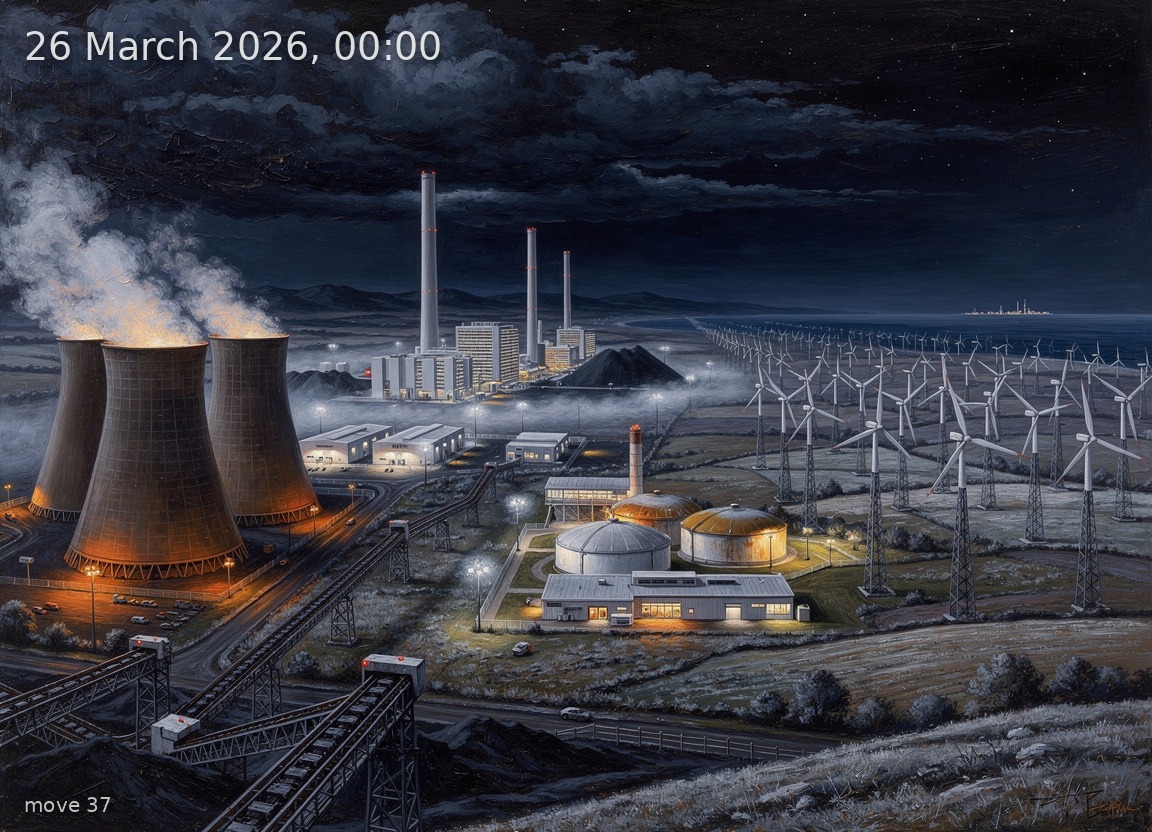
Strong wind (29.4 GW) leads nighttime generation; brown coal and gas cover residual load at an elevated 99.6 EUR/MWh price.
Back
Generation mix
Wind onshore 43%
Wind offshore 17%
Biomass 8%
Hydro 2%
Natural gas 8%
Hard coal 8%
Brown coal 14%
70%
Renewable share
29.3 GW
Wind (on + offshore)
0.0 GW
Solar
49.4 GW
Total generation
-0.4 GW
Net import
99.6 €/MWh
Day-ahead price
1.5°C / 13 km/h
Temp / Wind speed
Open-Meteo, Kassel (51.3°N 9.5°E)
37% / 0.0 W/m²
Cloud cover / Radiation
215
gCO₂/kWh
Image prompt
Wind onshore 21.1 GW dominates the right two-thirds of the scene as vast ranks of three-blade turbines on lattice towers stretching across rolling farmland into the distance, rotors visibly turning in moderate wind; wind offshore 8.3 GW appears on the far right horizon as a faint line of offshore turbine silhouettes with red aviation warning lights blinking against a black sea. Brown coal 7.1 GW occupies the left foreground as a cluster of massive hyperbolic cooling towers emitting thick white steam plumes lit from below by orange sodium lights, with conveyor belts of dark lignite visible. Natural gas 4.2 GW sits centre-left as two compact CCGT units with tall single exhaust stacks emitting thin heat shimmer, illuminated by industrial floodlights. Hard coal 3.7 GW appears behind the gas plant as a smaller coal-fired station with rectangular chimneys and a visible coal stockpile. Biomass 4.0 GW is rendered as a mid-ground biogas facility with rounded digesters and a small smokestack with warm light spilling from its control building. Hydro 1.0 GW is a modest run-of-river weir in a stream in the lower-left corner, water reflecting facility lights. Time is midnight: completely dark sky, deep navy-black, scattered stars visible through 37% broken cloud cover, absolutely no twilight or sky glow on the horizon. Temperature is 1.5°C in late March: bare deciduous trees, frost on grass, patches of old snow at field edges, early spring barrenness. The atmosphere feels heavy and oppressive reflecting the high electricity price — low cloud masses press down, the air thick and brooding. Highly detailed oil painting in the tradition of 19th-century German Romantic landscape painters — rich dark palette of indigo, amber, burnt sienna, and ivory; visible impasto brushwork; atmospheric depth with misty layers between the industrial structures; meticulous engineering detail on turbine nacelles, cooling tower parabolic profiles, CCGT stacks, and coal conveyor infrastructure. The scene evokes Caspar David Friedrich meeting industrial modernity — sublime, contemplative, vast. No text, no labels.