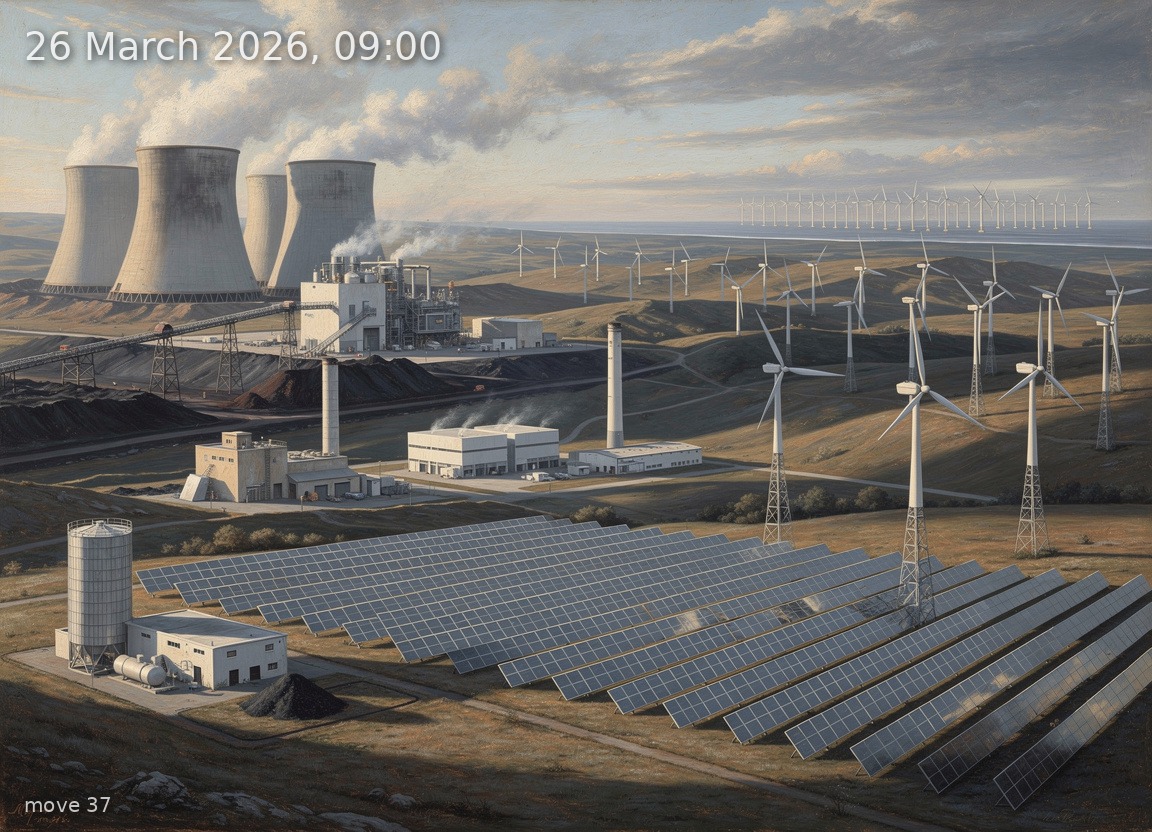
Strong wind and moderate solar drive 77% renewables while lignite and gas cover a 20 GW residual load at elevated prices.
Back
Generation mix
Wind onshore 35%
Wind offshore 9%
Solar 25%
Biomass 6%
Hydro 2%
Natural gas 7%
Hard coal 6%
Brown coal 11%
77%
Renewable share
29.7 GW
Wind (on + offshore)
16.7 GW
Solar
67.1 GW
Total generation
+0.6 GW
Net export
87.4 €/MWh
Day-ahead price
2.7°C / 20 km/h
Temp / Wind speed
Open-Meteo, Kassel (51.3°N 9.5°E)
30% / 119.0 W/m²
Cloud cover / Radiation
162
gCO₂/kWh
Image prompt
Wind onshore 23.4 GW dominates the scene as vast ranks of three-blade turbines on lattice towers stretching across rolling hills from the centre to the right edge, their rotors spinning briskly in strong wind; wind offshore 6.3 GW appears as a distant line of larger turbines on the far-right horizon over a sliver of grey-blue sea. Solar 16.7 GW fills the centre-left foreground as extensive fields of aluminium-framed crystalline silicon photovoltaic panels angled toward the low morning sun, their surfaces catching pale golden light. Brown coal 7.1 GW occupies the left background as a cluster of massive hyperbolic cooling towers with thick white-grey steam plumes drifting northeast in the wind, beside a conveyor belt feeding dark lignite into a large power station. Natural gas 4.5 GW sits centre-left as two compact CCGT units with tall single exhaust stacks emitting thin transparent heat shimmer. Hard coal 3.7 GW appears as a smaller coal plant with a blocky boiler house and single square chimney stack beside a dark coal pile, positioned left of centre. Biomass 4.3 GW is rendered as a mid-sized facility with a wood-chip silo and modest smokestack near the left foreground edge. Hydro 1.1 GW is a small run-of-river weir with a powerhouse visible along a stream in the lower-left corner. The sky is late-March morning at 09:00 — full daylight, sun low in the east casting long shadows, 30% cloud cover with scattered cumulus against a cool blue sky, direct sunlight breaking through gaps and illuminating the solar arrays. The atmosphere feels slightly oppressive and heavy despite the partial sun, reflecting high electricity prices — a subtle haze or weight in the air, muted contrasts. Vegetation is early spring: bare deciduous trees with the faintest green buds, brown-grey dormant grass, patches of frost lingering in shadows at 2.7 °C. Style: highly detailed oil painting in the tradition of 19th-century German Romantic landscape painters such as Caspar David Friedrich and Carl Blechen — rich colour palette of steely blues, warm ochres, cool greys and pale golds, visible confident brushwork, deep atmospheric perspective with layers of distance. Each energy technology rendered with meticulous engineering accuracy: turbine nacelles, rotor blade profiles, PV cell grid patterns, cooling tower parabolic curves, conveyor structures. The composition evokes a grand panoramic industrial landscape — sublime and contemplative, not celebratory or alarming. No text, no labels, no human figures.