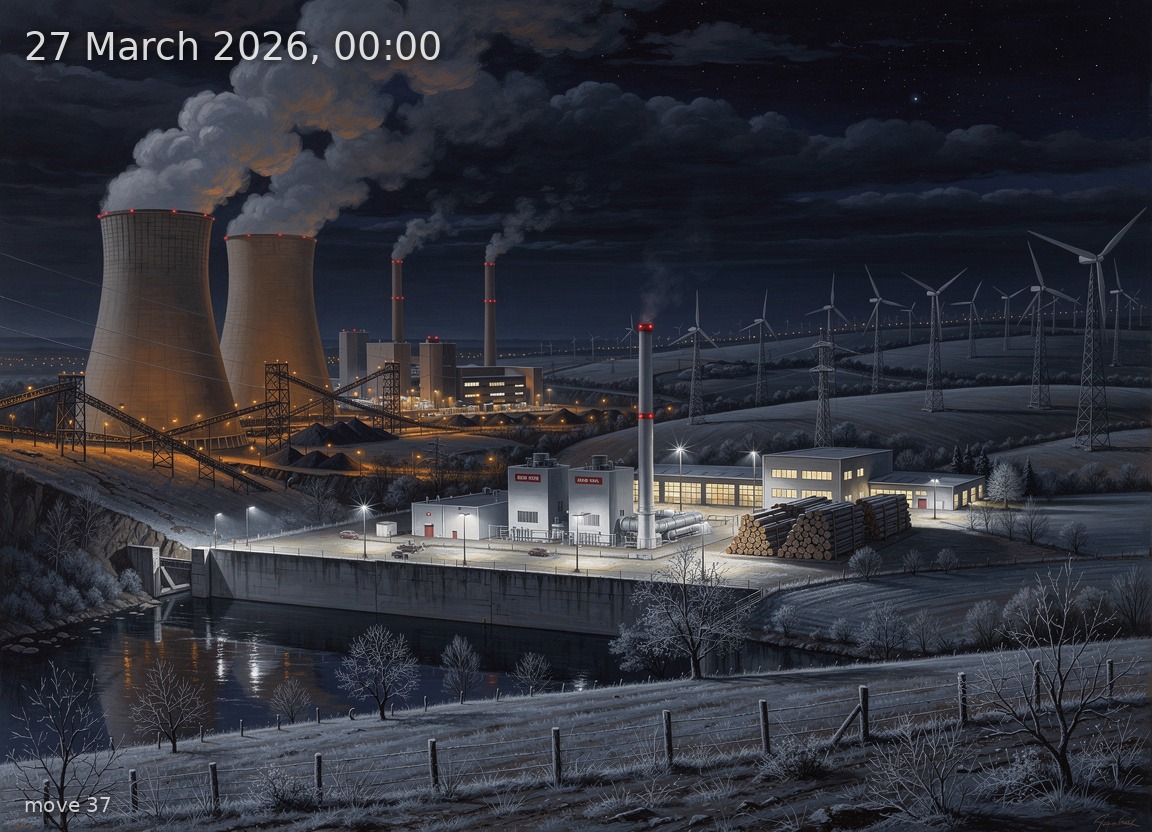
Brown coal and wind share the midnight load as near-freezing temperatures and modest wind push gas dispatch and prices higher.
Back
Generation mix
Wind onshore 30%
Wind offshore 8%
Solar 0%
Biomass 9%
Hydro 2%
Natural gas 14%
Hard coal 11%
Brown coal 25%
49%
Renewable share
18.2 GW
Wind (on + offshore)
0.0 GW
Solar
47.1 GW
Total generation
-3.3 GW
Net import
119.4 €/MWh
Day-ahead price
0.3°C / 3 km/h
Temp / Wind speed
Open-Meteo, Kassel (51.3°N 9.5°E)
45% / 0.0 W/m²
Cloud cover / Radiation
360
gCO₂/kWh
Image prompt
Highly detailed oil painting in the tradition of Caspar David Friedrich and Carl Blechen, depicting the German energy grid at midnight under a deep-navy to black sky with 45% broken cloud partially revealing faint stars. Brown coal 12.0 GW dominates the left third of the canvas: three massive hyperbolic cooling towers rise against the darkness, thick white steam plumes drifting rightward, lit from below by orange sodium lamps illuminating the lignite plant's conveyors and coal bunkers. Hard coal 5.1 GW appears just left of centre as a smaller power station with two rectangular chimneys trailing grey smoke, red aviation warning lights blinking at their summits. Natural gas 6.8 GW occupies the centre as two compact CCGT blocks with slender single exhaust stacks emitting thin heat shimmer, their turbine halls glowing warm white through tall industrial windows. Wind onshore 14.3 GW spans the right third and recedes into the distance: dozens of three-blade turbines on lattice and tubular towers across rolling hills, red nacelle lights dotting the dark horizon, blades turning slowly in the light 2.8 km/h breeze. Wind offshore 3.9 GW is suggested in the far right background as a faint cluster of red blinking lights on the dark horizon line above a barely visible sea. Biomass 4.0 GW appears as a mid-ground wood-fired CHP plant with a modest smokestack and stacked timber logs visible under floodlights. Hydro 1.0 GW is a small dam structure in a valley at far left, water gleaming faintly under a single floodlight. The foreground shows frost-covered early-spring fields with sparse bare-branched trees, temperature near 0 °C visible as rime on fence posts and grass. The overall atmosphere is heavy and oppressive — reflecting the 119.4 EUR/MWh price — with a low, pressing cloud base tinged amber by the industrial glow below. No solar panels anywhere. No sunlight. No text or labels. Rich visible brushwork, deep chiaroscuro, atmospheric perspective fading distant turbines into haze, the painting conveying industrial grandeur and quiet nocturnal tension.