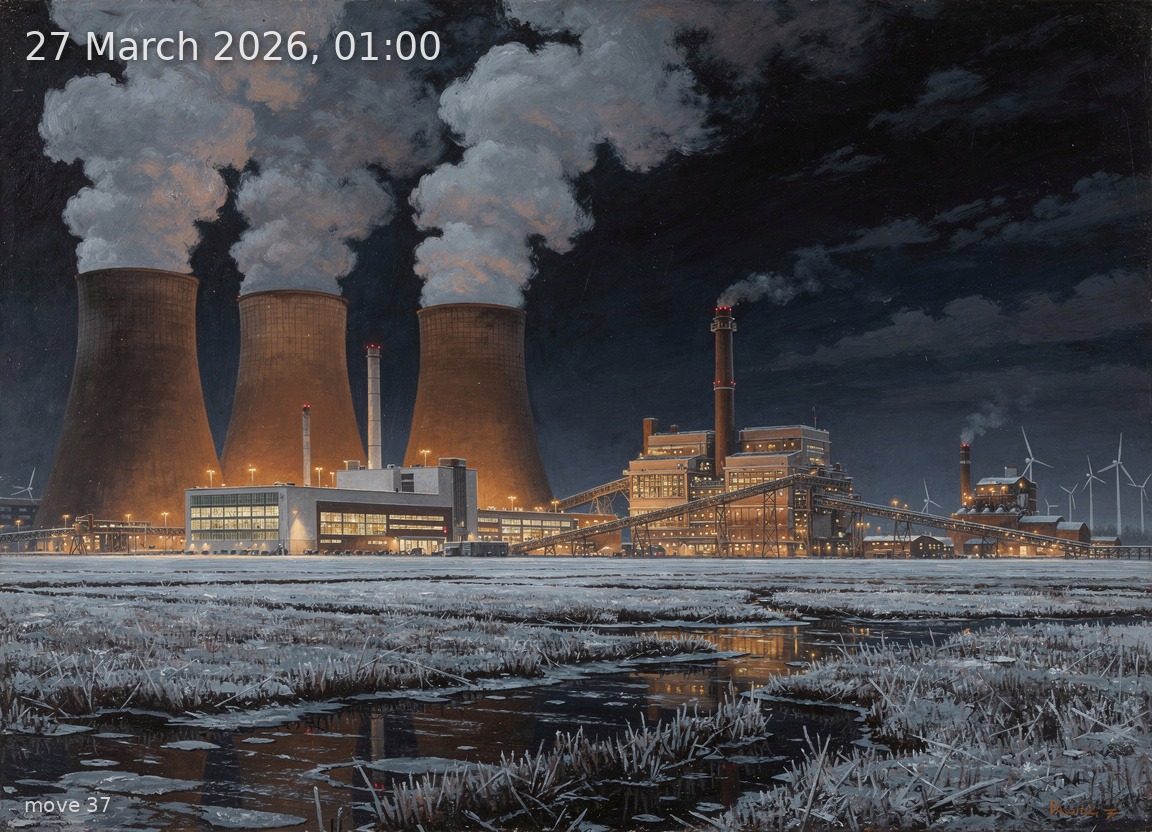
Brown coal, wind, and gas anchor overnight supply as sub-zero temperatures lift demand and prices.
Back
Generation mix
Wind onshore 29%
Wind offshore 7%
Solar 0%
Biomass 9%
Hydro 2%
Natural gas 15%
Hard coal 11%
Brown coal 27%
47%
Renewable share
16.1 GW
Wind (on + offshore)
0.0 GW
Solar
45.1 GW
Total generation
-3.3 GW
Net import
119.5 €/MWh
Day-ahead price
-0.2°C / 4 km/h
Temp / Wind speed
Open-Meteo, Kassel (51.3°N 9.5°E)
33% / 0.0 W/m²
Cloud cover / Radiation
378
gCO₂/kWh
Image prompt
Brown coal 12.0 GW dominates the left third of the scene as a massive lignite power station with four hyperbolic cooling towers emitting thick white steam plumes lit from below by sodium-orange industrial floodlights; natural gas 6.8 GW appears centre-left as two compact CCGT plants with tall single exhaust stacks and faintly glowing turbine halls; hard coal 5.2 GW sits centre-right as a large coal-fired station with a tall chimney and conveyor belt infrastructure, all bathed in amber security lighting; wind onshore 13.1 GW and wind offshore 3.0 GW span the entire right third and extend across the distant horizon as dozens of three-blade turbines on lattice and tubular towers, their red aviation warning lights blinking against the black sky; biomass 4.0 GW appears as a modest wood-chip-fired plant with a squat stack and small steam wisp near the coal station; hydro 1.0 GW is suggested by a small dam structure with illuminated spillway at the far right edge. The sky is completely dark, deep navy-black, no twilight, no moon, roughly 33% broken cloud faintly visible only where industrial light scatters upward. The ground is a flat north-German plain with frost-whitened stubble fields, temperature below zero, patches of thin ice glinting. The atmosphere feels heavy and oppressive, referencing the high electricity price — low-hanging steam and haze from the cooling towers press down across the landscape. Rendered as a highly detailed oil painting in the tradition of 19th-century German Romantic landscape art — rich impasto brushwork, deep chiaroscuro between orange-lit industrial complexes and pitch-dark surroundings, atmospheric depth receding into misty darkness, meticulous engineering detail on turbine nacelles, cooling tower parabolic curves, CCGT exhaust cowls, and coal conveyor gantries. No text, no labels, no human figures.