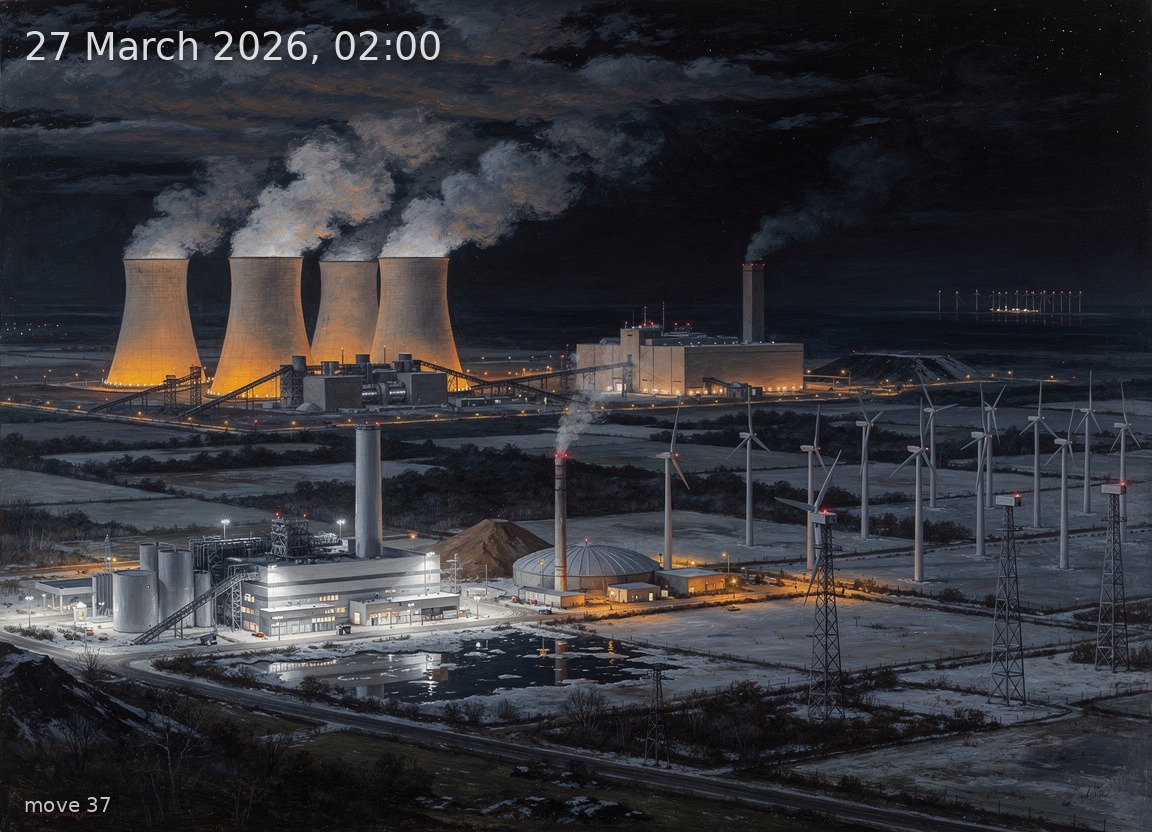
Brown coal and onshore wind each near 12 GW anchor a cold, tight overnight grid requiring 5 GW net imports.
Back
Generation mix
Wind onshore 27%
Wind offshore 5%
Biomass 9%
Hydro 2%
Natural gas 16%
Hard coal 12%
Brown coal 28%
44%
Renewable share
14.1 GW
Wind (on + offshore)
0.0 GW
Solar
42.9 GW
Total generation
-5.0 GW
Net import
117.3 €/MWh
Day-ahead price
-0.4°C / 4 km/h
Temp / Wind speed
Open-Meteo, Kassel (51.3°N 9.5°E)
48% / 0.0 W/m²
Cloud cover / Radiation
395
gCO₂/kWh
Image prompt
Brown coal 11.9 GW dominates the left third of the scene as a massive lignite power station with four hyperbolic cooling towers exhaling thick white steam plumes into the frigid night air; onshore wind 11.8 GW spans the right third as dozens of tall three-blade turbines on lattice and tubular towers receding across flat northern plains, their red aviation warning lights blinking in the darkness; natural gas 6.7 GW appears centre-left as a compact CCGT facility with tall single exhaust stacks and lit control buildings; hard coal 5.1 GW sits centre-right as a coal-fired station with a large rectangular boiler house and a tall square chimney trailing a grey plume; biomass 4.0 GW is rendered as a medium-sized industrial plant with a rounded wood-chip storage dome and a single smokestack, positioned in the mid-ground; offshore wind 2.3 GW is suggested by a distant cluster of turbines on the far-right horizon above a barely visible dark sea line; hydro 1.0 GW appears as a small dam structure nestled in a valley in the far background. Time is 02:00 at night — the sky is completely black with faint stars visible through 48% broken cloud, absolutely no twilight or sky glow on the horizon. Sub-zero temperature: frost glistens on bare branches and frozen puddles reflect sodium-orange streetlights. The atmosphere feels heavy and oppressive, hinting at the high electricity price — low clouds press down, illuminated from below by the industrial glow of the thermal plants. Vegetation is late-winter bare: skeletal deciduous trees, brown dormant grass, patches of frost. Style: highly detailed oil painting in the tradition of 19th-century German Romantic landscape painters such as Caspar David Friedrich, with rich deep blues, blacks, warm ambers from industrial lights, visible confident brushwork, atmospheric depth and chiaroscuro. Each energy technology is rendered with meticulous engineering accuracy — turbine nacelles and three-blade rotors, hyperbolic concrete cooling towers with internal steam, aluminium-clad CCGT modules. The scene conveys the immense quiet effort of an industrial nation powering itself through a freezing night. No text, no labels.