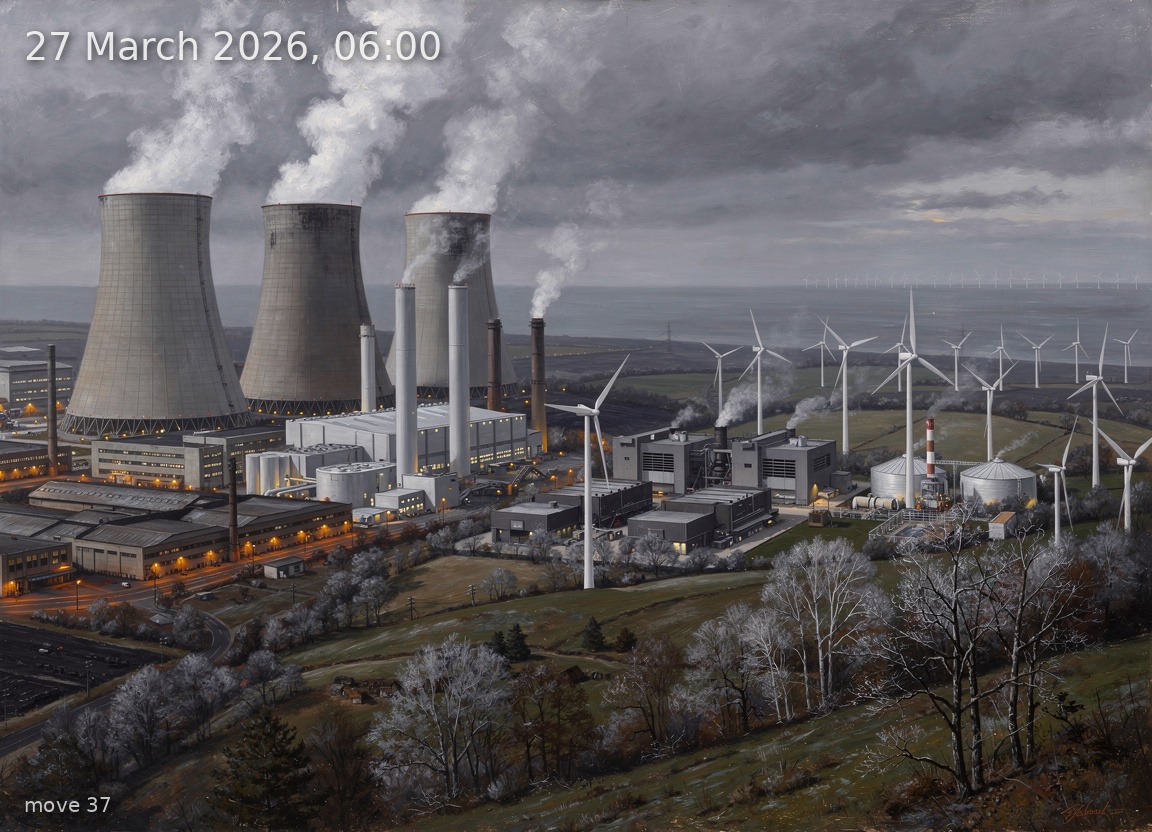
Brown coal, gas, and hard coal dominate as overcast skies, near-calm winds, and cold drive heavy thermal dispatch and high prices.
Back
Generation mix
Wind onshore 18%
Wind offshore 3%
Solar 4%
Biomass 11%
Hydro 3%
Natural gas 21%
Hard coal 13%
Brown coal 29%
38%
Renewable share
8.7 GW
Wind (on + offshore)
1.6 GW
Solar
42.1 GW
Total generation
-16.6 GW
Net import
172.6 €/MWh
Day-ahead price
0.4°C / 2 km/h
Temp / Wind speed
Open-Meteo, Kassel (51.3°N 9.5°E)
100% / 0.0 W/m²
Cloud cover / Radiation
432
gCO₂/kWh
Image prompt
Brown coal 12.1 GW occupies the left third of the scene as a vast lignite power complex with four massive hyperbolic cooling towers emitting thick white steam plumes into the heavy sky; natural gas 8.8 GW fills the centre-left as a cluster of modern CCGT plants with tall slender exhaust stacks trailing thin vapour; hard coal 5.3 GW appears centre-right as a pair of older coal-fired stations with rectangular boiler houses and fat chimneys; wind onshore 7.6 GW spans the right third as dozens of three-blade turbines on lattice and tubular towers scattered across low rolling hills, their rotors barely turning in the near-calm air; wind offshore 1.1 GW is glimpsed as a faint row of turbines on the far-right horizon over a grey sea; biomass 4.4 GW appears as two mid-sized biomass plants with rounded wood-chip silos and short stacks amid bare deciduous trees in the centre-right middle ground; hydro 1.2 GW is a small concrete run-of-river dam with foaming tailrace in the foreground right; solar 1.6 GW is rendered as a modest field of aluminium-framed crystalline silicon PV panels in the centre foreground, their surfaces dark and unreflective under the dense clouds. Time is early dawn at 06:00 in late March: the sky is a deep blue-grey pre-dawn tone with no direct sunlight, only the faintest pale luminescence along the eastern horizon behind the cooling towers; sodium-orange streetlights and industrial facility lights glow warmly across the scene. Temperature is near freezing: frost rims the bare branches and dormant brown grass; patches of old snow linger in field furrows. The sky is entirely overcast at 100% cloud cover, low and oppressive, with heavy stratiform clouds pressing down—conveying the weight of a 172.6 EUR/MWh price signal. Wind is barely perceptible, no motion in grass or flags. Style: highly detailed oil painting in the tradition of 19th-century German Romantic landscape painters such as Caspar David Friedrich and Carl Blechen—rich tonal depth, visible confident brushwork, dramatic atmospheric perspective, with meticulous engineering accuracy on every turbine nacelle, cooling tower fluting, PV cell grid pattern, and exhaust stack. The mood is sombre, industrial, weighty, a pre-dawn industrial Rhineland panorama. No text, no labels, no people prominently featured.