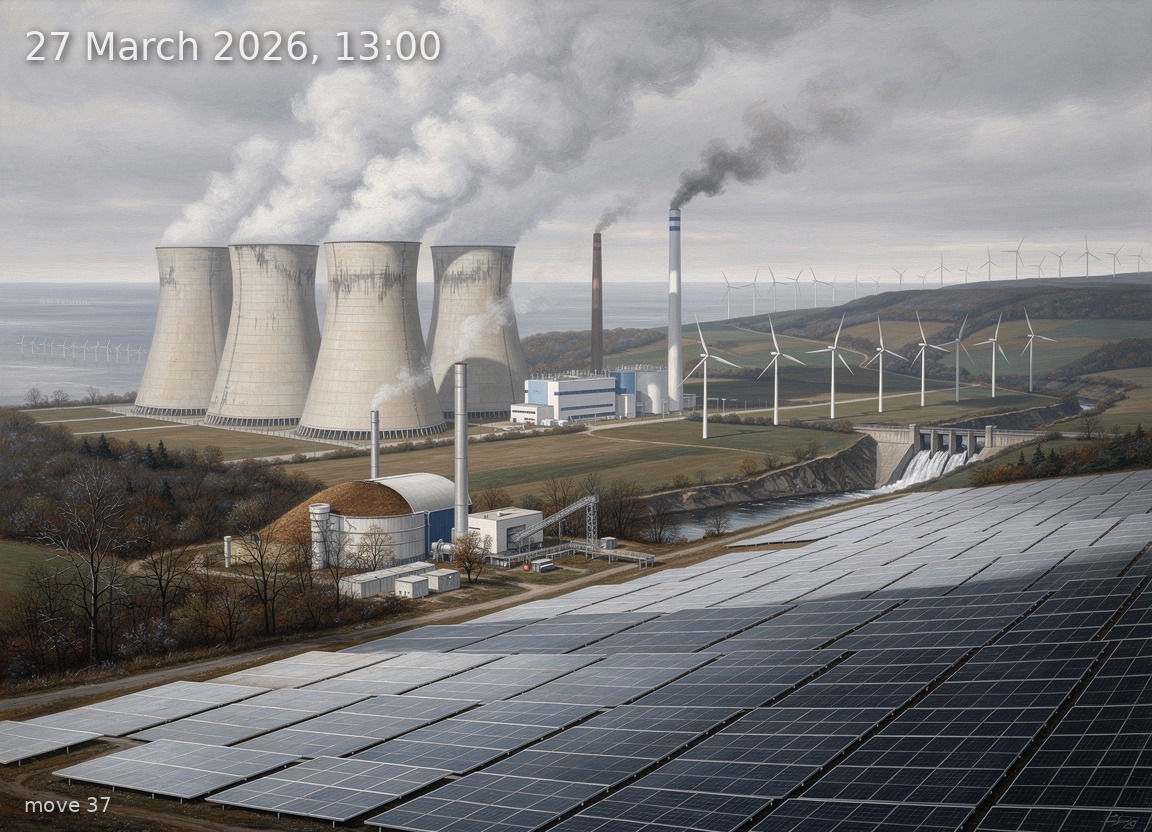
Diffuse solar at 35.8 GW leads Germany's 81% renewable grid despite full overcast, with lignite providing 6.9 GW baseload.
Back
Generation mix
Wind onshore 9%
Wind offshore 8%
Solar 56%
Biomass 6%
Hydro 2%
Natural gas 5%
Hard coal 3%
Brown coal 11%
81%
Renewable share
11.2 GW
Wind (on + offshore)
35.8 GW
Solar
64.1 GW
Total generation
+4.3 GW
Net export
59.6 €/MWh
Day-ahead price
4.5°C / 4 km/h
Temp / Wind speed
Open-Meteo, Kassel (51.3°N 9.5°E)
99% / 50.0 W/m²
Cloud cover / Radiation
135
gCO₂/kWh
Image prompt
Solar 35.8 GW dominates the centre and right of the composition as vast plains of aluminium-framed crystalline silicon PV panels stretching to the horizon, their glass surfaces reflecting a uniform grey-white sky; brown coal 6.9 GW occupies the left quarter as a cluster of massive hyperbolic cooling towers with thick white-grey steam plumes merging into the overcast; wind onshore 5.9 GW appears as a line of tall three-blade turbines with white tubular towers on rolling hills in the mid-distance, their rotors barely turning in the still air; wind offshore 5.3 GW is suggested by a faint row of offshore turbines visible on a distant grey sea horizon at the far left; natural gas 3.2 GW is rendered as two compact CCGT units with slim exhaust stacks and thin heat shimmer near the coal complex; biomass 4.0 GW appears as a modest industrial facility with a wood-chip storage dome and a single smoking chimney nestled among bare early-spring trees at centre-left; hard coal 1.9 GW is a single smaller stack with dark smoke beside the brown coal towers; hydro 1.2 GW is a small concrete dam with spillway visible in a valley in the far right background. The sky is completely overcast at 99% cloud cover — flat, heavy, pewter-grey stratus from horizon to horizon with no blue patches, yet fully bright midday daylight at 13:00 illuminates the scene evenly without shadows. Temperature is 4.5°C: vegetation is late-winter bare branches with just the faintest green buds on deciduous trees, brown grass, patches of old snow in shaded ditches. The air feels cool, damp, still. The atmosphere is neither oppressive nor light — a matter-of-fact moderate-price industrial calm. Highly detailed oil painting in the tradition of 19th-century German Romantic landscape painters — Caspar David Friedrich meets industrial modernity — with rich layered colour, visible confident brushwork, atmospheric aerial perspective fading distant objects into grey haze, meticulous engineering detail on every turbine nacelle, every PV panel frame, every cooling tower's parabolic curve and concrete texture. No text, no labels, no people in the foreground.