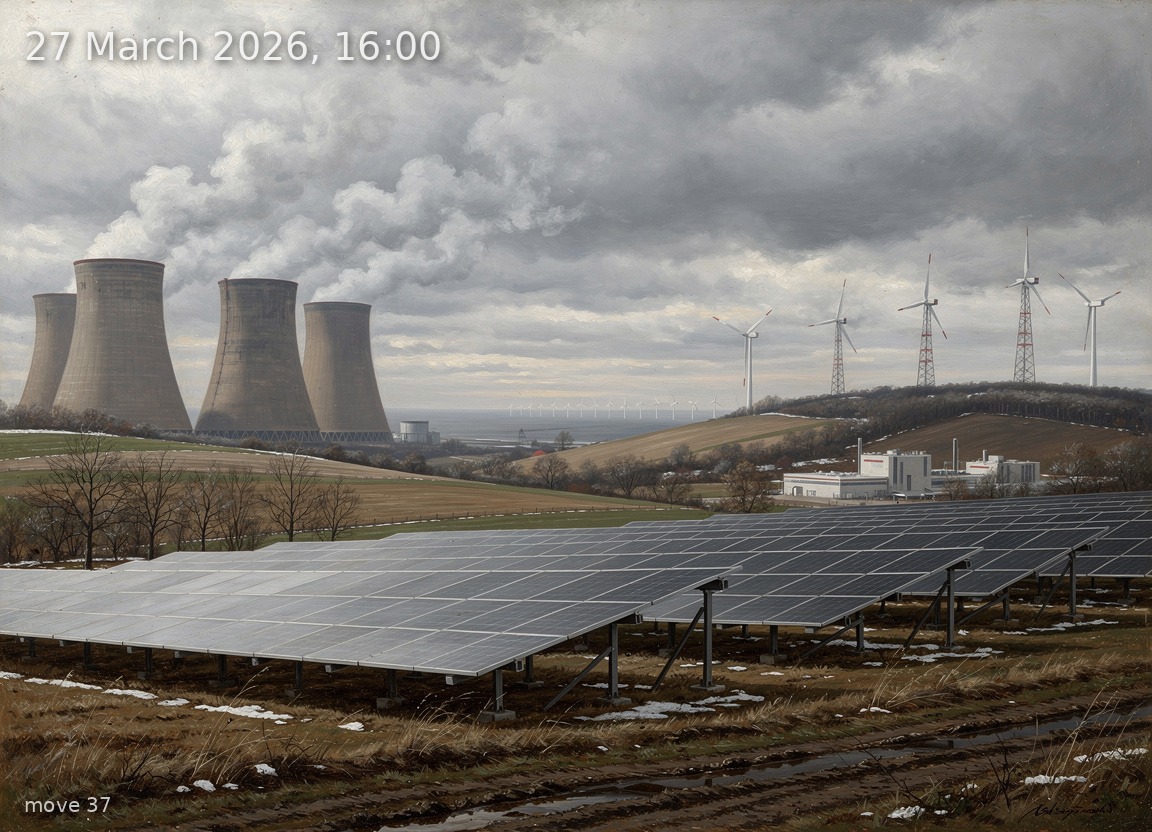
Solar leads at 16.7 GW alongside 13.3 GW wind and 10.8 GW brown coal under heavy overcast with moderate prices.
Back
Generation mix
Wind onshore 11%
Wind offshore 13%
Solar 30%
Biomass 8%
Hydro 2%
Natural gas 11%
Hard coal 6%
Brown coal 20%
64%
Renewable share
13.3 GW
Wind (on + offshore)
16.7 GW
Solar
55.2 GW
Total generation
-1.7 GW
Net import
103.1 €/MWh
Day-ahead price
6.2°C / 6 km/h
Temp / Wind speed
Open-Meteo, Kassel (51.3°N 9.5°E)
88% / 152.0 W/m²
Cloud cover / Radiation
256
gCO₂/kWh
Image prompt
Brown coal 10.8 GW dominates the left quarter as a cluster of massive hyperbolic cooling towers with thick white-grey steam plumes rising into an overcast sky; solar 16.7 GW occupies the centre-left as vast fields of aluminium-framed crystalline silicon PV panels stretching across flat farmland, their surfaces reflecting diffuse grey light; wind offshore 7.0 GW appears in the far background centre as a line of tall three-blade turbines on steel monopile foundations rising from a distant hazy sea horizon; wind onshore 6.3 GW fills the centre-right as a row of modern lattice-and-tubular tower turbines on gentle hills, blades turning slowly; natural gas 5.9 GW is rendered right of centre as two compact CCGT plants with slim exhaust stacks emitting thin heat shimmer; biomass 4.3 GW appears as a modest wood-chip-fueled plant with a rounded storage dome and short chimney trailing faint smoke; hard coal 3.2 GW sits at the far right as a single coal-fired station with conveyor belts and a rectangular stack; hydro 1.1 GW is a small concrete dam with spillway visible in a river valley at the far right edge. Time is 16:00 in late March — full but fading daylight, the sun very low and completely hidden behind a thick 88% overcast layer of grey stratocumulus; the sky is heavy, oppressive, and uniformly grey-white with no blue breaks, pressing down on the landscape to evoke the high electricity price. Temperature is 6°C: bare deciduous trees with the faintest buds, dormant brown grass, patches of old snow in shadows. Central German terrain of gentle rolling plains and shallow valleys. Light wind bends thin grasses slightly. Highly detailed oil painting in the tradition of 19th-century German Romantic landscape painters — Caspar David Friedrich's atmospheric depth merged with Adolph Menzel's industrial precision — rich earth tones, visible impasto brushwork, dramatic chiaroscuro despite the overcast, meticulous engineering detail on every turbine nacelle, PV module frame, cooling tower shell, and smokestack. No text, no labels, no people.