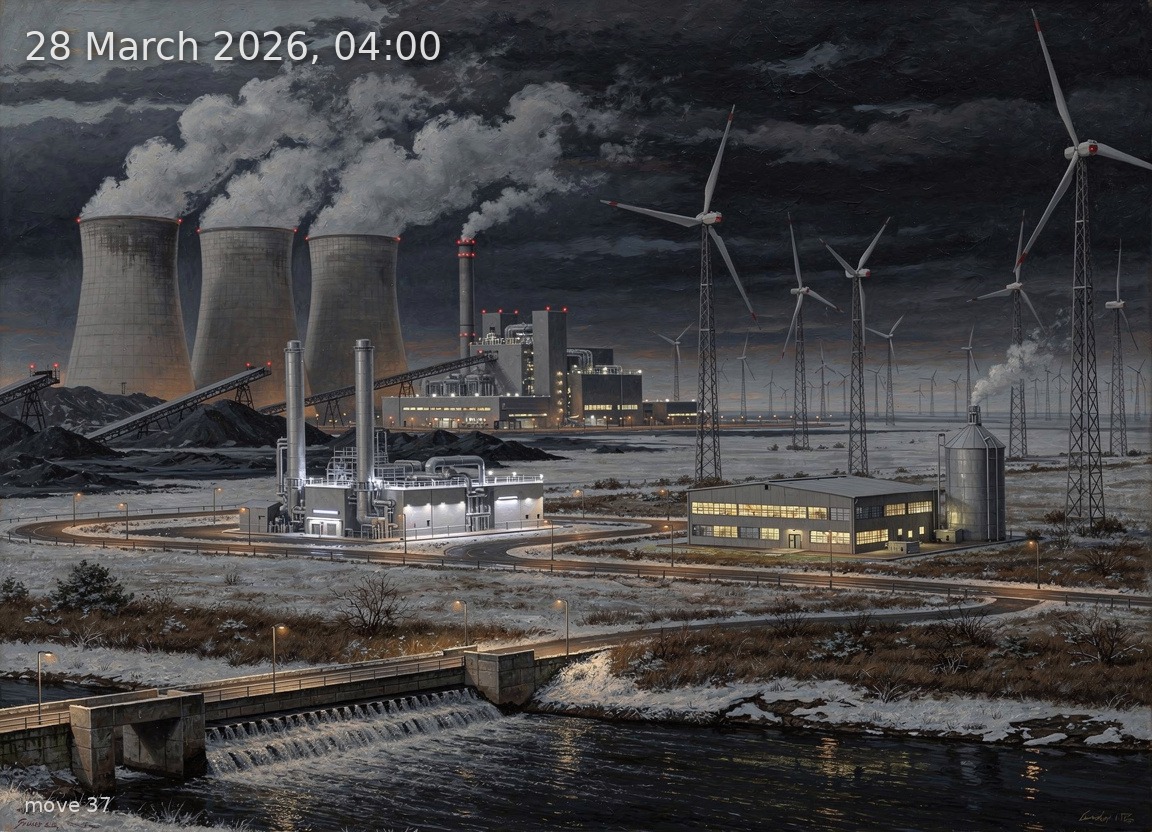
Wind leads at 21.5 GW with brown coal at 9.6 GW backstopping a cold, dark, high-demand early morning.
Back
Generation mix
Wind onshore 42%
Wind offshore 7%
Biomass 9%
Hydro 2%
Natural gas 10%
Hard coal 8%
Brown coal 22%
60%
Renewable share
21.5 GW
Wind (on + offshore)
0.0 GW
Solar
44.1 GW
Total generation
-1.3 GW
Net import
88.1 €/MWh
Day-ahead price
0.8°C / 7 km/h
Temp / Wind speed
Open-Meteo, Kassel (51.3°N 9.5°E)
98% / 0.0 W/m²
Cloud cover / Radiation
287
gCO₂/kWh
Image prompt
Wind onshore 18.4 GW dominates the right half of the canvas as dozens of tall three-blade turbines with lattice towers receding across a flat, frost-whitened North German plain, blades slowly turning in moderate wind. Brown coal 9.6 GW occupies the left quarter as a massive Lausitz-style lignite power station with four hyperbolic concrete cooling towers emitting thick white steam plumes that merge into the overcast sky, conveyor belts visible feeding raw lignite. Natural gas 4.3 GW appears centre-left as a compact CCGT plant with two slender cylindrical exhaust stacks and a low turbine hall, lit by orange sodium lamps. Hard coal 3.6 GW sits behind it as a single large boiler house with a tall rectangular chimney and coal bunkers. Biomass 4.1 GW is rendered as a mid-sized wood-chip CHP facility with a conical silo and short stack, warm interior glow through high windows. Hydro 1.0 GW appears as a small concrete run-of-river weir in the lower foreground with a faintly lit control building. Wind offshore 3.1 GW is suggested by distant turbines barely visible on a dark horizon line far left. Time is 04:00 — completely dark night sky, no twilight whatsoever, deep black-navy firmament, 98% cloud cover means no stars, only the faintest grey differentiation in the overcast. All illumination is artificial: sodium-orange streetlights along access roads, red aviation warning lights blinking atop turbine nacelles and cooling towers, cool-white LED floodlights on the gas plant, warm yellow windows in control rooms. Frost coats bare branches and dormant brown grass — late winter, near 0 °C. The atmosphere feels heavy and oppressive, reflecting the high electricity price: low dense clouds press down, steam plumes flatten and spread. Painted in the style of a highly detailed 19th-century German Romantic oil painting — rich impasto brushwork, deep chiaroscuro contrasts, atmospheric perspective with industrial haze, meticulous engineering detail on every nacelle, cooling tower, and exhaust stack. No text, no labels.