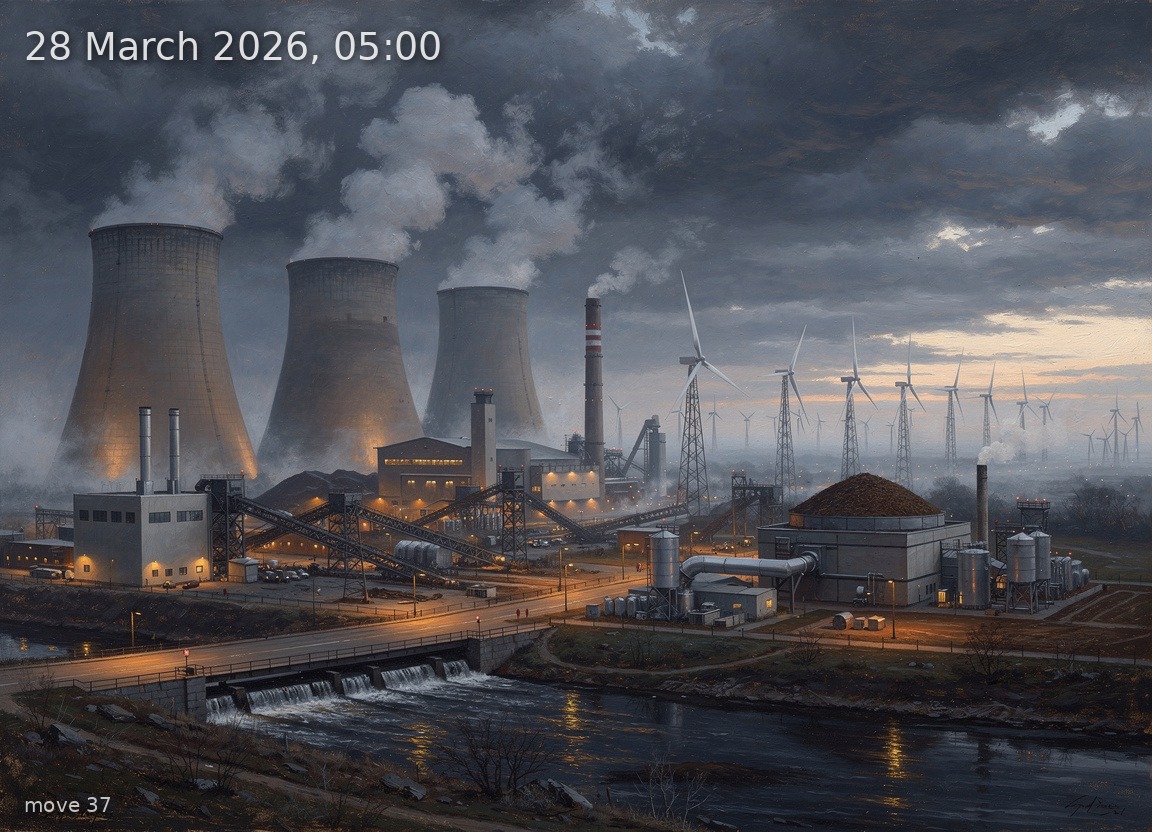
Wind and brown coal dominate a pre-dawn grid with zero solar, cold temperatures, and elevated prices.
Back
Generation mix
Wind onshore 40%
Wind offshore 8%
Solar 0%
Biomass 10%
Hydro 2%
Natural gas 10%
Hard coal 8%
Brown coal 22%
60%
Renewable share
20.9 GW
Wind (on + offshore)
0.0 GW
Solar
43.8 GW
Total generation
-1.6 GW
Net import
91.6 €/MWh
Day-ahead price
1.0°C / 8 km/h
Temp / Wind speed
Open-Meteo, Kassel (51.3°N 9.5°E)
99% / 0.0 W/m²
Cloud cover / Radiation
291
gCO₂/kWh
Image prompt
Brown coal 9.7 GW dominates the left third of the scene as a massive lignite power station with four hyperbolic cooling towers emitting thick white-grey steam plumes into the darkness; wind onshore 17.3 GW spans the entire background and right half as dozens of tall three-blade turbines on lattice and tubular towers, rotors turning steadily; wind offshore 3.5 GW is suggested by a distant cluster of turbines on the far-right horizon above a dark river or canal; natural gas 4.3 GW appears centre-left as a compact CCGT plant with twin exhaust stacks and a single shorter cooling structure, warm exhaust visible; hard coal 3.6 GW sits adjacent to the lignite plant as a smaller coal-fired station with a tall chimney and conveyor belts; biomass 4.3 GW is rendered as a medium-sized industrial facility with a wood-chip storage dome and a single stack emitting faint vapour, placed centre-right; hydro 1.0 GW appears as a modest run-of-river weir and powerhouse along the canal in the foreground. Time of day is 05:00 pre-dawn in late March: the sky is deep blue-grey with the faintest hint of pale light on the eastern horizon, no direct sunlight, no solar panels anywhere. Temperature is 1 °C—bare deciduous trees with frost on branches, patches of frost on brown fields, breath-like mist near ground level. Cloud cover is 99%, a low heavy overcast pressing down oppressively on the scene, reinforcing the high electricity price atmosphere. Wind turbine blades show moderate motion blur. Sodium-orange streetlights and amber industrial lighting illuminate the power stations from below. The entire scene is rendered as a highly detailed oil painting in the tradition of 19th-century German Romantic landscape painters—Caspar David Friedrich meets industrial sublime—with rich, dark colour palette of deep navy, amber, slate grey, and burnt umber, visible expressive brushwork, atmospheric depth and haze from the cooling tower plumes, meticulous engineering detail on every turbine nacelle, cooling tower hyperbolic curve, and gas-turbine exhaust stack. No text, no labels.