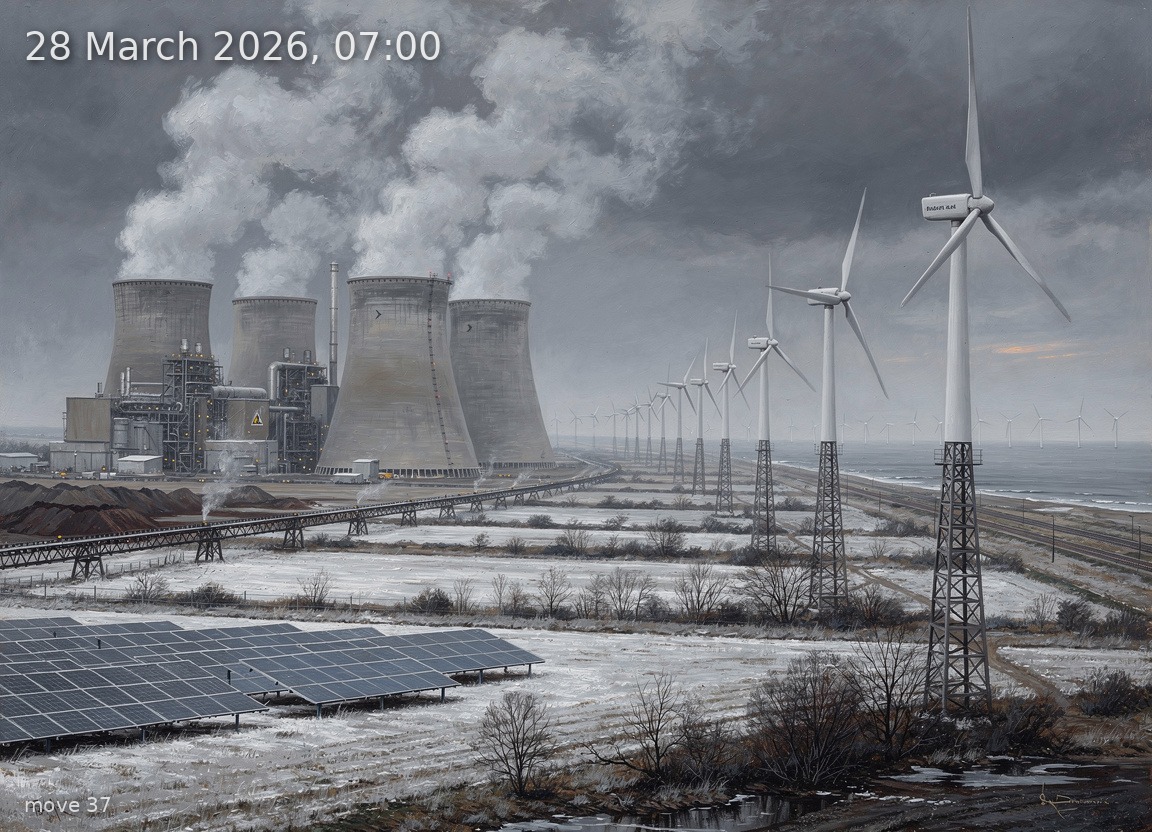
Wind leads at 17.9 GW with brown coal at 8.8 GW backstopping an overcast, cold March morning.
Back
Generation mix
Wind onshore 30%
Wind offshore 8%
Solar 19%
Biomass 10%
Hydro 2%
Natural gas 7%
Hard coal 5%
Brown coal 19%
69%
Renewable share
17.9 GW
Wind (on + offshore)
9.0 GW
Solar
47.3 GW
Total generation
-1.3 GW
Net import
79.2 €/MWh
Day-ahead price
1.5°C / 12 km/h
Temp / Wind speed
Open-Meteo, Kassel (51.3°N 9.5°E)
100% / 0.0 W/m²
Cloud cover / Radiation
228
gCO₂/kWh
Image prompt
Wind onshore 14.0 GW dominates the right half of the scene as dozens of three-blade turbines on lattice and tubular steel towers stretching across a flat, frost-whitened North German plain; wind offshore 3.9 GW appears as a distant line of turbines on the far-right horizon above a grey sea. Brown coal 8.8 GW occupies the left quarter as a massive Lausitz-style lignite power station with four hyperbolic cooling towers emitting thick white steam plumes that merge with the overcast sky, conveyor belts feeding raw lignite visible at ground level. Solar 9.0 GW appears in the centre-left as vast fields of aluminium-framed crystalline silicon panels stretching across farmland, their surfaces dull and reflecting only grey sky—no sunshine, no glare. Biomass 4.5 GW is rendered as a cluster of mid-sized combined-heat-and-power plants with cylindrical digesters and short stacks amid bare deciduous trees. Natural gas 3.5 GW appears as two compact CCGT units with single tall exhaust stacks and small exhaust plumes centre-right. Hard coal 2.5 GW shows as a single coal-fired plant with a large boiler house and rectangular cooling tower behind the gas units. Hydro 1.0 GW is a small run-of-river weir with visible turbine housing at a river in the lower foreground. Sky and lighting: pre-dawn first light at 07:00 in late March—deep blue-grey sky, no direct sun, 100% cloud cover forming a low oppressive blanket from horizon to horizon, the atmosphere heavy and slightly hazy suggesting the 79 EUR price tension. Temperature 1.5 °C: frost on grass, bare branches, thin ice on puddles, breath-visible cold. Moderate wind at 11.6 km/h moves the turbine blades at visible rotation and pushes steam plumes sideways. Style: highly detailed oil painting in the tradition of Caspar David Friedrich and Carl Blechen—rich, moody colour palette of slate grey, Prussian blue, umber, and muted ochre; visible confident brushwork; atmospheric depth with haze softening distant turbines; meticulous engineering detail on every turbine nacelle, PV panel frame, cooling tower geometry, and CCGT stack. The painting conveys the monumental scale of industrial infrastructure against a cold, reluctant dawn. No text, no labels.