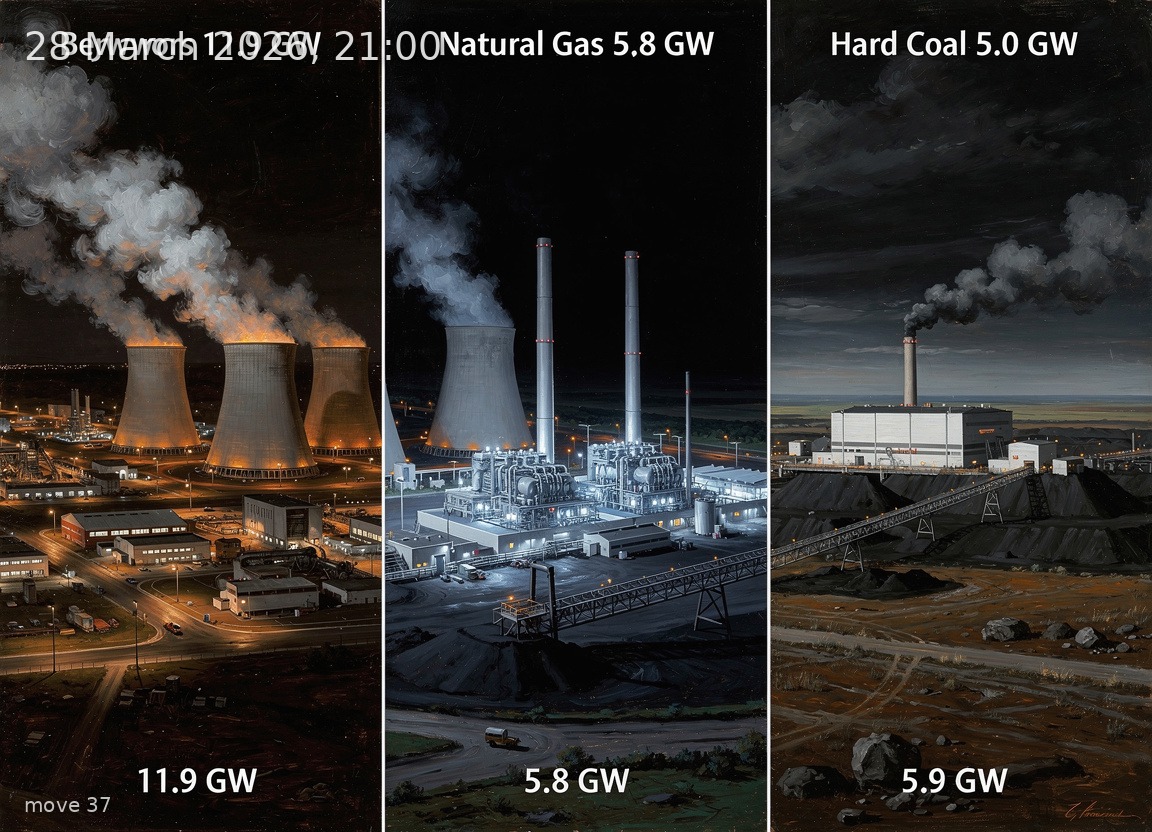
Brown coal and wind dominate as cold, dark evening drives high demand and 7.8 GW net imports.
Back
Generation mix
Wind onshore 23%
Wind offshore 11%
Biomass 10%
Hydro 2%
Natural gas 14%
Hard coal 12%
Brown coal 28%
46%
Renewable share
14.3 GW
Wind (on + offshore)
0.0 GW
Solar
42.3 GW
Total generation
-7.8 GW
Net import
131.6 €/MWh
Day-ahead price
2.1°C / 8 km/h
Temp / Wind speed
Open-Meteo, Kassel (51.3°N 9.5°E)
99% / 0.0 W/m²
Cloud cover / Radiation
386
gCO₂/kWh
Image prompt
Brown coal 11.9 GW occupies the left third as a vast lignite power station complex with four massive hyperbolic cooling towers emitting thick white steam plumes lit from below by orange sodium lamps; natural gas 5.8 GW appears centre-left as two compact CCGT units with tall single exhaust stacks venting thin heat shimmer; hard coal 5.0 GW sits at centre as a coal-fired station with a large rectangular boiler house, conveyor belts, and a single fat chimney trailing grey smoke; wind onshore 9.7 GW spans the right third as a long row of tall three-blade turbines on lattice towers stretching across rolling farmland, blades turning slowly; wind offshore 4.6 GW appears in the far right distance as a cluster of turbines on a dark horizon line barely visible; biomass 4.3 GW is rendered as a medium-sized industrial facility with a wood-chip storage dome and a modest smokestack glowing warmly, placed between the coal plant and the wind turbines; hydro 1.0 GW appears as a small concrete dam structure with a lit powerhouse tucked into a hillside at the far left edge. TIME AND ATMOSPHERE: full nighttime, 21:00, completely black sky with no twilight glow, heavy 99% overcast hiding all stars, temperature 2°C — bare late-winter trees with no leaves, patches of frost on brown fields, cold breath of steam from the cooling towers especially vivid against the dark. The air feels heavy and oppressive reflecting the high electricity price. Sodium-orange and blue-white industrial lighting illuminates each facility from below, casting long shadows. The ground is flat North German plain. Light wind barely stirs the turbine blades. STYLE: highly detailed oil painting in the tradition of 19th-century German Romantic landscape painters — rich, dark colour palette of deep navy, amber, burnt sienna, and slate grey — visible impasto brushwork — atmospheric depth with industrial haze — meticulous engineering detail on turbine nacelles, cooling tower parabolic curves, CCGT stacks, coal conveyor infrastructure — the scene evokes Caspar David Friedrich's sublime darkness merged with industrial realism. No text, no labels.