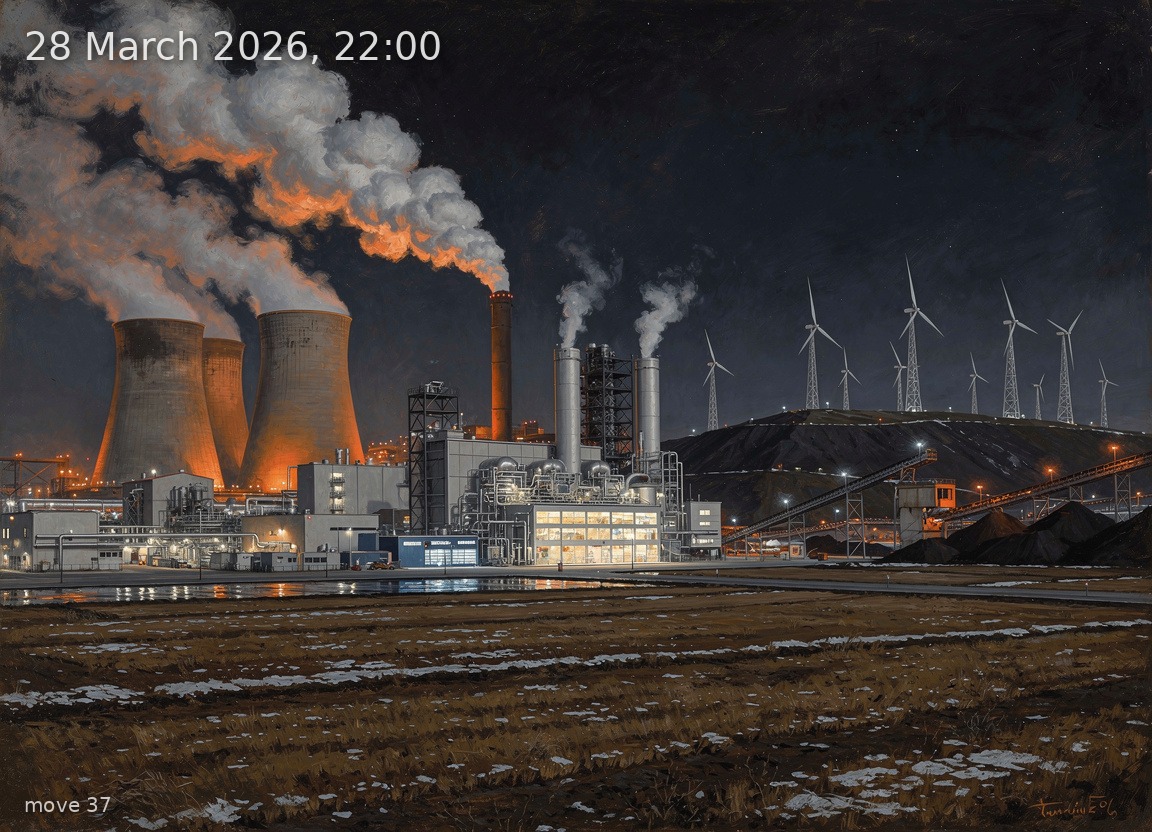
Brown coal, wind, and gas dominate nighttime generation as Germany imports 5 GW to meet cold-weather demand.
Back
Generation mix
Wind onshore 25%
Wind offshore 12%
Biomass 10%
Hydro 2%
Natural gas 13%
Hard coal 11%
Brown coal 28%
48%
Renewable share
15.9 GW
Wind (on + offshore)
0.0 GW
Solar
43.4 GW
Total generation
-5.0 GW
Net import
125.3 €/MWh
Day-ahead price
1.6°C / 8 km/h
Temp / Wind speed
Open-Meteo, Kassel (51.3°N 9.5°E)
64% / 0.0 W/m²
Cloud cover / Radiation
373
gCO₂/kWh
Image prompt
Brown coal 11.9 GW occupies the left third of the scene as a sprawling lignite power station with three massive hyperbolic cooling towers emitting thick white steam plumes lit from below by sodium-orange industrial lights; wind onshore 10.7 GW fills the centre-right as a long ridge of three-blade turbines on lattice towers slowly turning in light wind; wind offshore 5.2 GW appears as a distant row of larger turbines visible along a far northern horizon line; natural gas 5.5 GW sits centre-left as a compact CCGT plant with twin exhaust stacks venting thin white plumes, flanked by piping and a glowing turbine hall; hard coal 5.0 GW is rendered as a second thermal station slightly behind the lignite plant, with a single large smokestack and conveyor belts carrying dark coal to bunkers; biomass 4.2 GW appears as a modest wood-chip-fired combined heat plant with a low corrugated-metal building, a small chimney trailing pale smoke, and stacked timber nearby; hydro 1.0 GW is a small dam and powerhouse barely visible in a valley at far right, with water faintly gleaming under artificial light. The sky is completely dark — deep navy-black with no twilight, no sky glow, only a faint scattering of stars glimpsed through 64% broken cloud cover rendered as heavy grey masses. Temperature is near freezing: bare deciduous trees, patches of frost on flat brown agricultural fields in the foreground, breath-like condensation visible near ground-level structures. The atmosphere is heavy and oppressive, reflecting the high electricity price — a brooding, weighty industrial darkness pressing down. All facilities are lit by warm sodium-vapor and cool LED industrial lighting, casting long reflections on wet ground. Highly detailed oil painting in the tradition of 19th-century German Romantic landscape painters — rich impasto brushwork, deep atmospheric chiaroscuro, luminous contrast between the orange glow of industrial fires and the cold navy darkness above, meticulous engineering accuracy on every turbine nacelle, cooling tower contour, and exhaust stack. No text, no labels.