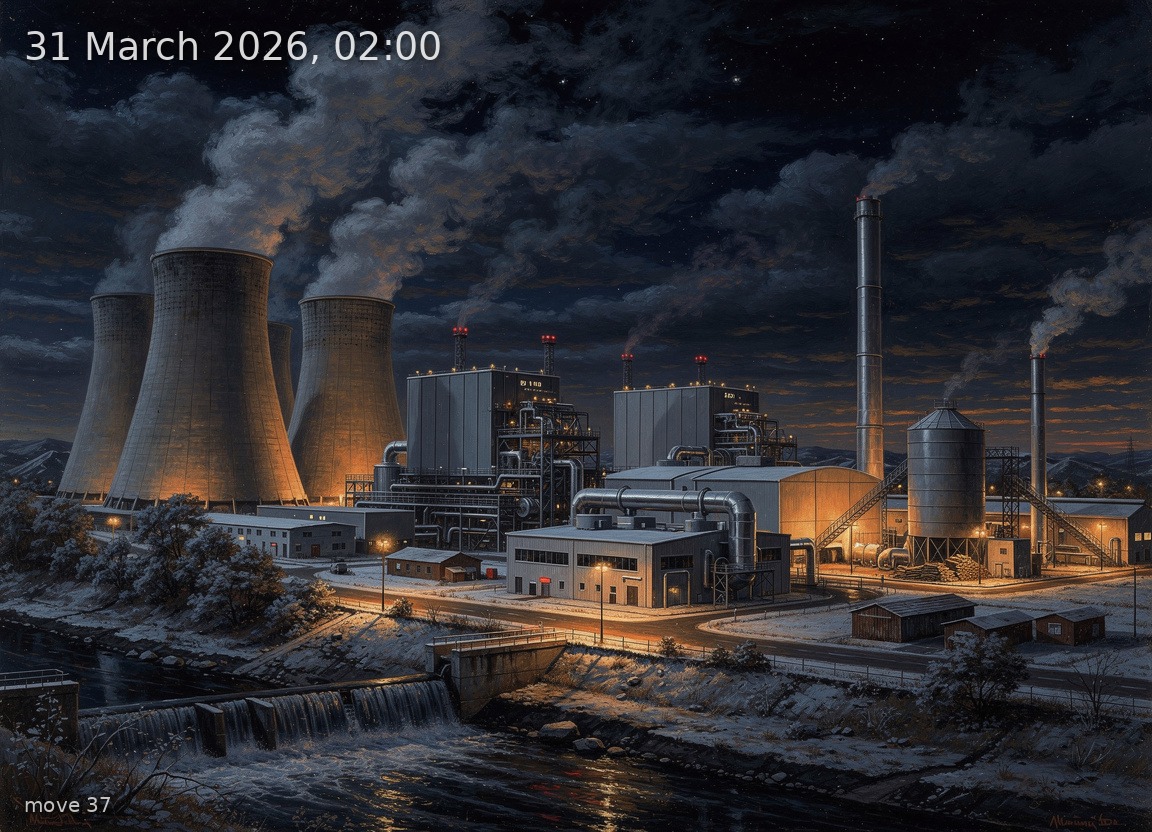
Wind leads at 22.6 GW with 20.5 GW of coal and gas sustaining overnight baseload at elevated prices.
Back
Generation mix
Wind onshore 35%
Wind offshore 12%
Biomass 8%
Hydro 2%
Natural gas 12%
Hard coal 12%
Brown coal 19%
58%
Renewable share
22.6 GW
Wind (on + offshore)
0.0 GW
Solar
48.1 GW
Total generation
+1.9 GW
Net export
101.3 €/MWh
Day-ahead price
3.2°C / 9 km/h
Temp / Wind speed
Open-Meteo, Kassel (51.3°N 9.5°E)
67% / 0.0 W/m²
Cloud cover / Radiation
301
gCO₂/kWh
Image prompt
Brown coal 9.0 GW dominates the left quarter of the scene as a cluster of massive hyperbolic cooling towers with thick white steam plumes rising into darkness; hard coal 5.9 GW appears just right of centre-left as a large power station with rectangular boiler houses, red aviation warning lights, and thin smoke trails; natural gas 5.6 GW sits at centre as two compact CCGT units with single tall exhaust stacks emitting faint heat shimmer, lit by sodium-orange floodlights; wind onshore 16.7 GW spans the entire right half and background as dozens of tall three-blade turbines on lattice and tubular towers, their nacelle lights blinking red across rolling farmland; wind offshore 5.9 GW is suggested on the far-right horizon as a line of turbines with blinking lights above a distant dark sea; biomass 4.0 GW appears as a mid-sized industrial plant with a wood-chip silo and short stack near the coal station; hydro 1.1 GW is a small concrete run-of-river weir with illuminated spillway in the foreground stream. Time is 02:00 — completely dark sky, deep navy to black, no twilight, no sky glow; a 67% overcast layer obscures most stars, only a few visible through breaks. Temperature 3.2°C: bare early-spring trees, patches of frost on grass, breath-fog visible near the lit facility gates. Moderate wind animates turbine blades and bends the steam plumes sideways. The atmosphere is heavy and oppressive, reflecting the high electricity price — low-hanging clouds tinged amber by industrial lighting, a brooding tension in the air. Style: highly detailed oil painting in the tradition of 19th-century German Romantic landscape painters — rich deep colour palette of indigo, amber, charcoal, and slate; visible impasto brushwork; atmospheric depth with layers of mist between the foreground river and distant turbine rows. Each technology rendered with meticulous engineering accuracy: three-blade rotors with correct nacelle proportions, aluminium cladding on CCGT stacks, hyperbolic concrete cooling tower geometry with condensation drift. The scene evokes Caspar David Friedrich's sense of sublime scale meeting Carl Blechen's industrial observation — a masterwork painting of the nocturnal industrial landscape. No text, no labels.