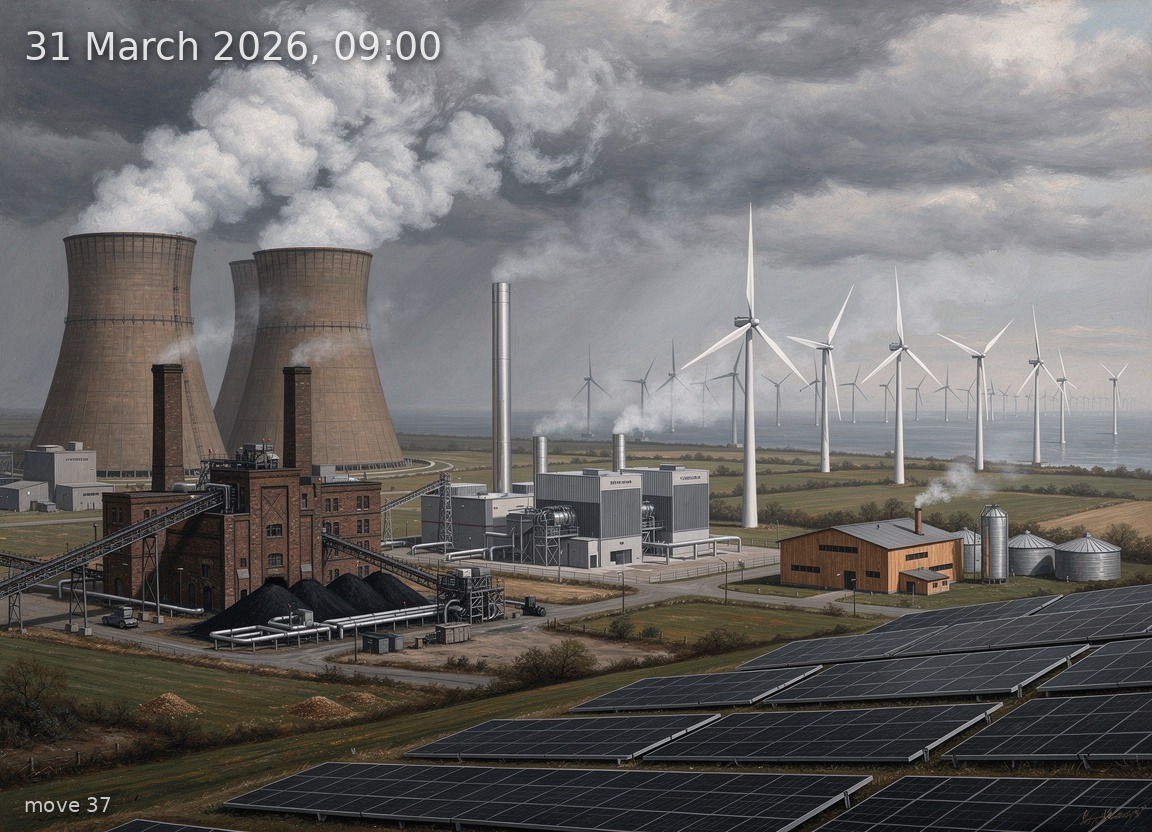
Wind and coal dominate a cloudy, cool March morning as net imports cover a 5.7 GW shortfall.
Back
Generation mix
Wind onshore 21%
Wind offshore 8%
Solar 20%
Biomass 7%
Hydro 3%
Natural gas 13%
Hard coal 12%
Brown coal 16%
59%
Renewable share
17.3 GW
Wind (on + offshore)
11.6 GW
Solar
59.0 GW
Total generation
-5.8 GW
Net import
135.6 €/MWh
Day-ahead price
3.9°C / 12 km/h
Temp / Wind speed
Open-Meteo, Kassel (51.3°N 9.5°E)
97% / 9.5 W/m²
Cloud cover / Radiation
286
gCO₂/kWh
Image prompt
Brown coal 9.7 GW occupies the left quarter as a massive lignite power station with three hyperbolic cooling towers releasing thick white steam plumes into heavy overcast; hard coal 6.9 GW sits just right of centre-left as a dark-bricked coal plant with twin rectangular stacks and conveyor belts carrying black fuel; natural gas 7.6 GW fills the centre as two compact CCGT units with slender polished exhaust stacks emitting thin translucent heat haze; wind onshore 12.6 GW spans much of the right half as dozens of tall three-blade turbines on lattice and tubular towers across rolling farmland, blades turning steadily in moderate wind; wind offshore 4.8 GW appears in the far right background as a distant row of turbines rising from a grey North Sea horizon; solar 11.6 GW is represented by broad fields of aluminium-framed crystalline silicon panels in the right foreground, but their surfaces are dark and matte, reflecting only the flat grey sky with no glint of sunlight; biomass 4.3 GW appears as a modest wood-clad CHP plant with a small smokestack and woodchip storage silos near the centre-right; hydro 1.5 GW is a small run-of-river weir with a low concrete dam visible in a stream in the lower foreground. The sky is almost entirely overcast at 97% cloud cover—a thick, oppressive, low ceiling of stratiform grey clouds pressing down, with no blue sky visible and only the faintest diffuse brightness suggesting a hidden morning sun behind the clouds. The light is flat, cool daylight at 09:00 in late March—no shadows, no warmth in the palette. Temperature near 4°C: bare deciduous trees with the faintest swelling buds, pale brown dormant grass, patches of frost lingering in shaded ditches. The atmosphere feels heavy and costly, reflecting the high electricity price—an almost tangible weight in the grey air. Style: highly detailed oil painting in the tradition of 19th-century German Romantic landscape masters such as Caspar David Friedrich and Carl Blechen, with rich, sombre colour, visible impasto brushwork, atmospheric perspective fading the offshore turbines into mist, meticulous engineering detail on every turbine nacelle, cooling tower, PV module frame, and exhaust stack. No text, no labels, no human figures.