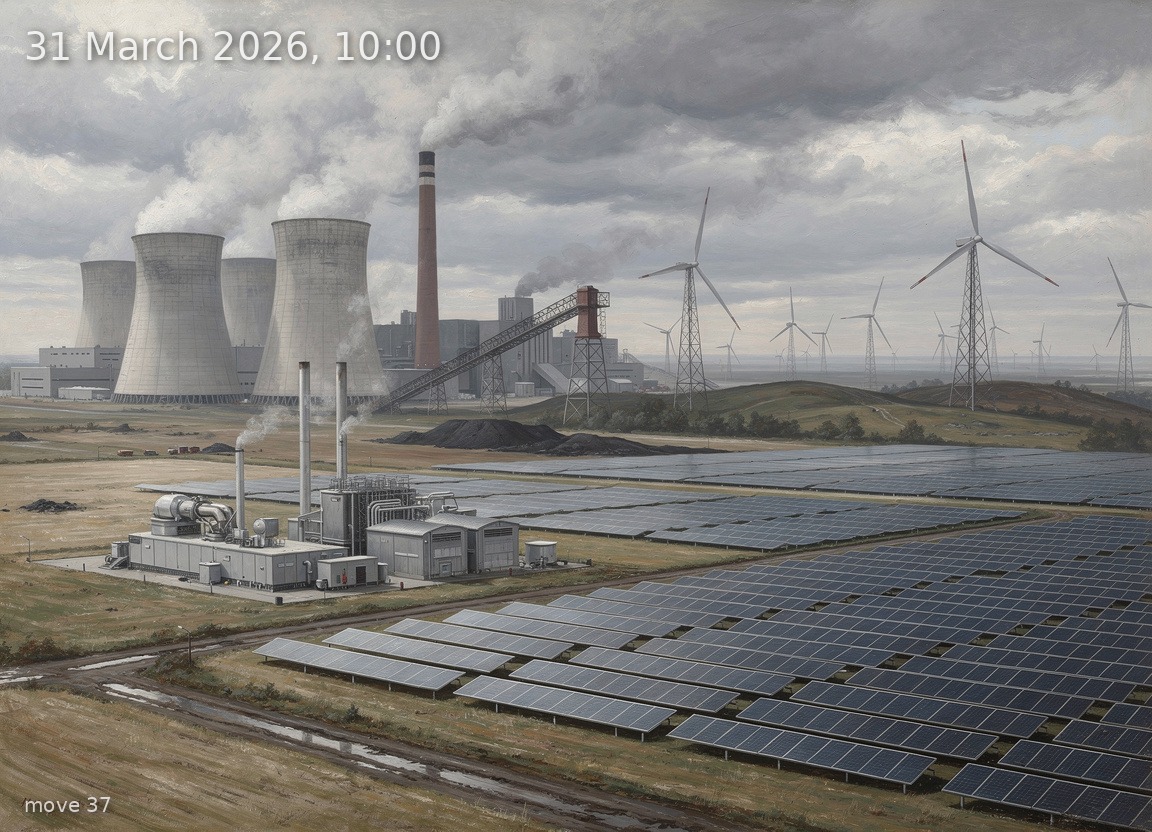
Solar leads at 18.3 GW despite overcast skies; coal and wind share the balance under cool late-March demand.
Back
Generation mix
Wind onshore 21%
Wind offshore 6%
Solar 29%
Biomass 7%
Hydro 2%
Natural gas 11%
Hard coal 10%
Brown coal 15%
64%
Renewable share
17.3 GW
Wind (on + offshore)
18.3 GW
Solar
64.1 GW
Total generation
-1.3 GW
Net import
104.3 €/MWh
Day-ahead price
4.8°C / 12 km/h
Temp / Wind speed
Open-Meteo, Kassel (51.3°N 9.5°E)
95% / 58.5 W/m²
Cloud cover / Radiation
251
gCO₂/kWh
Image prompt
Solar 18.3 GW occupies the right third of the scene as vast fields of aluminium-framed crystalline silicon PV panels stretching across flat farmland, their blue-grey surfaces reflecting a uniformly overcast sky; brown coal 9.5 GW dominates the left background as a massive lignite power station with four hyperbolic cooling towers emitting thick white steam plumes that merge into the low cloud base; hard coal 6.4 GW appears as a second power station slightly further left with a pair of tall brick chimneys and a coal conveyor belt; natural gas 7.0 GW stands in the centre-left as compact CCGT units with slender exhaust stacks and smaller vapour trails; wind onshore 13.5 GW fills the centre and right background as dozens of three-blade turbines on lattice and tubular towers across rolling hills, blades turning in moderate wind; wind offshore 3.8 GW is suggested by a distant row of turbines on the far horizon above a sliver of grey North Sea; biomass 4.2 GW appears as a modest wood-chip-fired plant with a short smokestack near a timber yard in the mid-ground; hydro 1.3 GW is a small run-of-river weir with a concrete dam visible beside a swollen stream in the foreground. The time is mid-morning with full but flat daylight under 95% cloud cover—no direct sun, no shadows, a heavy uniform grey-white sky pressing down oppressively, suggesting elevated electricity prices. Temperature is near 5 °C: bare deciduous trees with only the faintest buds, pale dormant grass, patches of mud, a lingering wintry palette of browns and slate greys. Moderate wind bends the grass and ruffles puddles. Style: highly detailed oil painting in the tradition of 19th-century German Romantic landscape painters such as Caspar David Friedrich and Carl Blechen—rich muted colour, visible impasto brushwork, atmospheric depth and haze, dramatic scale contrasting industry with nature—but with meticulous engineering accuracy on every turbine nacelle, every cooling tower's hyperbolic curve, every PV panel's cell grid. No text, no labels.