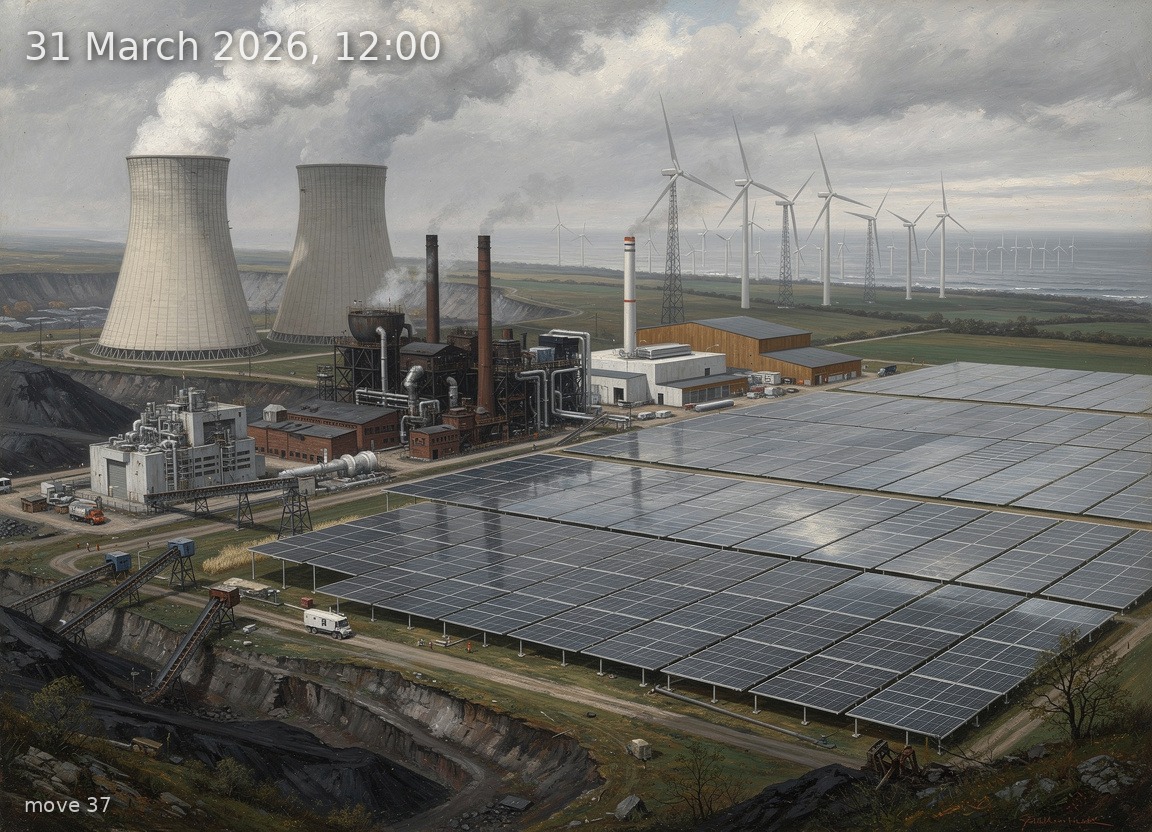
Solar (25.2 GW) and wind (20.3 GW) dominate at midday, but 19.9 GW of coal and gas persist under overcast skies.
Back
Generation mix
Wind onshore 25%
Wind offshore 4%
Solar 36%
Biomass 6%
Hydro 2%
Natural gas 9%
Hard coal 8%
Brown coal 11%
72%
Renewable share
20.3 GW
Wind (on + offshore)
25.2 GW
Solar
70.6 GW
Total generation
+5.4 GW
Net export
78.7 €/MWh
Day-ahead price
6.8°C / 12 km/h
Temp / Wind speed
Open-Meteo, Kassel (51.3°N 9.5°E)
90% / 189.8 W/m²
Cloud cover / Radiation
197
gCO₂/kWh
Image prompt
Solar 25.2 GW occupies the broad centre-right as vast fields of aluminium-framed crystalline silicon PV panels stretching across flat farmland, their surfaces reflecting diffused grey-white light; wind onshore 17.7 GW fills the far right and recedes into the hazy distance as dozens of tall three-blade turbines on lattice and tubular towers, blades turning slowly in moderate breeze; wind offshore 2.6 GW appears as a faint line of turbines on a grey horizon at the far right edge. Brown coal 8.1 GW dominates the left foreground with three massive hyperbolic cooling towers releasing thick white steam plumes that merge into the overcast, beside open-pit conveyors and a blocky power station; hard coal 5.7 GW sits left of centre as a dark industrial complex with tall chimneys and coal stockpiles; natural gas 6.1 GW appears centre-left as a compact CCGT facility with twin exhaust stacks emitting thin heat shimmer. Biomass 4.0 GW is a mid-ground timber-clad plant with a modest smokestack and wood-chip silos; hydro 1.2 GW is a small run-of-river weir with turbine house nestled beside a swollen spring stream in the lower foreground. Time is noon under heavily overcast skies—flat, bright, shadowless daylight with a 90% grey cloud ceiling pressing low, yet enough direct radiation filters through to give a faintly luminous quality to the clouds. Temperature is 6.8 °C in early spring: bare deciduous trees with the faintest haze of green buds, brown stubble fields, damp earth, patches of old snow in furrows. The atmosphere feels heavy and oppressive, reflecting elevated electricity prices—a leaden, pressurised sky weighing on the industrial landscape. Style: highly detailed oil painting in the tradition of 19th-century German Romantic landscape painters such as Caspar David Friedrich and Carl Blechen, with rich earth tones, visible impasto brushwork, atmospheric aerial perspective receding into mist, meticulous engineering detail on every turbine nacelle, PV module frame, cooling tower flute, and smokestack rivet. No text, no labels.