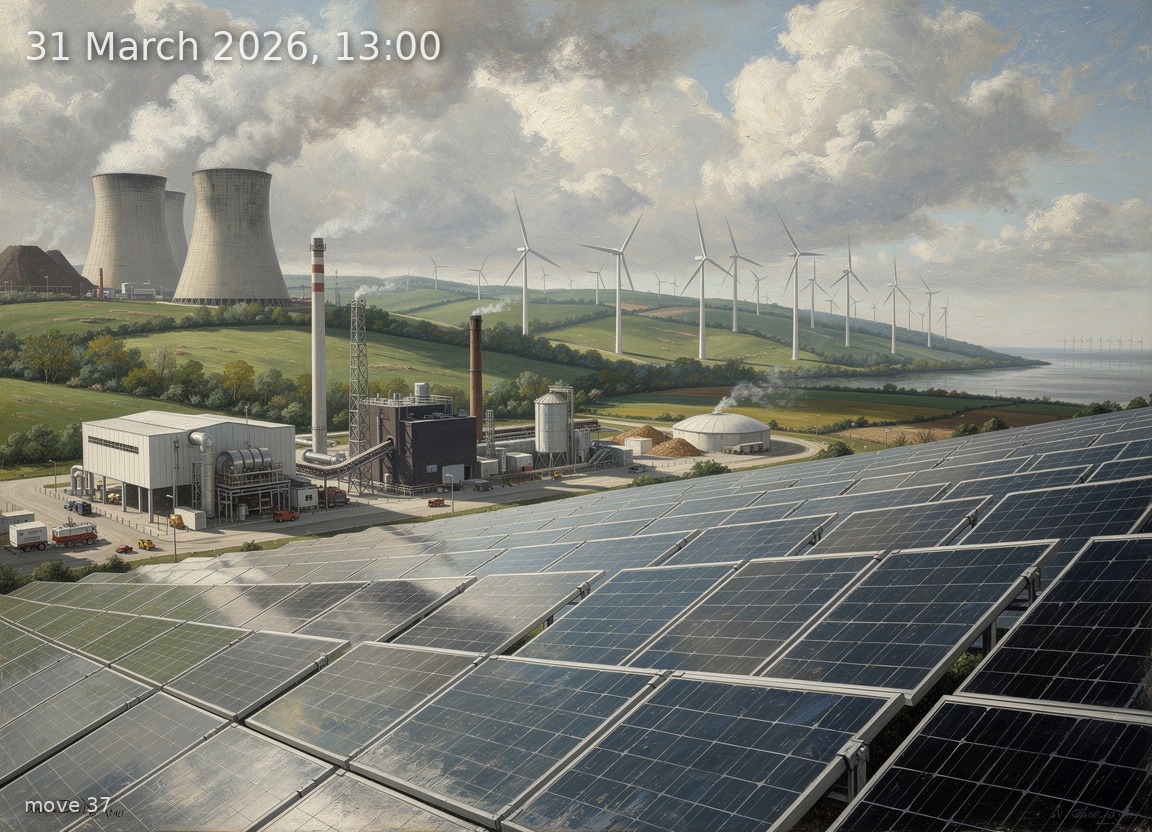
Solar at 27.1 GW and wind at 20.7 GW drive 73.6% renewables, with 7.9 GW net export under partly cloudy spring skies.
Back
Generation mix
Wind onshore 26%
Wind offshore 3%
Solar 38%
Biomass 5%
Hydro 2%
Natural gas 8%
Hard coal 8%
Brown coal 11%
74%
Renewable share
20.7 GW
Wind (on + offshore)
27.1 GW
Solar
71.9 GW
Total generation
+7.9 GW
Net export
55.2 €/MWh
Day-ahead price
7.7°C / 12 km/h
Temp / Wind speed
Open-Meteo, Kassel (51.3°N 9.5°E)
60% / 209.5 W/m²
Cloud cover / Radiation
184
gCO₂/kWh
Image prompt
Solar 27.1 GW dominates the centre-right as a vast rolling field of aluminium-framed crystalline silicon photovoltaic panels stretching toward the horizon, reflecting a partially cloudy midday sky; wind onshore 18.9 GW fills the far background as dozens of tall three-blade turbines on lattice and tubular towers, rotors turning gently in moderate wind across green spring hillsides; brown coal 7.7 GW occupies the far left as a cluster of massive hyperbolic cooling towers trailing white-grey steam plumes into the overcast; natural gas 5.8 GW appears as a pair of compact CCGT plants with slender exhaust stacks emitting thin heat haze, positioned left of centre; hard coal 5.5 GW sits adjacent to the lignite plant as a smaller power station with a single rectangular boiler house and squat chimney; biomass 4.0 GW is rendered as a modest wood-chip-fed plant with a domed silo and low stack near the middle ground; wind offshore 1.8 GW is visible as a tiny row of turbines on a distant grey sea glimpsed through a gap in the terrain at the far right; hydro 1.2 GW appears as a small concrete dam with cascading water on the right edge. The sky is full midday brightness at 13:00, pale blue breaking through layered cumulus clouds at roughly 60% coverage, with direct sunlight casting soft but visible shadows across the landscape. Early spring vegetation: fresh pale-green buds on birch and beech trees, patches of brown dormant grass turning green, scattered wildflowers. Temperature around 8°C gives a crisp, cool clarity to the air. The atmosphere is neither oppressive nor perfectly calm — a moderate, workaday feel matching a 55 EUR/MWh price. Style: highly detailed oil painting in the tradition of 19th-century German Romantic landscape painters — rich colour palette of soft greens, steel greys, pale blues, and warm industrial ochres — visible impasto brushwork, atmospheric aerial perspective with haze softening distant cooling towers, meticulous engineering detail on every turbine nacelle, every PV cell grid line, every rivet on the CCGT stacks. The composition evokes Caspar David Friedrich's sense of scale — small human figures near the solar field for perspective — crossed with the industrial precision of Adolph Menzel. No text, no labels, no overlays.