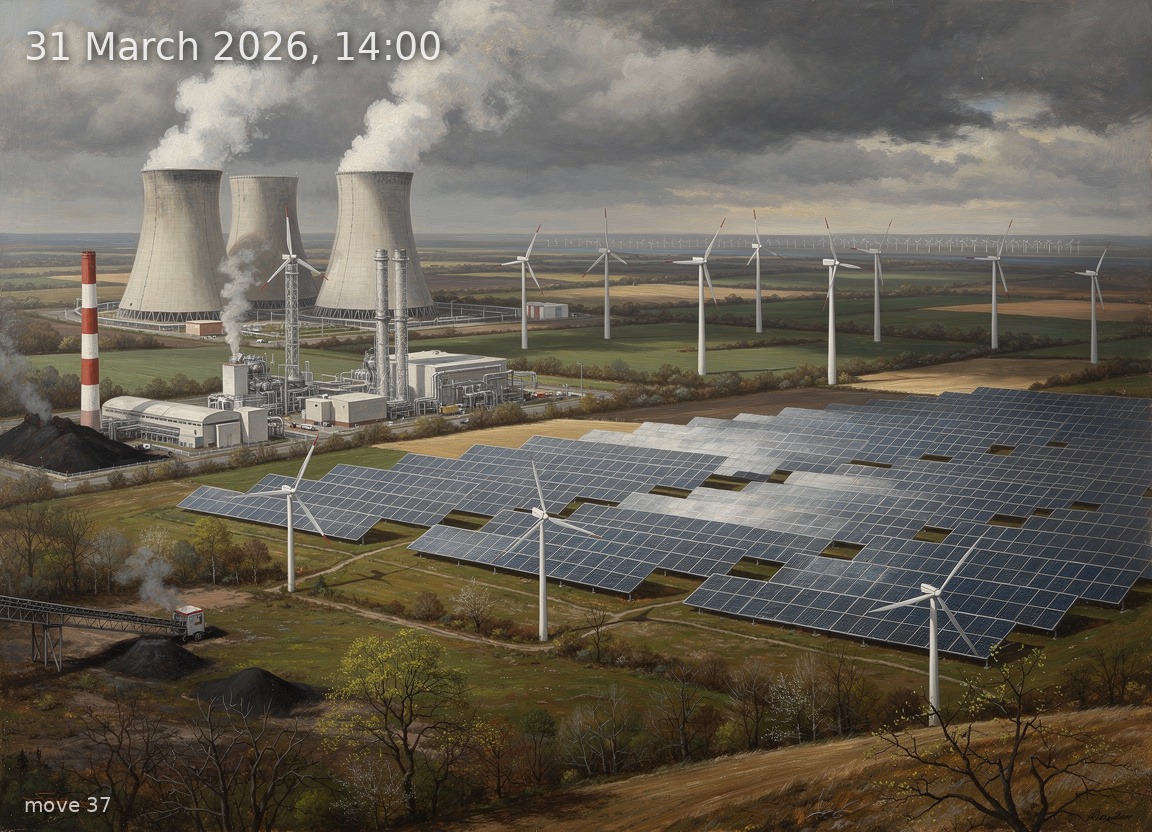
Solar (26.7 GW) and wind (21.7 GW) dominate a 75.6% renewable mix, with 8 GW net export under overcast skies.
Back
Generation mix
Wind onshore 28%
Wind offshore 2%
Solar 38%
Biomass 6%
Hydro 2%
Natural gas 8%
Hard coal 7%
Brown coal 10%
76%
Renewable share
21.7 GW
Wind (on + offshore)
26.7 GW
Solar
70.7 GW
Total generation
+8.0 GW
Net export
53.5 €/MWh
Day-ahead price
8.3°C / 13 km/h
Temp / Wind speed
Open-Meteo, Kassel (51.3°N 9.5°E)
92% / 244.0 W/m²
Cloud cover / Radiation
170
gCO₂/kWh
Image prompt
Solar 26.7 GW dominates the right half of the scene as vast fields of aluminium-framed crystalline silicon photovoltaic panels stretching across gently rolling central-German farmland, their blue-grey surfaces reflecting diffuse daylight; wind onshore 19.9 GW fills the mid-ground and extends toward the horizon as dozens of tall three-blade turbines on lattice and tubular towers, rotors turning at moderate speed in a 13 km/h breeze; wind offshore 1.8 GW appears as a small cluster of turbines visible on a distant hazy plain suggesting far-off North Sea connections; brown coal 6.9 GW occupies the left background as three massive hyperbolic cooling towers emitting thick white steam plumes rising into the overcast; natural gas 5.4 GW sits left of centre as a compact combined-cycle gas turbine plant with twin exhaust stacks and thin heat shimmer; hard coal 5.0 GW appears as a large coal-fired station with a tall chimney and conveyor gantry beside a dark coal pile, modest grey smoke trailing sideways; biomass 3.9 GW is a mid-sized industrial plant with a rounded silo and wood-chip storage yard, thin white vapour rising; hydro 1.1 GW is a small concrete run-of-river weir with a powerhouse visible along a river in the mid-ground. The sky is heavily overcast at 92% cloud cover, a uniform pale-grey blanket with occasional brighter patches where the sun pushes through—full midday daylight but flat and diffuse, no harsh shadows. Early spring landscape: bare deciduous trees with the first pale-green buds, patches of brown and green grass, temperature around 8°C suggesting cool dampness. The atmosphere is mildly heavy—moderate day-ahead price reflected in a slightly hazy, industrially tinged air. Highly detailed oil painting in the tradition of 19th-century German Romantic landscape painters—Caspar David Friedrich meets industrial realism—rich layered colour, visible confident brushwork, atmospheric depth with receding planes, meticulous engineering accuracy on every turbine nacelle, every cooling tower curve, every PV panel frame. No text, no labels, no people in the foreground.