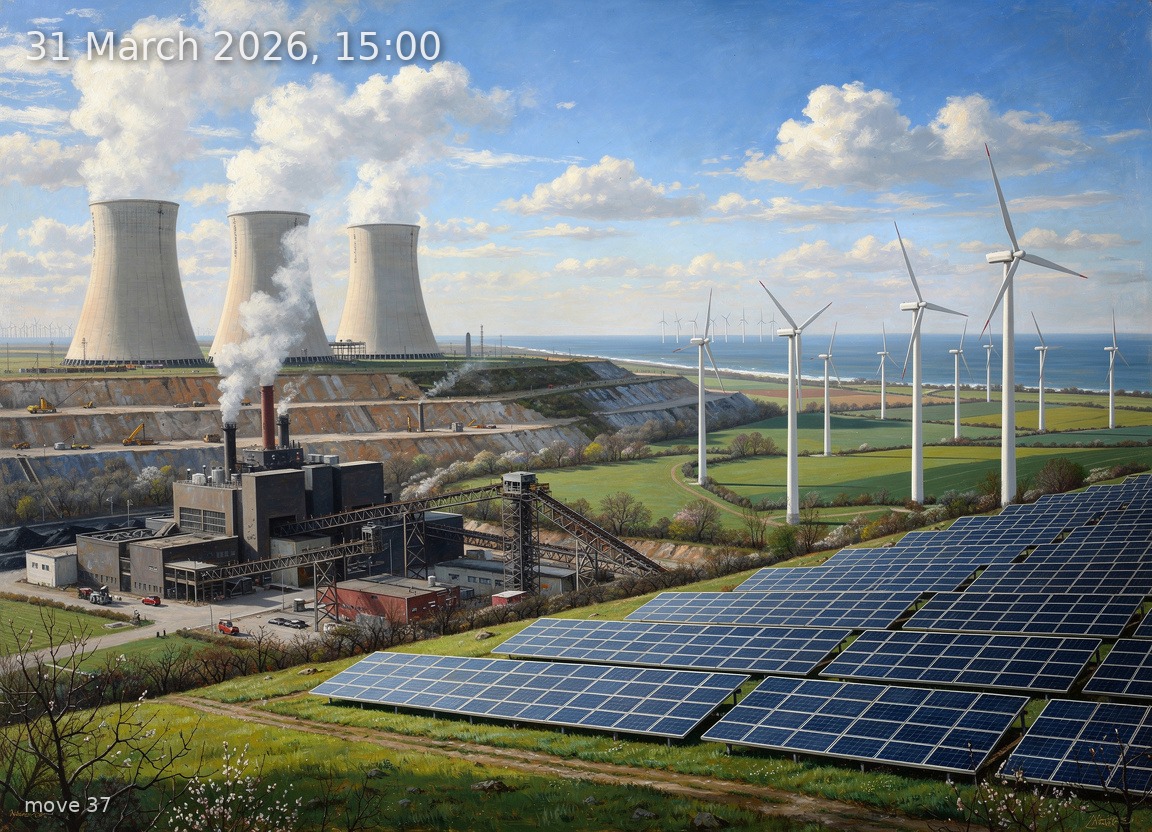
Strong solar and onshore wind drive 75% renewables at midday while coal baseload persists, enabling 7.4 GW net export.
Back
Generation mix
Wind onshore 29%
Wind offshore 3%
Solar 35%
Biomass 6%
Hydro 2%
Natural gas 7%
Hard coal 7%
Brown coal 11%
75%
Renewable share
22.4 GW
Wind (on + offshore)
24.5 GW
Solar
69.3 GW
Total generation
+7.4 GW
Net export
63.0 €/MWh
Day-ahead price
9.0°C / 14 km/h
Temp / Wind speed
Open-Meteo, Kassel (51.3°N 9.5°E)
25% / 286.0 W/m²
Cloud cover / Radiation
175
gCO₂/kWh
Image prompt
Solar 24.5 GW dominates the right half of the scene as vast fields of aluminium-framed crystalline silicon photovoltaic panels stretching across gently rolling farmland, angled toward a bright afternoon sun in a mostly clear sky with scattered cumulus clouds covering roughly a quarter of the blue expanse. Wind onshore 20.2 GW fills the centre-right as dozens of tall three-blade turbines on lattice and tubular towers, their rotors turning steadily in moderate breeze across green early-spring fields with emerging wheat and bare-branched hedgerows. Wind offshore 2.2 GW appears as a small cluster of turbines visible on a distant northern horizon above a faint coastal strip. Brown coal 7.4 GW occupies the far left as a massive lignite power station with three hyperbolic cooling towers emitting thick white steam plumes rising into the afternoon light, alongside open-pit mine terraces visible behind. Hard coal 4.8 GW sits left of centre as a coal-fired plant with tall rectangular boiler houses, conveyor gantries, and dark smoke stacks releasing grey exhaust. Natural gas 5.1 GW appears as a compact combined-cycle gas turbine facility with cylindrical exhaust stacks and a single smaller cooling tower emitting thin vapour, positioned between the coal plants and the wind turbines. Biomass 4.0 GW is rendered as a modest wood-chip-fed power station with a rounded storage dome and a short stack among trees at the edge of a village. Hydro 1.2 GW appears as a small run-of-river weir and powerhouse on a stream in the middle distance. The lighting is full bright afternoon daylight at 15:00 in late March—warm golden sunlight from the southwest casting long-ish shadows, the sky luminous blue with 25% fair-weather cloud cover. Temperature is a cool 9°C: vegetation is early spring, grass greening but trees mostly bare with first buds. The atmosphere is clear and calm, not oppressive, reflecting a moderate electricity price. Style: highly detailed oil painting in the tradition of 19th-century German Romantic landscape painters such as Caspar David Friedrich and Carl Blechen—rich saturated colour, visible impasto brushwork, atmospheric aerial perspective with depth from foreground solar panels through midground turbines to background industrial stacks. Each energy technology rendered with meticulous engineering accuracy: turbine nacelles with three correctly proportioned blades, PV cell grid patterns, hyperbolic cooling tower parabolic curves, CCGT cylindrical housings. The overall composition conveys a nation's energy landscape in springtime transition—clean and fossil sources coexisting under a bright sky. No text, no labels.