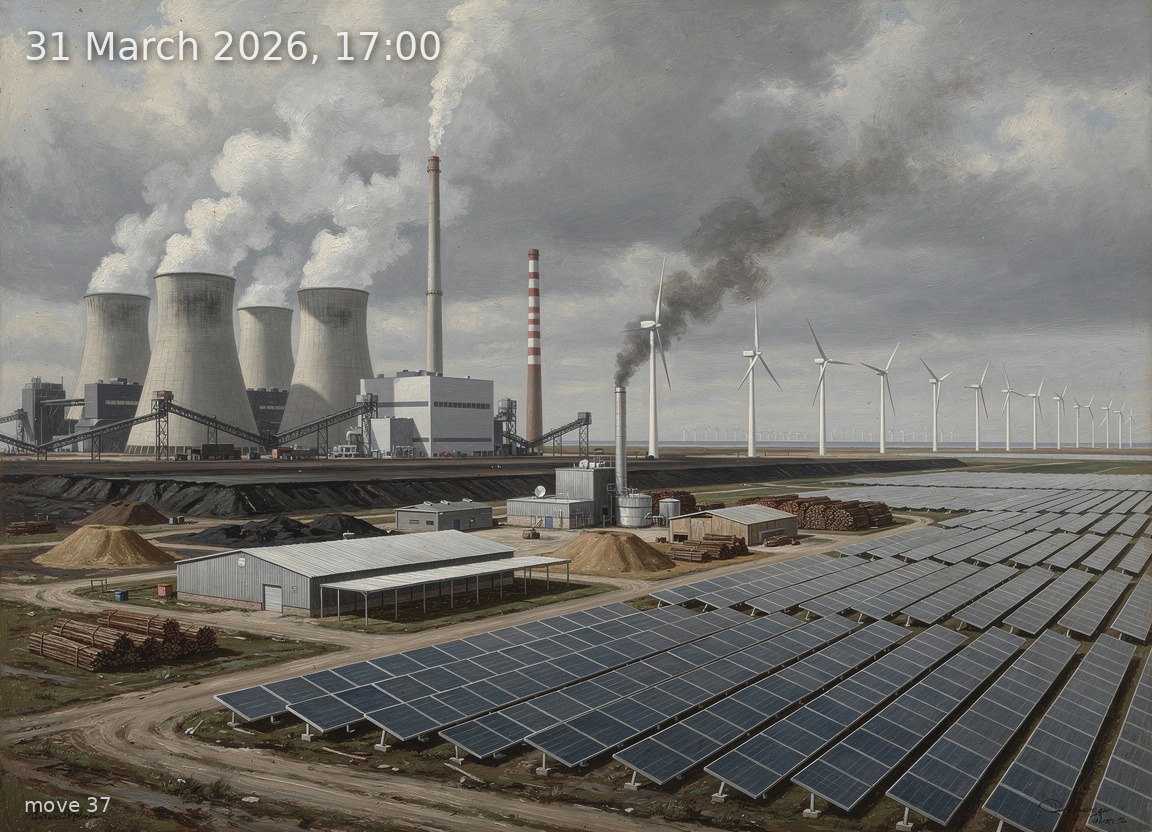
Wind onshore (18.4 GW), solar (12.8 GW), and lignite (10.1 GW) anchor a 63 GW mix at elevated prices.
Back
Generation mix
Wind onshore 29%
Wind offshore 4%
Solar 20%
Biomass 7%
Hydro 2%
Natural gas 12%
Hard coal 10%
Brown coal 16%
62%
Renewable share
20.7 GW
Wind (on + offshore)
12.8 GW
Solar
63.0 GW
Total generation
+2.8 GW
Net export
111.0 €/MWh
Day-ahead price
8.8°C / 10 km/h
Temp / Wind speed
Open-Meteo, Kassel (51.3°N 9.5°E)
100% / 171.5 W/m²
Cloud cover / Radiation
266
gCO₂/kWh
Image prompt
Wind onshore 18.4 GW dominates the right half of the canvas as dozens of three-blade turbines with white tubular towers and nacelles stretching across a flat North German plain into atmospheric haze; solar 12.8 GW fills the centre-right foreground as vast fields of aluminium-framed crystalline silicon panels angled low, reflecting a pewter-grey sky; brown coal 10.1 GW occupies the left third as a massive lignite power station with four hyperbolic concrete cooling towers emitting thick white steam plumes merging into overcast; natural gas 7.5 GW appears centre-left as a compact CCGT plant with a single tall exhaust stack and a slender column of hot exhaust; hard coal 6.4 GW sits behind the gas plant as a large boiler house with a striped chimney trailing darker smoke; biomass 4.2 GW is rendered as a mid-ground wood-chip CHP facility with a modest stack and stored timber piles; wind offshore 2.3 GW is glimpsed as tiny turbines on a distant grey horizon line suggesting the North Sea; hydro 1.2 GW appears as a small concrete weir and penstock structure beside a swollen early-spring river in the lower-left corner. Time of day is 17:00 late March dusk: the sky is entirely overcast at 100% cloud cover yet a fading orange-red glow bleeds along the lowest horizon in the west, the upper sky darkening to slate-grey and indigo; the oppressive low cloud ceiling evokes the high electricity price. Temperature is 8.8 °C: early-spring landscape with bare deciduous trees just hinting at bud-break, pale-green grass, patches of mud. Moderate wind animates the turbine blades mid-rotation and bends young reeds along the river. Style: highly detailed oil painting in the tradition of 19th-century German Romantic landscape masters—Caspar David Friedrich's atmospheric depth merged with Adolph Menzel's industrial precision—rich impasto brushwork, dramatic chiaroscuro between the warm horizon glow and the cold industrial steam, meticulous engineering detail on every turbine nacelle, panel frame, and cooling tower. No text, no labels.