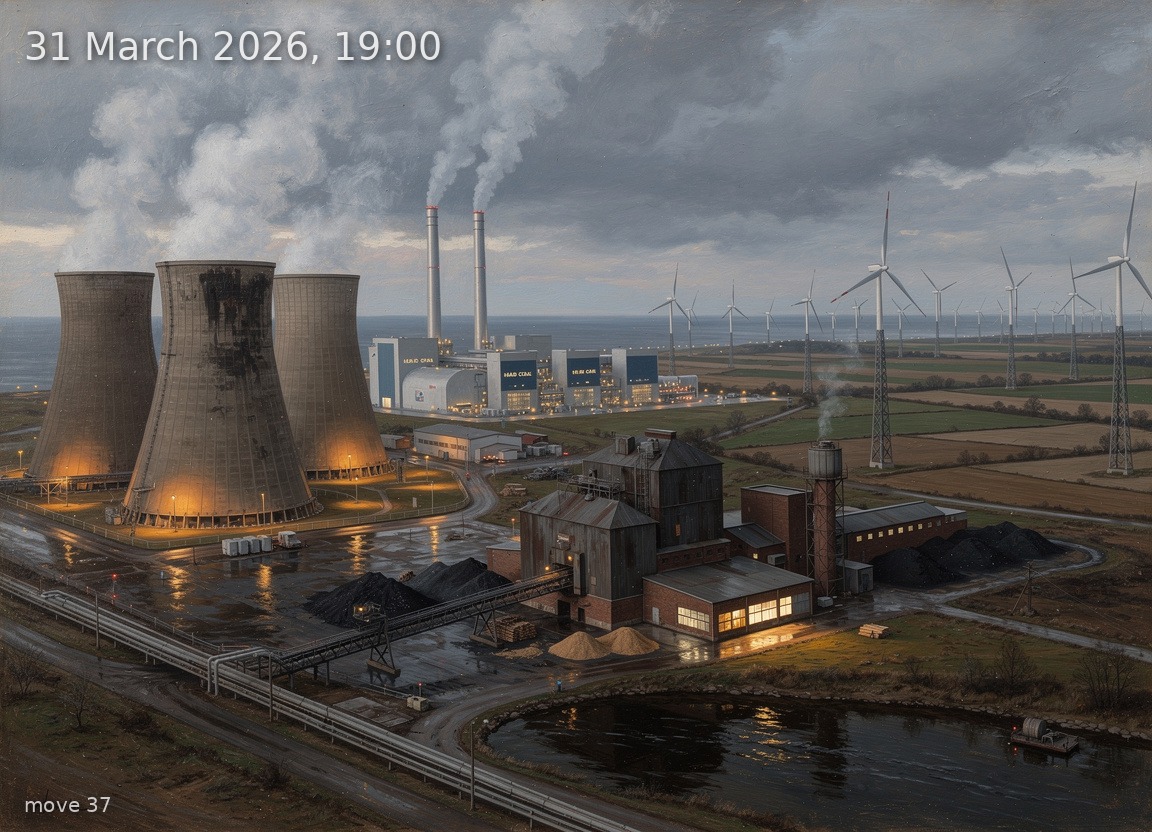
Brown coal, gas, and hard coal dominate evening dispatch as solar fades and elevated demand drives 12 GW net imports.
Back
Generation mix
Wind onshore 27%
Wind offshore 4%
Solar 2%
Biomass 9%
Hydro 2%
Natural gas 20%
Hard coal 14%
Brown coal 22%
44%
Renewable share
15.0 GW
Wind (on + offshore)
0.8 GW
Solar
49.0 GW
Total generation
-12.2 GW
Net import
175.0 €/MWh
Day-ahead price
7.9°C / 10 km/h
Temp / Wind speed
Open-Meteo, Kassel (51.3°N 9.5°E)
72% / 21.2 W/m²
Cloud cover / Radiation
383
gCO₂/kWh
Image prompt
Brown coal 10.7 GW dominates the left third of the scene as a cluster of massive hyperbolic cooling towers with thick white-grey steam plumes rising into a heavy overcast sky, their concrete surfaces lit by amber sodium lamps; natural gas 10.0 GW occupies the centre-left as a row of compact CCGT power stations with slender exhaust stacks emitting faint heat shimmer; hard coal 6.8 GW appears centre-right as a gritty coal-fired plant with squat rectangular boiler houses, conveyor belts, and coal stockpiles; onshore wind 13.1 GW spans the right third and background as dozens of three-blade turbines on lattice and tubular towers, their rotors turning slowly in light wind across rolling farmland; offshore wind 1.9 GW is suggested by a distant line of turbines on the far-right horizon; biomass 4.5 GW appears as a mid-ground wood-chip-fed CHP facility with a modest stack and warm interior glow; hydro 1.2 GW is a small run-of-river station nestled by a dark river in the lower right; solar 0.8 GW is represented by a small field of crystalline PV panels, dark and inactive, barely catching residual light. TIME: 19:00 late March dusk — the sky is deep indigo-grey above with only a thin band of fading burnt-orange glow along the lowest horizon line, rapidly giving way to near-darkness; most illumination comes from industrial sodium streetlights and facility lighting casting amber pools on wet roads and metallic surfaces. The atmosphere is heavy and oppressive, reflecting 175 EUR/MWh pricing — low dense clouds press down, 72% overcast, muted colours, early spring bare trees with only the faintest green buds, damp cool air at 8°C suggested by condensation and mist around the cooling towers. Rendered as a highly detailed oil painting in the tradition of 19th-century German Romantic landscape painters — rich chiaroscuro, visible impasto brushwork, atmospheric depth and sfumato in the distant turbine rows, meticulous engineering detail on every nacelle, cooling tower rib, and gas turbine exhaust cowl. The mood evokes Caspar David Friedrich's sublime industrial twilight. No text, no labels.