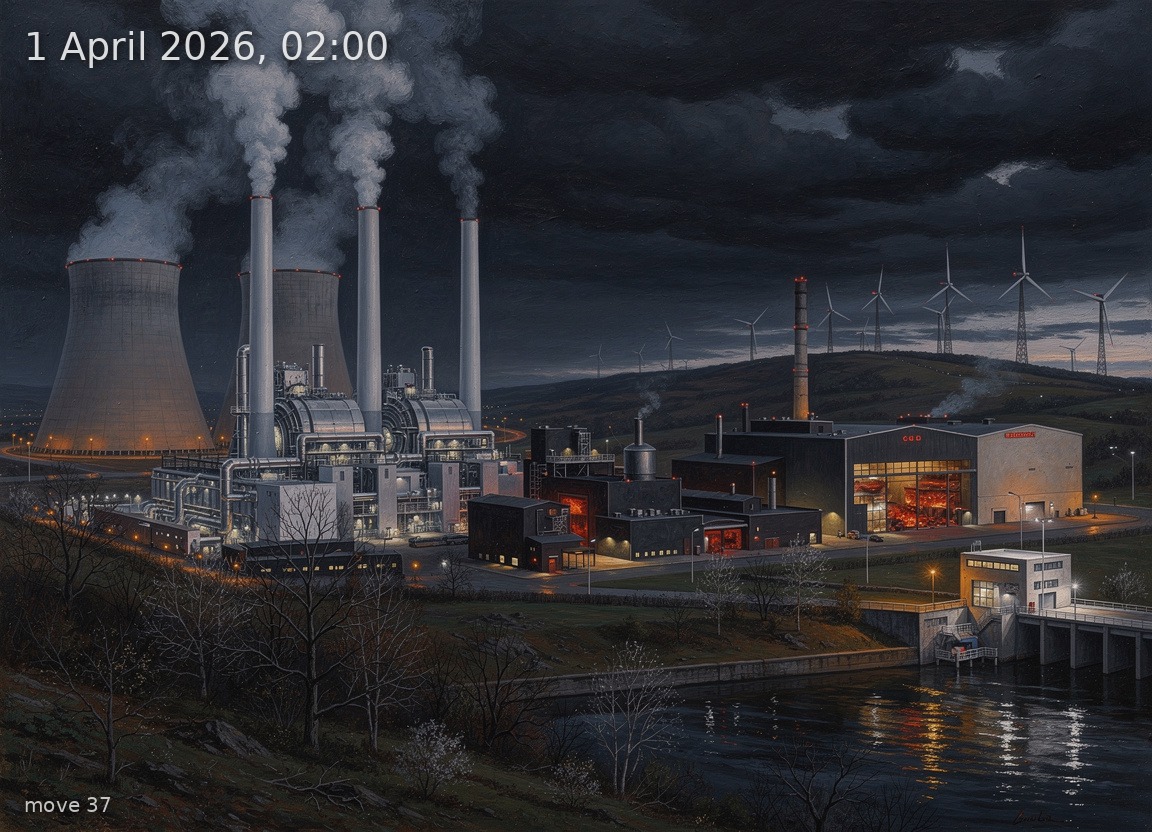
Gas, brown coal, and hard coal dominate a cold, calm, windless spring night requiring 8.3 GW net imports.
Back
Generation mix
Wind onshore 13%
Wind offshore 0%
Biomass 11%
Hydro 4%
Natural gas 29%
Hard coal 18%
Brown coal 25%
28%
Renewable share
4.6 GW
Wind (on + offshore)
0.0 GW
Solar
34.9 GW
Total generation
-8.2 GW
Net import
125.3 €/MWh
Day-ahead price
3.5°C / 4 km/h
Temp / Wind speed
Open-Meteo, Kassel (51.3°N 9.5°E)
93% / 0.0 W/m²
Cloud cover / Radiation
481
gCO₂/kWh
Image prompt
Natural gas 10.2 GW occupies the centre-left as a sprawling complex of compact CCGT units with tall single exhaust stacks venting pale plumes; brown coal 8.8 GW fills the left background as massive hyperbolic cooling towers with thick white steam columns rising into the darkness; hard coal 6.1 GW appears centre-right as a cluster of industrial boiler buildings with shorter chimneys and reddish flue-gas glow; onshore wind 4.5 GW is rendered as a scattered row of three-blade turbines with lattice towers on a distant ridge, blades barely turning in the still air; biomass 4.0 GW sits in the right-centre as a mid-sized wood-chip-fed plant with a modest stack and warm amber interior glow visible through windows; hydro 1.2 GW appears far right as a small concrete dam structure with water glinting under artificial floodlights. TIME: 02:00 — completely dark, black sky with no twilight, no moon, heavy 93% overcast blocking all stars, deep navy-charcoal atmosphere. The only light sources are sodium-orange industrial lamps illuminating the plant grounds, the faint red aviation warning lights atop the cooling towers and wind turbines, and the dull furnace glow from coal facilities. The air feels cold at 3.5°C — early spring, bare deciduous trees with no leaves, patches of frost on the ground, dormant brown grass. Wind is nearly absent — no motion in steam plumes, which rise vertically. The atmosphere is heavy and oppressive, reflecting the high electricity price — a thick, brooding overcast pressing down on the industrial panorama. A network of high-voltage transmission pylons stretches toward the horizon, hinting at cross-border power flows. Highly detailed oil painting in the tradition of 19th-century German Romantic landscape painters — rich, dark colour palette of deep blues, warm ambers, coal-red glows, visible impasto brushwork, atmospheric chiaroscuro depth — but with meticulous engineering accuracy in every turbine nacelle, every cooling tower's hyperbolic curve, every CCGT exhaust stack. The scene evokes Caspar David Friedrich's sublime darkness applied to a modern fossil-heavy industrial nightscape. No text, no labels.