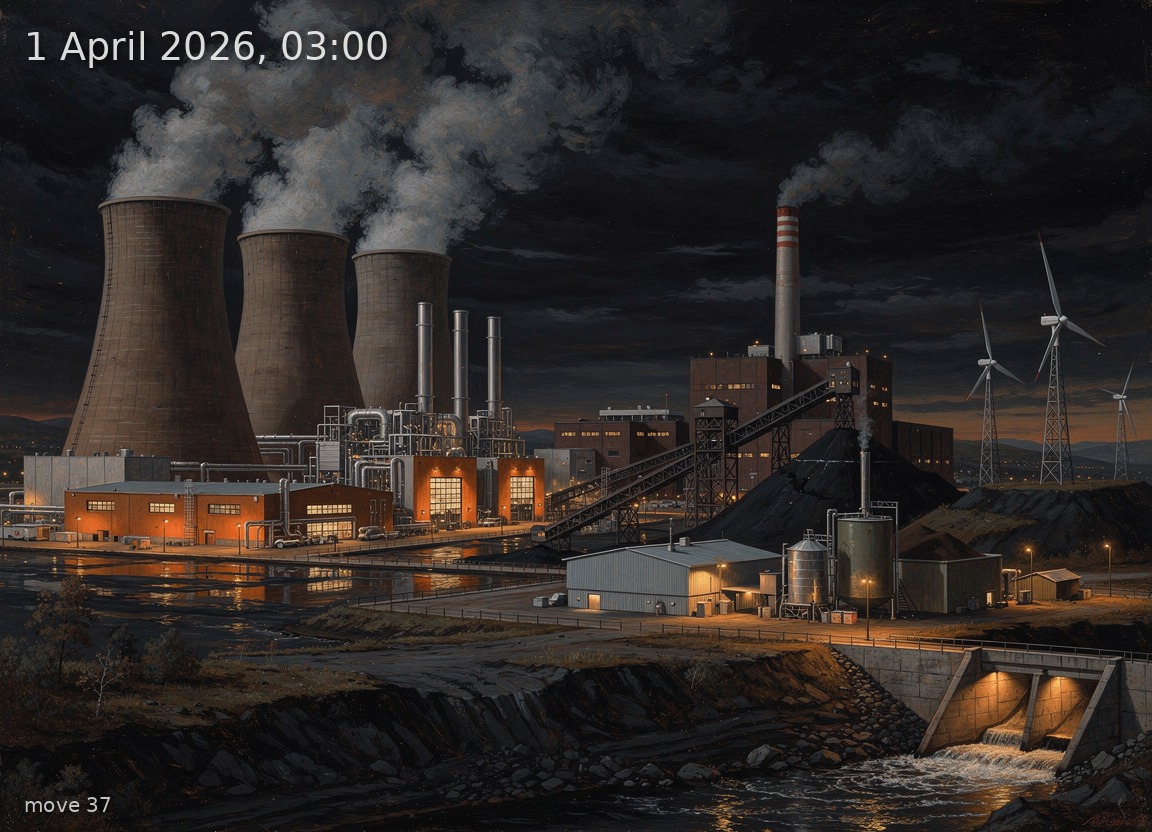
Coal and gas dominate overnight generation at 25.4 GW combined; 12.5 GW net imports fill the gap under low wind.
Back
Generation mix
Wind onshore 11%
Wind offshore 0%
Biomass 12%
Hydro 4%
Natural gas 30%
Hard coal 18%
Brown coal 26%
26%
Renewable share
3.8 GW
Wind (on + offshore)
0.0 GW
Solar
34.4 GW
Total generation
-12.5 GW
Net import
129.4 €/MWh
Day-ahead price
3.7°C / 5 km/h
Temp / Wind speed
Open-Meteo, Kassel (51.3°N 9.5°E)
78% / 0.0 W/m²
Cloud cover / Radiation
492
gCO₂/kWh
Image prompt
Brown coal 8.9 GW dominates the left third of the scene as a massive lignite power station with four hyperbolic cooling towers emitting thick white-grey steam plumes into the night sky; natural gas 10.4 GW fills the centre-left as a sprawling CCGT complex with tall slender exhaust stacks and glowing orange turbine halls; hard coal 6.1 GW appears centre-right as a dark brick-and-steel coal plant with conveyor belts, a single large chimney trailing pale smoke; biomass 4.0 GW sits in the right-centre as a cluster of smaller industrial facilities with wood-chip silos and modest stacks; onshore wind 3.8 GW occupies the far right as a handful of three-blade turbines on lattice towers turning slowly in light breeze; hydro 1.2 GW appears as a small concrete dam structure with lit spillway at the far right edge. Time is 3 AM — the sky is completely black with no twilight, no sky glow, deep navy-black overhead, a heavy 78% overcast blotting out stars. Temperature near freezing: bare early-spring trees with no leaves, frost on the ground, patches of dormant brown grass. The atmosphere is oppressive and heavy, dense low clouds pressing down, reflecting the amber-orange sodium glow of the industrial facilities below. Plumes from cooling towers merge with the low cloud base. Sodium streetlights cast pools of warm amber light on wet roads. Transmission towers with high-voltage lines recede into the murky distance, symbolising import flows. Style: highly detailed oil painting in the tradition of 19th-century German Romantic landscape painters — rich, dark palette of deep blues, blacks, umbers, and warm oranges from artificial light — visible confident brushwork, atmospheric depth and chiaroscuro. Each energy technology rendered with meticulous engineering accuracy: turbine nacelles and three-blade rotors, aluminium-framed details, hyperbolic concrete cooling tower geometry, CCGT exhaust stack proportions. The scene evokes a brooding industrial sublime — a masterwork painting of the nocturnal energy landscape. No text, no labels.